THE CHURCH – The Edifice

That which is Good, Acceptable and Perfect
It could be said that the forerunner of the Christian church was the Tabernacle also known as the Tent of the Congregation or the Tent of the Meeting. It was the portable earthly dwelling of God used by the Israelites from the Exodus until the conquest of Canaan. Moses was instructed at Mount Sinai to construct and transport the tabernacle with the Israelites on their journey through the wilderness and their subsequent conquest of the Promised Land. After 440 years, Solomon’s Temple in Jerusalem superseded it as the dwelling-place of God (also see The Tabernacle, Learn Religions).
The Tabernacle was an outward expression of an inward confession and conviction. The Lord spoke to Moses and to Aaron after the Israelite fled captivity in Egypt, and gave them explicit instructions on setting up their wilderness camp. Numbers 2 consists entirely of God giving commandments as to how the Israelite camp should be arranged. From the NASB:
On the east, toward the sunrise, the divisions of the camp of Judah are to encamp under their standard. The tribe of Issachar will camp next to them. The tribe of Zebulun will be next. All the men assigned to the camp of Judah, according to their divisions, number 186,400. They will set out first. (The rest of the tribes are described).
So the Israelites did everything the Lord commanded Moses; that is the way they encamped under their standards, and that is the way they set out, each of them with their clan and family.

If you want to read more about the significance and the symbolism of the Tabernacle and the of Holies, click here: The Tabernacle, or here, Explore the Tabernacle.
Why does the Bible record all the things that happened during those 40 years? The Scripture tells us it was for an example, a foreshadowing. These things happened to them for our admonition. Paul makes a point in 1 Corinthians 10:11 that everything written then is for our application now. Every one of the events in Numbers has a lesson for us. And that’s why it is so important to study this book in detail.
The word ”example” in Greek is ‘tupos’, which is ”a figure, an image, a pattern, a pre-figuring.” That’s where we get the term ”type,” or model. Engineers speak of a prototype, which is from the same root. Types are common in the Bible, where some event, some object, or some situation is a lesson, in advance, of what’s coming. Once again, the Tabernacle and the wilderness camp was an outward expression of an inward conviction and confession.

The center of the Tabernacle was the Holy of Holies, the Holy Place, the outer chamber, which was surrounded first by priests of the tribe of Levi, then by the clan or tribes of Israel, the warriors and their families. It is easy to imagine the layers of protection provided from the outer to the innermost, the Holy of Holies. Possibly a pattern for the Christian’s human psyche and even the intent for the Christian church. But with the coming of Christ, the outermost is the Church Body or the Body of Christ. The courtyard resembles the priestly duties of spiritual gifts at work of each and every Christian. The Holy are of the Tabernacle is accessible by those who are fully dedicated in prayer and service to God through Christ Jesus and the Holy of Holies is the presence of God within each believer.
Should we, today, model our churches in such a fashion? Probably not. Jesus removed the barriers and indwells the believer. We are one with Him.
However, it is worthy to note that shortly after the establishment of the Christian Church, Sacred Christian architecture in the West, in particular Western Europe, has been influenced by a variety of architectural styles that initially derived from Roman pagan designs to new forms that attempted to break away from Roman influences. Christian church architecture indicates the cultural influences on Christianity but also reflected the spiritual ideas dominant in the period churches were built.
After 313 AD, as Christianity became accepted by the Roman government under Constantine the Great, early churches were beginning to be established in Western Europe and the Roman Empire. By this point, churches had already existed throughout the Sassanian Empire and Armenia, but had yet to be established, at least formally, in the Roman Empire. Initially, late Roman Empire churches often utilized converted pagan temples, as these were readily available structures that could accommodate many people. It was also convenient to use existing worship areas for the masses that had converted – this too, was and is an outward expression of an inward belief and conviction and confession. The drift to apostasy had begun!
There are many today that will say that the style, appearance or type of building is irrelevant. A building is just a tool for ministry. And, I agree. I am not referring to architecture. I am referring to intent. Is it our intention to follow the teachings and of Jesus and the Bible and to pay close attention to the significance of the meanings contained in the symbolism of the Tabernacle and of the Temple, or are we willing to go our own way in order to draw a crowd? Well, it isn’t working for the ‘mainline’ protestant churches. For examples: (click images for links to webpages).
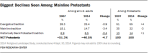


The mainline tradition’s share of the Protestant population has declined along with its share of the overall population. Today, 32% of Protestants identify with denominations in the mainline tradition, down from 35% in 2007. Evangelicals now constitute a clear majority of all Protestants in the U.S., with their share of the Protestant population having risen from 51% in 2007 to 55% in 2014.
“So what?” you might ask? Is the departure from the Tabernacle-to-Christ-to-Postmodernism-evolution related to the statistics of church attendance decline and to the emergent apostasy?
For further examples, scores of protestant denominations and hundreds of thousands of churches, over time, have abandoned the clear mandates, doctrines and teachings of the Bible.
AD 1 The Church of Jesus Christ, The Body of Christ, had no buildings, little money and no wealth. The Church was a Movement.
Jesus said to make disciples; collect no money except to make your journey.
The penalty for becoming a Christian was often death.
The Church grew exponentially.
AD 49 The Church expanded into Greece. The Church became a philosophy to many. The Church grew and size and influence.
AD 313 The Church expanded into Rome and it gained recognition. It grew in power and popularity. It obtained wealth, buildings, property and influence. It became an institution.
AD 380 The Church expanded into Europe. It was becoming a worldwide phenomenon. It grew in wealth, stature, power and influence. It had become a culture.
AD 1607 The Church reaches America.
AD 1681 The Church became corporate. It had become a business and incorporated. It became regulated by the government.
The Corporate Church grew. It needed money to support growth and expansion, which meant the Corporate Church needed more people.
AD 1777 The state of Virginia granted tax exemption to houses of worship.
AD 1894 The corporate church was granted tax exemptions by the Federal Government.
AD 1954 The Federal Government regulated what a church could and could not say in order to retain tax-exempt status.
The church continued to grow, and in order to attract more people the Corporate Church lowered its membership and doctrinal standards. More people became ‘members’ and gave more money to support more growth.
The Church corporation is complete with leaders, boards and membership and a business model.
Local churches compete against one another for members (customers). The church is selling itself in “three line slogans”.
The Church members now have choices and have become religious consumers. Church people can shop around for the religious brand and standards that best suits them. (2 Timothy 3)
The Leadership (pastors and preachers) have become CEOs, disciples have become church leaders, growing their 501(c)(3) business models.
Record numbers of pastors quitting because of stress, burnout or are being fired by their congregations (some stats say 1500 – 1700 leave “the ministry” each month).
Church debt in America soars; church foreclosures soar.
AD 1968 The church ordains homosexuals as clergy.
AD 1972 The United church of Christ ordains homosexual clergy
AD 2010 The Lutheran church ordains homosexual clergy
AD 2012 The Presbyterian church USA ordains homosexual clergy (not to be confused with the Presbyterian church PCA).
The Episcopal Church in the United States and the Christian Church (Disciples of Christ) have also allowed ordination of openly gay and lesbian candidates for ministry for some years.
Internationally, churches that have ordained openly lesbian or gay clergy include the Church of Scotland, the Church of England, the Church in Wales, the Church of Sweden, the Church of Norway, the Church of Denmark, the Church of Iceland, the Evangelical Lutheran Church of Finland, the Evangelical Church in Germany, the Methodist Church in Britain, the Protestant Church in the Netherlands, the United Protestant Church in Belgium, the Swiss Reformed Church, the United Protestant Church of France, the Evangelical Lutheran Church in Canada, Anglican Church in Canada, the Old Catholic Church, the Czechoslovak Hussite Church and the United Church of Christ in Japan.
AD 2024 The church is losing and has lost influence. The church in 2020 is losing members.
AD 2024 Much of the church is teaching and living a different Gospel than that of the Apostles.
The Age of Apostasy is well under way.
SO, WHAT TO DO?
Let me begin by saying that I know very few will have read this. I also know that I have little to no influence on the church or on those who lead and formulate policy for the church. So, why bother? Am I just ranting? Perhaps. But like the man who would stroll the beach after the tides would recede, picking up starfish, one at a time, tossing them back into the water. When asked why he would bother since thousands and thousands are stranded, dying on the beach, he picked up one more and said, it means something to this one. So it is with me.
We need to let our faith in Christ, and our understanding and belief in The Word, be expressed – pressed out – our expression, conviction and confession.
The Holy of Holies in the Tabernacle, should be expressed by how we speak, how we deport ourselves, how we live and how we treat others. It is Christ in us, our hope of glory, on display.
The Holy place in the Tabernacle is where we prepare ourselves as a living and holy sacrifice, acceptable to God, which is our spiritual service of worship, through words and deeds of love, joy, peace, patience, kindness, goodness, faithfulness, gentleness, and self-control.
Our ‘Camp of Israel’ is where we stand firm against the schemes of the devil. Our struggle is not against flesh and blood, but against the rulers, against the powers, against the world forces of this darkness, against the spiritual forces of wickedness in the heavenly places. Therefore, we take up the full armor of God, and resist.

The inner courts, are where we congregate and express our Spiritual Gifts in service to God and to one another.
The outer courts and where we invite and receive those who are drawn to Christ, where we proclaim the Gospel message and make disciples. This work takes place both outside and inside the Temple.

CHRIST DWELLS WITHIN – YOU ARE NOW THE EDIFICE
Although the architecture of modern-day church buildings may differ from the Tabernacle and the Temple, and the spiritual significance and symbolisms have been fulfilled with the coming of the Christ Jesus. It remains true that our beliefs and faith are expressed within the Church – be it a building, a program or a person. All of these things should not conform to the world, but must be transformed by the renewing of our minds so the we may prove what is the will of God, that which is good, acceptable and perfect! Or do you not know that your body is a temple of the Holy Spirit within you?
In conclusion, we should allow the Holy of Holies to influence, guide, direct and establish our ways. It should be ‘from the inside to the outside’. Every act and service of our worship is a result of our focus on the Holy of Holies, from the Holy places, to our priesthood as believers, to our encampment around our Tabernacles, through our inner courts, outer courts and into this world. Anything and everything else, is just a sideshow.
Your Brother and Friend,
Mike Young
PS: Examples of sideshows: Easter bunnies and egg hunts at church. Halloween at church disguised as Fall festivals. Christmas parties at church focused on materialism. There are times for these things, but not in the sanctuary, remembering, the Church is an Expression of what you really and truly believe.
Discover more from Whitestone Fellowship
Subscribe to get the latest posts sent to your email.

