IS YOUR CHURCH
RELATING TO THE CULTURE?

Many if not most pastors and churches have decided, whether deliberately or ignorantly, to make themselves and the ‘church experience’ more relatable for the potential ‘seeker’ or casual church attender.
 They say they try to look like and be more like the general public because coming to church can be an intimidating experience. You come into a place where you don’t know anyone, people behave differently and the service can be a little confusing.
Oh yeah? Well, these same people go to ball games where they don’t know anyone, people behave wildly different and getting into the stadium and finding your assigned seating can be a little confusing too. But they still go – by the thousands.
These same people go to movies, theaters, museums, restaurants, amusement parks, lectures, political gatherings, comedy clubs, and the likes, most of which can be an intimidating experience at first because you come into a place where they don’t know anyone, people behave differently and it can be a little confusing. But they still go – by the millions.
But, according to Jesus and according to the Bible, the primary aim of going to church should not be about being entertained or having ones’ adrenalin or dopamine flow increased.
According to GotQuestions.Org, coming to church is God’s will for believers. Hebrews 10:25 says we should “not be giving up meeting together, as some are in the habit of doing, but encouraging one another—and all the more as you see the Day approaching.” Even in the early church, some were falling into the bad habit of not meeting with other believers. The author of Hebrews says that’s not the way to go. We need the encouragement that church attendance affords. And the approach of the end times should prompt us to be even more devoted to going to church.
Church is the place where believers can love one another (1 John 4:12), encourage one another (Hebrews 3:13), “spur” one another to love and good works (Hebrews 10:24), serve one another (Galatians 5:13), instruct one another (Romans 15:14), honor one another (Romans 12:10), and be kind and compassionate to one another (Ephesians 4:32).
When a person trusts Jesus Christ for salvation, he or she is made a member of the body of Christ (1 Corinthians 12:27). For a church body to function properly, all of its “body parts” need to be present and working (1 Corinthians 12:14–20). We are not to attend church as if we are mere spectators. We are actually part of our church. Not only does our church help equip us for ministry, it is a place where we serve, using the spiritual gifts God has given us (Ephesians 4:11-13) A believer will never reach full spiritual maturity without having that outlet for his gifts, and we all need the assistance and encouragement of other believers (1 Corinthians 12:21–26). As we serve, worship, and live in community together, the body of Christ reflects who God is. Together, we are the light of the world (Matthew 5:14–16).
For these reasons and more, church attendance, participation, and fellowship should be regular aspects of a believer’s life. Weekly church attendance is in no sense “required” for believers, but someone who belongs to Christ should have a desire to worship God, receive His Word, and fellowship with other believers.
Jesus is the Cornerstone of the Church (1 Peter 2:6), and we are “like living stones . . . being built into a spiritual house to be a holy priesthood, offering spiritual sacrifices acceptable to God through Jesus Christ” (1 Peter 2:5). As the building materials of God’s “spiritual house,” we naturally have a connection with one another, and that connection is evident every time the Church “goes to church.”
And therein lies the problem. When the church organization becomes more like a 501-c-3 legal entity, and begins to adopt worldly attributes and begins to function as a corporate entity, many of God’s intentions and design for the church are either marginalized, obscured or relegated to the dustbin.

So, you enter many churches and you will be greeted by a coffee bar, prepared greeters and people milling around, chatting and ignoring all but their own little clutch. Almost like the lobby in a theatre. Relatable?
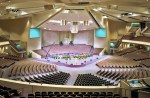
Then you enter an auditorium complete with padded seating, an elevated stage, stage lights, audio-visual effects. This used to be called the ‘sanctuary’, a place to reflect on God before the sermon. Now you read about upcoming events on a large screen while you uncomfortably avoid eye contact with others.
Then the show begins. A quality production and a mix of gospel music, religious rock-style music, accompanied by guitars, pianos, drummer’s rhythmic beats, and a ‘worship team’ of well-trained singer-actors.
I am not criticizing. I am critiquing. The fact is that all of this can be very entertaining and can get you in the mood. It elevates your mood and can put you on an emotional high, readying you for the final two acts – the offering (somebody has to pay for all this) and the sermon.
Now the unfortunate rub. One of the most frequent complaints you might hear from church seekers, visitors or casual attenders is that “it’s always about money”. (Jesus even dealt with this when When Jesus went into the temple of God and drove out all those who bought and sold in the temple, and overturned the tables of the money changers and the seats of those who sold doves. And He said to them, “It is written, ‘My house shall be called a house of prayer,’ but you have made it a ‘den of thieves.’ ” (see Matthew 21:12-13 and Mark 11:15-18)).
Perhaps all this is necessary in order to draw a crowd so they can hear the Gospel Message. Perhaps. But even that is dependent on two contributing factors. #1, will they hear a Gospel Truth? And, #2, if you build it, will they come?
A recent report from veteran researcher George Barna and the Cultural Research Center at Arizona Christian University showed that just 37% of Christian pastors have a biblical worldview, with the predominant worldview among pastors (62%) being syncretism, a hybrid mixture of disparate worldview elements blended into a customized philosophy of life. According to this latest report, the widespread absence of biblical worldview among American pastors is resulting in eroding beliefs in areas as basic as salvation through Jesus Christ, the nature of God, the sinful condition of human beings, and the existence of objective truth.
It can be a challenge to attract first time visitors to your church.
A study and survey by Pew research shows that people come to church for these top 9 reasons, or at least by those who attend religious services at least once a month. (For your information, respondents were allowed to give more than one reason.) The percentage refers to people who said this was a “very important” reason for their decision:
- To become closer to God. (81%)
- So their children will have a moral foundation. (69%)
- To become a better person. (68%)
- For comfort in times of trouble or sorrow. (66%)
- They find the sermons valuable. (59%)
- To be part of a faith community. (57%)
- To continue their family’s religious traditions. (37%)
- They feel a necessary obligation to go. (31%)
- To meet new people or socialize. (19%)
They will also leave a church if these expectations are not met.

Counter Cultural?
I will offer a meek (and probably a weak) contrast and rebuttal to all these statistical analyses, as this comes from my personal experience as a church deacon, Sunday School teacher, guest speaker, itinerant preacher, evangelist and pastor. (In order to shorten an already too lengthy article, I will cite just a few examples).
EXAMPLE #1.
As a relatively new Christian, I was asked to start a young adults Sunday school class. After about six months of effort, we had just three attendees. Me, my wife and one other. Visitors would come and leave. As failure hung over my efforts and weighed on my mind, I decided that I had nothing to lose, so rather than offering the typical Sunday school lesson from a Baptist quarterly, I would take a risk. I would use the Bible to relate to our daily lives. We would study a book of the Bible and search for practical and spiritual guidance. (I had very little-to-no idea of how to teach the Bible). But we began, and after about six months we had over 100 people coming to this class.
We had some gifted Bible teachers in the class now, so I recruited them to co-teach and rotated the responsibility. This group grew to around 200 people, and from this group we established six home based bible based social ‘small groups’. (This was before the ‘small group’ concept was popular so the senior pastor panicked a little at first, wondering how such a thing could happened. Was it a revolt? A takeover? Not likely considering it was being led by an inexperienced and lowly ‘layman’.) None-the-less, he politely and lovingly suggested it be restructured and a ‘more experienced’ bible teacher was assigned to the class. The small groups were disbanded. The class shrunk down to about 25 people. Everyone else found a different bible study group or stopped coming to Sunday School. Many simply left the church in search of what they had experienced.
My point? People do come to church and Sunday school for these 8 reasons, and I would like to add one more observable reason:
- To become closer to God. (81%)
- So their children will have a moral foundation. (69%)
- To become a better person. (68%)
- For comfort in times of trouble or sorrow. (66%)
- They find the Bible lesson valuable. (59%)
- To be part of a faith community. (57%)
- To meet new people or socialize. (19%)
- To feel included, loved, cared for and useful (100%).
EXAMPLE #2.
I was a deacon in a medium sized Baptist church, but concerned that the Sunday School program was not well attended nor was it growing. So I asked the senior pastor if I could start a class. He said there was no class room space available. So, I asked if I could use the sanctuary space if we ended our class time early enough that we would not interrupt the main service. He told me to give it a try.
I began by calling everyone who had once attended or was on the membership role, but had stopped coming to church. I explained that we were going to try a new approach, reciting what I had discovered during my time at our previous church. Many of those I called came. The group had immediate growth. We had people from our ‘church leadership teams’ sneak in to see what we were doing to cause this growth and excitement, and there was concern. We were not using the Baptist quarterly and we were laughing and making too much noise.
The pastor came to me with the concerns of ‘those people’. He said they had emptied a storage room for us to use. The room was more like a closet – windowless and small. They had succeeded in keeping the status quo. The class disbanded.
What can we gather from that? I think you know. But as a P.S., we started a small group with many of these folks at our home on Friday evenings. Covered dish dinners, bible studies, games and the entire family was invited. We grew to over 50 coming until our home could not hold any more. So, we divided into other homes. We discovered that people love to come together in order….
- To become closer to God. (81%)
- So their children will have a moral foundation. (69%)
- To become a better person. (68%)
- For comfort in times of trouble or sorrow. (66%)
- They find the Bible lesson valuable. (59%)
- To be part of a faith community. (57%)
- To meet new people or socialize. (19%)
- To feel included, loved, cared for and useful (100%).
EXAMPLE #3.
We moved to another church and after some time had passed I was asked to be a Sunday School teacher. Several in the class agreed to have some ‘at home socials’. After a few social events which included meals, testimonies, singing, games and prayer, it was my wife and my turn to host. It would be on a Memorial Day weekend. I reasoned that most people would be away. So, reasoning that we should invite more than we could expect to come, I recruited a friend to help and we invited around 85 people to a cookout at our house. The response was immediate. We had 85 respond in the affirmative, but wanted to bring other family members or friends. We made the adjustment, added another grill for cooking and, wow, what a crowd. We sang together, laughed, played games, told testimonies and prayed together, late into the evening.
Soon afterwards, the executive pastor called me and asked how we had accomplished what we had done, and would we show him how to do it? I said yes, and we planned another get-together. He sat and listened to the invitation process. He attended the gathering. Again we had around 80 people show up. Same process, same results. Everyone wanted to know when we would meet again! (All these folks attended this church, but had been avoiding Sunday school).
The executive pastor asked if we would head up a ‘small groups ministry’. I explained this was not a project, it was friends making friends and ‘loving the stuffings out of it’ and out of one another. But, yes, I would do it. He then said, ‘let’s keep the groups to around 12 people per group’. I explained that friends do not like to be segregated. They do that on their own. So, no, I would not be able to continue with that limitation. So, he relented and watched as the ‘main group’ eventually led to smaller groups at others’ homes. And just as it should be, the effect flowed over to greater attendance in the church building and in Sunday School class attendance.
You know, it seems that the vast majority of our seminary trained church leaders, pastors, and teachers know so much ABOUT church, that they have neglected to actually get to know the Church – which is THE PEOPLE OF GOD – The Ekklesia!
Similarly Jesus once said something like, “You’re hopeless, you religion scholars and Pharisees! Frauds! You keep meticulous account books, tithing on every nickel and dime you get, but on the meat of God’s Law, things like fairness and compassion and commitment—the absolute basics!—you carelessly take it or leave it. Careful bookkeeping is commendable, but the basics are required. Do you have any idea how silly you look, writing a life story that’s wrong from start to finish, nitpicking over commas and semicolons?” (Too harsh a comparison?)
I could go on, but you get it, right? People, and especially Christians are not cattle to be herded. They are God’s people and they need to be heard. And here is what they are saying:
- I want to get closer to God.
- I want my children to have a moral foundation through my church and through bible study.
- I want to become a better person, a better Christian.
- I want comfort from my Christian friends and my church in times of trouble or sorrow.
- I want to find valuable Bible Lessons to live by.
- I want to be part of a loving, interactive Christian faith community.
- I want to meet other Christians to socialize with.
- I want to feel included, loved, cared for and useful.
I am fortunate enough to be part of a faith community that provides these things which helps me to achieve and to have these things. I wish that for you. I pray for that for you.
But I have this to say to the church as a 501-c-3 business organization. I know it’s a tough business. And therein lies the problem. IT IS NOT A BUSINESS and there should be no such overriding priority such as ‘the business of church’. It killed Jesus for One Reason, and it will kill you for a thousand other reasons!
The Church is the Body of Christ. Hear that again, and this time listen: The Church is the BODY OF CHRIST. All the Williams, Marys, Timothys, Susans, Howards, Cathys, Sarahs, Billys and millions of others. They, all of them, are the BODY OF JESUS.
You say you ‘know Jesus’ but you admit that you don’t know each and every person who is part of Jesus’ Church? Naw. You don’t KNOW ALL OF JESUS if that is the case. You only know about Him. (Too harsh a comparison?)
If this angers some of you who read this, guess why? Guess why you are angry? So were the Pharisees, the scribes and the Sadducees angered. And, why were they angry? (You know why, don’t you.)

Oh, and by the way. Jesus and His Church is counter-cultural.
A noun
- A culture, with values or lifestyles in opposition to those of the established culture.
- Any culture whose values and lifestyles are opposed to those of the establishedmainstream culture, especially to western
- A culture with lifestyles and values opposed to those of the established culture.
So, what is the answer? Pray and read your Bible, Pray and understand what you read in the Bible. Pray and spend time with Jesus and His Body!
Now, let’s go and BE THE CHURCH and leave the ‘organizing’ to God’s people.
Your Brother and Friend,
Mike Young
(Comments Welcomed).
Discover more from Whitestone Fellowship
Subscribe to get the latest posts sent to your email.

