THE BOOK OF JOHN, Chapter 6, Part 1
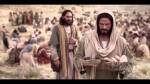
Five Thousand Men Fed
These verses tell of 5,000 men, and Matthew 14:21 says they numbered about five thousand men, besides women and children. So they numbered well over 10,000 men, women and children. Please ask yourself ‘what is the importance of a narrative of Jesus feeding a crowd of people numbering in the thousands’? Would it be to increase your faith, or to create a curiosity? Is it to further aggrandize the Name and Person of Jesus? Let’s look deeper into the words of these verses and see if we can discover the nuance, the symbolism, the meaning, the teaching of a profound truth and the application for our lives – God’s Word.
Jesus Feeds the Five Thousand
John 6:1, After this Jesus went away to the other side of the Sea of Galilee, which is the Sea of Tiberias. Verse 2. And a large crowd was following him, because they saw the signs that he was doing on the sick.
(Commentary Break): Note that this chapter begins with the words, “After this”. We need to remember that Jesus has just healed a man at the pool of Bethsaida and a crowd of Jews were accusing Jesus of unlawfully healing a man on the Sabbath. Therefore they were seeking to were seeking to kill him, because not only was he breaking the Sabbath, but they said that he was even calling God his own Father, making himself equal with God. Jesus finished testifying to His authority as the Son of God and His mission. And still a large crowd follows Him because of the miracles He has performed with the sick. If there is anything to gather here it would be that even those who are healed from physically illnesses will die one day. We should seek Jesus, not just for our physical needs, but for the healing that leads to eternal life.
Finally, one might assume Jesus that was escaping to the other side of the Sea of Galilee to find respite. But, Jesus is aware that His time is short and there is much to be done. Please read on. (End Commentary Break).
Verse 3. Jesus went up on the mountain, and there he sat down with his disciples. Verse 4. Now the Passover, the feast of the Jews, was at hand.
(Commentary Break): It is beyond simply interesting that whenever you read that Jesus “goes upon the mountain”, [and please notice that it is called “THE mountain, and not “A mountain” – an unnamed mountain, which is indicative of symbolism], that He is going there to pray, to draw near to His Father, and a teaching, is about to follow, usually accompanied by or followed by miracles: For examples, see Matthew 5;1, Matthew 14:23, Matthew 15:29, Mark 3:13, Mark 6:46, Luke 9:28, John 6:3.
It is significant that the Passover, the feast of the Jews, was at hand. The Hebrew word for “feasts” (moadim) literally means “appointed times.” God has carefully planned and orchestrated the timing and sequence of each of these seven feasts to reveal to us a special story. The seven annual feasts of Israel were spread over seven months of the Jewish calendar, at set times appointed by God. They are still celebrated by observant Jews today. But for both Jews and non-Jews who have placed their faith in Jesus, the Jewish Messiah, these special days demonstrate the work of redemption through God’s Son.
The Passover was an annual Jewish festival commemorating the Israelites’ deliverance from slavery in Egypt, and it holds significant meaning within biblical history. The Passover Jesus portrays redemption through the sacrifice of the “Lamb of God.” When John the Baptist saw Jesus, he declared: “Look, the Lamb of God, who takes away the sin of the world!” (John 1:29). This label directly connected Jesus to the Passover lamb-offered at the first sign of national deliverance for Israel. The New Testament writers consistently link Jesus’ atoning work with that of the sacrificial lamb demanded by God’s justice.
The Passover (Leviticus 23:5), pointed to the Messiah as our Passover lamb (1 Corinthians 5:7) whose blood would be shed for our sins. Jesus was crucified during the time that the Passover was observed (Mark 14:12). Christ is a “lamb without blemish or defect” (1 Peter 1:19) because His life was completely free from sin (Hebrews 4:15). As the first Passover marked the Hebrews’ release from Egyptian slavery, so the death of Christ marks our release from the slavery of sin (Romans 8:2). (End Commentary Break).
Verse 5. Lifting up his eyes, then, and seeing that a large crowd was coming toward him, Jesus said to Philip, “Where are we to buy bread, so that these people may eat?” Verse 6. He said this to test him, for he himself knew what he would do. Verse 7. Philip answered him, “Two hundred denarii (the equivalent of a day’s wages for a laborer) worth of bread would not be enough for each of them to get a little.” Verse 8. One of his disciples, Andrew, Simon Peter’s brother, said to him, Verse 9. “There is a boy here who has five barley loaves and two fish, but what are they for so many?” Verse 10. Jesus said, “Have the people sit down.” Now there was much grass in the place. So the men sat down, about five thousand in number. Verse 11. Jesus then took the loaves, and when he had given thanks, he distributed them to those who were seated. So also the fish, as much as they wanted.
(Commentary Break): Then, as suspected, a large crowd came toward Jesus. And right on cue, Phillip, again as Jesus suspected, was seeing through a human perspective, worries, “Where are we to buy bread, so that these people may eat?”
Please consider here, that we are seeing a microcosm of how God orchestrates our lives. Phillip, in this case, represents everyman and everywoman. Phillip is worrying about the cares of life and calculating his own solutions for this ‘God sized problem’. And although God is standing right at his side, Phillip neglects to turn to Him for answers – and Jesus was aware that he would do this.
Then Andrew joins the chorus and offers his idea: “There is a boy here who has five barley loaves and two fish, but what are they for so many?”
Then Jesus steps in and instructs the people to sit down. [This is symbolically significant]. Then Jesus takes the loaves, gives thanks, and distributes them to those who were seated, and they ate as much as they wanted, until they were filled.
(Please notice that He distributes them to those who were seated! This is significant if one assumes that others did not sit down, perhaps not committed to stay and listen. But those who sat down, were there to hear and see Jesus.)
Please also consider the magnitude of this situation. The setting is in a rural mountain region, in a open field, and were likely over 10,000 in attendance, considering around 5,000 men and women with children (see Matthew 14:21). And yes, the miracle is beyond astounding. But the miracle is not the main point.
The main point is the contrast between the lack of faith – not the smallness of their faith, but the absence of the disciples faith – and the willingness of God to provide.
Please hear me. This is not an isolated incident. This is not just a ‘teaching moment’ or an exception to God’s nature to provide. This is the very nature of God for those who will follow Him and obey His voice!
When we find ourselves in the remoteness of life, finding ourselves stranded on a faraway hillside with no or only meek provisions, even when we are following God, we must not worry or doubt. God always provides – always. We must find a means to deny our flesh, our own intellect and cunning and turn to God. “Ask and He will answer. Seek and you will find. Knock and the door will be opened to you. For how much more will your Father Who is in heaven give good gifts to those who ask Him?” (see Matthew 7:7-11). (End Commentary Break).
Verse 12. And when they had eaten their fill, he told his disciples, “Gather up the leftover fragments, that nothing may be lost.” Verse 13. So they gathered them up and filled twelve baskets with fragments from the five barley loaves left by those who had eaten.
(Commentary Break): “They had eaten their fill.” Their bellies were filled, so they were satisfied. (At least one half of the equation is satisfied).
Now, please consider each word here and see the symbolism and the main points of this narrative and Jesus’ prophetic intent:
Now Jesus instructed the disciples to “Gather up the leftover fragments, that nothing may be lost (“For the Son of Man came to seek and save the lost.”) So they gathered them up and filled twelve (the 12 Tribes of Israel – completed), baskets with fragments (the scattered ones) from the five barley loaves (Barley loaves hold significant symbolic and practical importance in the biblical narrative, representing sustenance, provision, and divine intervention. Barley, a grain more affordable and accessible than wheat, was a staple food in ancient Israel and often associated with the common people and the poor. Its mention in the Bible underscores themes of humility, provision, and God’s care for His people.) left by those who had eaten.”
This prophetic word is still true for us. We are to gather up the leftover fragments of our family, friends, acquaintances and those nearby by who are in danger of being tossed aside, left behind and lost, for the Son of Man has come to seek and save those who are lost. We are to bring them the Good News of God’s sustenance, provision, and divine intervention to the spiritually humble and poor. (End Commentary Break).
Verse 14. When the people saw the sign that he had done, they said, “This is indeed the Prophet who is to come into the world!”
Verse 15. Perceiving then that they were about to come and take him by force to make him king, Jesus withdrew again to the mountain by himself.
The people still do not understand the spiritual significance of the miracle of the loaves and the fish as being a prophetic reminder of what was, what is and what is to come: The Savior of the World, a suffering servant and the Lamb of God.
Now, how about us? Are we seeing God for what He can do for us in this world, considering the saving of our soul and eternal life just as an added benefit? Beware if this might be the hidden case. Jesus has warned that you cannot serve God and mammon; for you will love one and despise the other.
Trust, follow and worship God for Who He is and give Him thanks for what He has done.
Your Brother and Friend,
Mike Young
(Please bookmark this page or subscribe for future episodes).
Discover more from Whitestone Fellowship
Subscribe to get the latest posts sent to your email.

