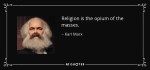
Many in the American and Western Christian Church are either deliberately or unwittingly preaching, teaching and practicing a form of religious humanism, better known as Marxism, cloaked in the garbs of the Gospel of Christ. Either way, the effect on the church is damning.
We can trace the roots of this demonic theory, or Marxism, an anathema to the Church, to Karl Marx. Interestingly, Marx called religion the “opiate of the masses”. He meant that it acts as a mind-numbing painkiller, dulling the suffering of the oppressed working class by providing a comforting illusion of a better afterlife and preventing them from confronting the root causes of their exploitation and suffering in this world. He believed this distraction, or “false consciousness,” served the interests of the ruling class by discouraging revolutionary action and maintaining the capitalist status quo.
I, as a Christian, vehemently disagree with and refute Marx’s philosophies, writing and teachings. They are satanically inspired and demonic in their application. History has shown it is the root of evil. It murdered hundreds of millions who resisted its grip and has enslaved hundreds of millions more in hopelessness, poverty disease and death under despotic regimes around the globe.
- Like opium, religion provides solace and hope to the poor and oppressed, easing their burdens by offering a promise of happiness in the afterlife or a more just future.
Distraction from reality:
-
By focusing on spiritual comfort, people are distracted from the concrete, temporal issues of exploitation and class struggle in their daily lives.
Marx saw religion as a tool used by the dominant, wealthy classes to justify and defend their power and privilege, placating the poor and encouraging them to accept their lot.
Marx was heavily influenced by Wilhelm Friedrich Hegel’s Philosophy of Right, published in 1821, which explores the concept of freedom as actualized through the institutions of the state, law, and society. Through a dialectical progression of Abstract Right, Morality, and Ethical Life, Hegel details how the free will finds expression and realization in the intertwined spheres of family, civil society, and a rational state. This influential work argues for a modern vision of the state that integrates individual freedom with collective well-being, departing from earlier political thought and profoundly impacting subsequent philosophy and political theory.
(This can be seen in our postmodern era as being free from the constraints of any personal disciplines, code of ethics, or morality as defined by Christianity or Judaism.  in other words you can be and do anything or anyone you choose, regardless of the consequences to the society or the people around you. It is the belief that no one has the right to tell you right from wrong or good from evil. You can be heterosexual, homosexual, transgender, or any other variant of a species you choose, regardless of how it affects those. This kind of thinking also says you have the right to force this on others and if they do not agree, you have every right to resist them to the point of violence and even murder. Anarchy and lawlessness are the trademarks of this world . It is like in the example of the tower of Babel, man has decided that he will determine his own fate, and he will build his own man-made tower to the heavens in rebellion of and in spite of God.)
Three Spheres of Right: Hegel develops his concept of right through three stages:
Abstract Right: This initial sphere focuses on the non-interference principle, recognizing others’ right to be free from direct interference.
This goes on to mean that no parental authority and no government authority has the right to restrain you from any activity or behavior you choose.)
Morality: The second stage introduces the subjective aspect of morality, where individuals reflect their own subjectivity in their interactions and commitments to others.
(This removes all societal safeguards and historical norms for a civil society. It is obviously impossible for any society to sustain itself or to survive when each person must have their own way at the expense of others.)
Ethical Life (Sittlichkeit): This is the highest sphere, where individual freedom and universal notions of right are integrated into the lived reality of the community. It comprises three interconnected parts:
Family: The primary form of social unity, founded on love and mutual flourishing, which develops individuals capable of ethical life.
(This  interconnected part makes the inane assumption that man is naturally good and capable of love and ethics, without any guiding principles outside of his own invention.)
Civil Society: A sphere of economic interdependence, property, contracts, and specialized labor, which creates a complex web of relations and interests.
(Once again this interconnected part makes the false assumption that people, each in competition and conflict with one another’s personal desires, imaginations, and inventions are capable of making contracts suitable to two parties that was support and interconnected social structure of any kind.  This is the fantasy world of the Marxist and the Hegelian.)
The State: The culmination of ethical life, where the individual’s freedom is fully realized through participation in a rational and integrated society.
(Finally, the founder and author of the Marxist worldview, ironically proved that his thesis was not only unworkable, but produced the antithesis to his proposition. Marxism does not produce freedom. It produces despotism murder death, and for those who survive a loss of freedoms and eternal captivity to the state.)
The Philosophy of Right offers a new framework for understanding freedom within a modern, integrated society.
(This is the epitome of lies. Calling a religion, i.e. Christianity a false consciousness while promoting a theory when actualized produces the exact opposite of what it promises. Call it a fantasy or a deceit. Marxism is a lie, and it has no place in the Church let alone society or government.)
It significantly influenced subsequent thinkers, most notably Karl Marx, whose ideas of communism were profoundly shaped by Hegel’s work.
The book has been subject to diverse interpretations, with some seeing it as a foundation for democracy and others as an origin point for national Socialism. Either way it’s a death
Discover more from Whitestone Fellowship
Subscribe to get the latest posts sent to your email.

