THE BOOK OF JOHN, Chapter 18
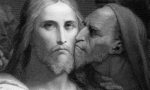
Judas Betrays Jesus, Jesus Before the Priests, Peter’s Denial of Jesus, Jesus Before Pilate
Matters concerning Jesus and His Mission on earth are coming to a crescendo. We can read, in Matthew chapter 26 that Jesus had told His disciples, that the Passover would take place in two days, and at that time the Son of Man will be handed over to be crucified. It was at this point the chief priests and the leaders of the people gathered in the palace of the chief priest Caiaphas and made plans to arrest Jesus in an underhanded way and to kill him. Then Judas Iscariot, (one of the 12 disciples) went to the chief priests and asked what they would pay him if he handed Jesus over to them. They offered him 30 silver coins. From then on, Judas looked for a chance to betray Jesus. During this time, Jesus revealed to His disciples that He knew that one of them would betray Him and Peter says that even if everyone abandoned Jesus, he would not. But Jesus rebukes Peter, telling him he would deny Him three times before a rooster crowed.
Jesus then went to the garden of Gethsemane and prayed, awaiting His arrest, mock trial, crucifixion and death.
As you read the following words, as best you can, walk with Jesus and visualize these events and watch with your mind’s eye the confidence shown by Jesus in the face of this episode of betrayal, false accusations and mistreatment. Jesus knew this appointment was ordained by His Father and was just one more step toward the grand finale in the defeat of sin and death and the evil one for all time. (Jesus’ victory over sin and death is highlighted in several Bible verses, such as Romans 6:23, which states, “For the wages of sin is death, but the free gift of God is eternal life in Christ Jesus our Lord.” Additionally, 1 Corinthians 15:55 proclaims, “O death, where is your victory? O death, where is your sting?” These verses emphasize the hope and assurance believers have through Jesus’ sacrifice and resurrection. This is not only our hope but the example set before us as our day of trial and testing comes upon us, also.
Judas Betrays Jesus
John 18:1, When Jesus had spoken these words, He went away with His disciples across the ravine of the Kidron, where there was a garden which He entered with His disciples. Verse 2. Now Judas, who was betraying Him, also knew the place, because Jesus had often met there with His disciples. Verse 3. So Judas, having obtained the Roman cohort and officers from the chief priests and the Pharisees, came there with lanterns, torches, and weapons. Verse 4. Jesus therefore, knowing all the things that were coming upon Him, came out into the open and said to them, “Whom are you seeking?” Verse 5. They answered Him, “Jesus the Nazarene.” He said to them, “I am He.” And Judas also, who was betraying Him, was standing with them. Verse 6. Now then, when He said to them, “I am He,” they drew back and fell to the ground. Verse 7. He then asked them again, “Whom are you seeking?” And they said, “Jesus the Nazarene.” Verse 8. Jesus answered, “I told you that I am He; so if you are seeking Me, let these men go on their way.” Verse 9. This took place so that the word which He spoke would be fulfilled: “Of those whom You have given Me I lost not one.”
(Commentary Break): Jesus is confronted by Judas, the Pharisees and a Roman cohort which was a standard tactical military unit of a Roman legion which was generally composed of 480 soldiers – considered to be the equivalent of a modern military battalion – carrying lanterns, torches and weapons! Imagine the sight of these hundreds of armed militia coming to arrest one man. And when they see Him, “they drew back and fell to the ground”!
Many commentaries overstate or dramatize this moment saying these men and the Roman Cohort were overcome when recognizing Jesus’ divine authority. However, if that were the case, they would not have recovered so quickly as to arrest Him. It is more likely This involuntary response underscores the authority of Jesus’ Words and His (supernatural spiritual) control over the situation, even as He submits to arrest. (It also fulfills the prophecy of Isaiah 53:7, where the Messiah is described as being led like a lamb to the slaughter, yet with divine authority.) At any rate, this is not something can be understood or explained by mere words. It is a supernatural work of the divine. (End Commentary Break).
Verse 10. Then Simon Peter, since he had a sword, drew it and struck the high priest’s slave, and cut off his right ear; and the slave’s name was Malchus. Verse 11. So Jesus said to Peter, “Put the sword into the sheath; the cup which the Father has given Me, am I not to drink it?”
(Commentary Break): This is an important event with subtle but profound implications. Peter responds emotionally, as many of us might. This addresses the question, “can and should a follower of Jesus, (a Christian), defend themselves using aggressive or violent means? Malchus was the servant of Caiaphas, the Jewish High Priest. During the arrest of Jesus in the Garden of Gethsemane, Simon Peter cut off Malchus’s right ear with a sword in an attempt to defend Jesus. (This event is recorded in all four Gospels, but only the Gospel of John names Malchus specifically).
After Peter’s action, Jesus intervened. He told Peter to put away his sword and then healed Malchus by touching his ear. (This act of healing is noted in the Gospel of Luke, which states, “But Jesus answered, ‘No more of this!’ And he touched the man’s ear and healed him.”) Several commentaries contend with the idea that “the healing of Malchus’s ear illustrates Jesus’s compassion and his commitment to peace, even in the face of violence. It also serves as a reminder of the importance of mercy and reconciliation”. But there are two valid perspectives at play here. (1). Jesus completes his remark to Peter saying, “the cup which the Father has given Me, am I not to drink it?” This seems to be less about “compassion and commitment to peace” than Jesus saying that Peter’s action is not just an improper response, it is a diversion and potentially an interruption to God’s Plan, Purpose and Mission for Jesus. And, (2). If we were to allow the opponents or adversaries of Jesus kill and maim all Christians at will, where would that leave us? There is a time for appropriate responses such as not escalating a situation out of emotions, or removing oneself from harm’s way; of responding with no more aggression than necessary to preserve life. In certain circumstances there may not be an easy way out. But we should always remember that we too, are on the same Mission as Christ Jesus. And overcoming our enemies and threats of violence with maiming and killing will accomplish little-to-nothing in our cause. (Like a quip from a war movie parody, “you can’t save them if you are killing them”). Let’s remember that the Roman cohort fell back and to the ground reassuring us that Jesus is in control at all times. Submit yourself to Him and not to the dreads you are facing. “For so the Lord spoke to me with mighty power and instructed me not to walk in the way of this people, saying, “You are not to say, ‘It is a conspiracy!’ regarding everything that this people call a conspiracy; and you are not to fear what they fear or be in dread of it. It is the Lord of armies whom you are to regard as holy. And He shall be your fear, And He shall be your dread. Then He will become a sanctuary.” (Isaiah 8:11-14). (End Commentary Break).
Jesus before the Priests
Verse 12. So the Roman cohort, the commander, and the officers of the Jews arrested Jesus and bound Him, verse 13, and brought Him to Annas first; for he was the father-in-law of Caiaphas, who was high priest that year. Verse 14. Now Caiaphas was the one who had advised the Jews that it was in their best interest for one man to die in behalf of the people.
(Commentary Break): The irony and prophetic nature of Verse 14 is so obvious as not to need additional comment. (End Commentary Break).
Verse 15. Simon Peter was following Jesus, and so was another disciple. Now that disciple was known to the high priest, and he entered with Jesus into the courtyard of the high priest, verse 16, but Peter was standing at the door outside. So the other disciple, who was known to the high priest, went out and spoke to the doorkeeper, and brought Peter in. Verse 17. Then the slave woman who was the doorkeeper said to Peter, “You are not also one of this Man’s disciples, are you?” He said, “I am not.” Verse 18. Now the slaves and the officers were standing there, having made a charcoal fire, for it was cold and they were warming themselves; and Peter was also with them, standing and warming himself.
Verse 19. The high priest then questioned Jesus about His disciples, and about His teaching. Verse 20. Jesus answered him, “I have spoken openly to the world; I always taught in synagogues and in the temple area, where all the Jews congregate; and I said nothing in secret. Verse 21. Why are you asking Me? Ask those who have heard what I spoke to them. Look: these people know what I said.” Verse 22. But when He said this, one of the officers, who was standing nearby, struck Jesus, saying, “Is that the way You answer the high priest?” Verse 23. Jesus answered him, “If I have spoken wrongly, testify of the wrong; but if rightly, why do you strike Me?” Verse 24. So Annas sent Him bound to Caiaphas the high priest.
Peter’s Denial of Jesus
Verse 25. Now Simon Peter was still standing and warming himself. So they said to him, “You are not one of His disciples as well, are you?” He denied it, and said, “I am not.” Verse 26. One of the slaves of the high priest, who was related to the one whose ear Peter cut off, said, “Did I not see you in the garden with Him?” Verse 27. Peter then denied it again, and immediately a rooster crowed.
(Commentary Break): Peter had loudly proclaimed (see chapter 13, verse 38) that he would never deny Jesus, whereupon Jesus replied, “Will you lay down your life for Me? Truly, truly I say to you, a rooster will not crow until you deny Me three times. Scriptures instruct us not to make rash vows, but simply make your yes, yes and your no, no – “anything more is evil”. (see Matthew 5:33-37). (End Commentary Break).
Jesus before Pilate
Verse 28. Then they brought Jesus from Caiaphas into the Praetorium, and it was early; and they themselves did not enter the Praetorium, so that they would not be defiled, but might eat the Passover. Verse 29. Therefore Pilate came out to them and said, “What accusation are you bringing against this Man?” Verse 30. They answered and said to him, “If this Man were not a criminal, we would not have handed Him over to you.” Verse 31. So Pilate said to them, “Take Him yourselves, and judge Him according to your law.” The Jews said to him, “We are not permitted to put anyone to death.” Verse 32. This happened so that the word of Jesus which He said, indicating what kind of death He was going to die, would be fulfilled.
Verse 33. Therefore Pilate entered the Praetorium again, and summoned Jesus and said to Him, “You are the King of the Jews?” Verse 34. Jesus answered, “Are you saying this on your own, or did others tell you about Me?” Verse 35. Pilate answered, “I am not a Jew, am I? Your own nation and the chief priests handed You over to me; what have You done?” Verse 36. Jesus answered, “My kingdom is not of this world. If My kingdom were of this world, My servants would be fighting so that I would not be handed over to the Jews; but as it is, My kingdom is not of this realm.” Verse 37. Therefore Pilate said to Him, “So You are a king?” Jesus answered, “You say correctly that I am a king. For this purpose I have been born, and for this I have come into the world: to testify to the truth. Everyone who is of the truth listens to My voice.” Verse 38. Pilate said to Him, “What is truth?” And after saying this, he came out again to the Jews and said to them, “I find no grounds at all for charges in His case.”
(Commentary Break): This dialogue is revealing and further study would be helpful (see BibleHub.Org), but I would focus on the fact that Pilate is speaking from a human perspective and Jesus is speaking from a spiritual perspective, which, to Pilate, is foolishness. But we should pay close attention: For this purpose I have been born, and for this I have come into the world: to testify to the truth. Everyone who is of the truth listens to My voice.” Every word and action of Jesus points to His deity, His union with the Father, His Mission to seek and save the lost by His Own Sacrifice, and to reconcile the faithful with the Father – and that is the truth. And ironically, Pilate asks, “What is truth?” while all this time he is looking at the Truth, and the Truth is, a Person. The Person of Jesus. The profundity of these remarks cannot be overstated. If you or I are ever in the need of knowing the Truth on any matter, look to Jesus. (End Commentary Break).
Verse 39. However, you have a custom that I release one prisoner for you at the Passover; therefore do you wish that I release for you the King of the Jews?” Verse 40. So they shouted again, saying, “Not this Man, but Barabbas.” Now Barabbas was a rebel. (End Chapter 18).
Has Pilate seen the Truth? He finds no grounds of wrongdoing and declines to bring charges against Jesus and in his proclamation he addresses Jesus as the King of the Jews! But the crowd of Jews sought to release one more like them – Barabbas – a rebel.
These are defining moments. A clear distinction between good and evil. Right and wrong. The way of the cross or the way of the world. This crowd made its choice and you and I will have to make ours. And in the final analysis, words alone will not suffice. God “will repay each person according to his (or her) deeds”. (see Romans 2:6).
Your Brother and Friend,
Mike Young
NEXT: THE BOOK OF JOHN, Chapter 19, The Crown of Thorns, The Crucifixion.
(Please bookmark this page for future episodes).
Discover more from Whitestone Fellowship
Subscribe to get the latest posts sent to your email.

