Please ask yourself these most important questions:
Is it possible the “birth pains” of tribulation have begun and if so,
When was the First tribulation seal broken?
Where are we in the tribulation seals (one through seven)?
When do the 7 years of Great Tribulation begin?
When does the “Great and Terrible Day of The Lord” being, and what is it?
And, when does the “midpoint” (3.5 years of the final 7 years) occur?
You may have heard or have been taught in certain denominations that these are future events which, if you are a Christian, you will never have to experience. But what if the Bible clearly is saying otherwise? What if Jesus, the Apostles Paul, Peter and Timothy say otherwise?
This can be a great mystery. But, it should not be. Remove the denominationalism and read the clear face-value teachings of the Bible:
You will read in Matthew 24:3-8, “And as He was sitting on the Mount of Olives, the disciples came to Him privately, saying, “Tell us, when will these things happen, and what will be the sign of Your coming, and of the [b]end of the age?”
“And Jesus answered and said to them, “See to it that no one misleads you. For many will come in My name, saying, ‘I am the Christ,’ and they will mislead many people. And you will be hearing of wars and rumors of wars. See that you are not alarmed, for those things must take place, but that is not yet the end. For nation will rise against nation, and kingdom against kingdom, and there will be famines and earthquakes in various places. But all these things are merely the beginning of birth pains” of the tribulation.
The phrase “the beginning of birth pains” is a statement made by Jesus in or around the year AD 30 and is a translation of the Greek archē ōdin. The meaning of the phrase, translated in the KJV as “the beginning of sorrows” is a direct reference to preliminary birth pangs that ultimately lead to the full-scale contractions and travail, which leads to the actual birth.
Recognizing the Old Testament reference that Jesus was hearkening to is an essential, but often overlooked, key to determining the timing of the prophecy. Jesus was pointing his disciples to two key passages from the prophet Isaiah.
The first passage is Isaiah 26, a portion of Scripture found in the middle of what is sometimes referred to as “Isaiah’s little apocalypse”. There, the Lord speaks through Isaiah, specifically contrasting the expectations of the Jewish people regarding deliverance, redemption and physical resurrection with the reality of the pain, suffering and travail that they had corporately experienced. In verses 16-18, the complaint of Israel is raised that despite having endured the great suffering of labor, the expected “birth” of deliverance, redemption and resurrection had not arrived.
This makes clear that the Last Days and the opening of the tribulation Seals began sometime between 2 B.C., and AD 30. Other references which confirm this date as spoken by Jesus and the Apostles Paul, Peter and Timothy, are found in :
Section A.2. With the breaking of the Sixth Tribulation Seal we will see that THE SUN WILL BE DARKENED, AND THE MOON WILL NOT GIVE ITS LIGHT, AND THE STARS WILL FALL from the sky, and the powers of the heavens will be shaken. “And then the sign of the Son of Man will appear in the sky, and then all the tribes of the earth will mourn, and they will see the SON OF MAN COMING ON THE CLOUDS OF THE SKY with power and great glory. “And He will send forth His angels with A GREAT TRUMPET and THEY WILL GATHER TOGETHER His elect from the four winds, from one end of the sky to the other. (Matthew 24:29-31 & Revelation 6:12-16).
Section A.3. The Antichrist enters into a treaty with Israel at the beginning of Daniel’s Seventieth Week, which is marked by the breaking of the Sixth Tribulation Seal, which is also beginning point of the final seven-years of the Great tribulation, as known as the Great and Terrible Day of the Lord and the Wrath of the Lamb. This event is prophesied in Daniel 9:24-27).
Section A.4. At the midpoint of the tribulation (1,260 days later), the Antichrist breaks the treaty, desecrates the temple, and begins to persecute the Jews.
Section A.5. At the end of the tribulation (1,260 days after the desecration of the temple), Jesus Christ returns to earth and defeats the forces of the Antichrist.
Section A.6. During the next 30 days (leading up to 1,290 days after the desecration of the temple), Israel is rebuilt, and the earth is restored.
Section A.7. During the next 45 days (leading up to 1,335 days after the desecration of the temple), the Gentile nations are judged for their treatment of Israel.
Section A.8. The dispensation of the millennium begins, and it will last for 1,000 years (Revelation 20:3, 5–6).
(Below here is a more complete description of the Tribulation Timeline. Concern yourself with the first SIX SEALS.)
the signing of a peace treaty between Israel and her enemies.
The First Seal of the tribulation was being broken perhaps sometime just after the birth of Jesus up until just after the death and resurrection of Christ. The succeeding seals (Seals 2 – 5) have been broken at various periods of time sometime since A.D. 1 and that we have now entered a time of the intensification of the Fifth Tribulation Seal. Jesus refers to this period, the breaking of the tribulation Seals ONE through FIVE as “the beginning of the birth pangs”,and He points out that “this is not yet the end”.
The Sixth Tribulation Seal, as described in Matthew 24 we see in Verse 29. “Immediately after the tribulation of those days THE SUN WILL BE DARKENED, AND THE MOON WILL NOT GIVE ITS LIGHT, AND THE STARS WILL FALL from the sky, and the powers of the heavens will be shaken.
Verse 30. “And then the sign of the Son of Man will appear in the sky, and then all the tribes of the earth will mourn, and they will see the SON OF MAN COMING ON THE CLOUDS OF THE SKY with power and great glory.
Verse 31. “And He will send forth His angels with A GREAT TRUMPET, and THEY WILL GATHER TOGETHER His elect from the four winds, from one end of the sky to the other.”
Section B.3. The “7 years of Great Tribulation” (a.k.a. Daniel’s 70th week) begins with the breaking of the Sixth tribulation seal, and, will reach the mid-point of the tribulation period, (after 3.5 years) with the sounding of the Sixth Trumpet of the Great Tribulation.
Section B.4. Then, the Great Tribulation will end with the pouring out of the 7 Bowls of Wrath.
THE TRIBULATION JUDGMENTS LEAD TO THE END OF THE AGE
The world has endured, and is enduring, the first five tribulation seals, and is now experiencing the intensifying of the Fifth tribulation seal (which will include the appearing of the Antichrist, martyrdom of Christians, the great falling away from the faith,).
Multitude from the tribulation before the Throne of God
I will continue through the ‘Bowl Judgments’ in part 2 of this article, but, for the Christian, The Rapture will have occurred by this point and Jesus has taken His Spotless Bride, The Church, to the Throne of God, Her eternal home.
Dear Lord Jesus, I know that I am a sinner, and I ask for Your forgiveness. I believe You died for my sins and rose from the dead. I turn from my sins and surrender my heart and my life to you. I will trust and follow You as my Lord and Savior the rest of my days.
Eternally In His Grip – Your Brother and Friend
Mike Young
PS: Please don’t be confused or deceived by denominationalism. Trust the Bible. The Pre-Wrath-Tribulation view says that (#1). The first tribulation judgement seals were broken (opened) at or just after the birth of Jesus, and (#2). Tribulation seals ONE through FIVE have been opened sequentially, progressively, overlapping, and the effects have been intensifying to this date.
The SIXTH tribulation seal is still a future event, at which time and Matthew 24, verse 29 “immediately after the tribulation of the previous days, the sun will be darkened, and the moon will not give its light, and the stars will fall from the sky, and the powers of the heavens will be shaken. Verse 30 And then the sign of the Son of Man will appear in the sky, and then all the tribes of the earth will mourn, and they will see the Son of Man coming on the clouds of the sky with power and great glory. Verse 31 And He will send forth His angels with a great trumpet blast, and they will gather together His [c] elect from the four winds, from one end of the sky to the other.”
This is not a matter of your salvation if you are already saved, it is a matter of preparation and being ready for what is upon us (see Matthew 24 – Matthew 25).
Far too many Christians have been lulled to complacency having been taught that being saved is all this is necessary. But Jesus says otherwise. Once you have secured His great gift of salvation for your life and soul, then you and I are to join Him in His Great Command and Commission to go and make disciples, telling and teaching them all He has commanded us. Please dear ones, do not be the one who, when face-to-face with our Lord, to hear the words “why did you not do what I asked of you and commaned that you do?”
Perhaps you have read some books on Christianity or read of some people’s testimonies about the benefits and goodness of Christianity. Or maybe you have read some church websites that describe their cultures, goals and offerings. From what I have read, it would seem these would be some of the friendliest, kindest, warmest, happiest, safest, most understanding places on the earth. So why not give it a try?
Typically (which will vary from church to church) you walk into a church and are met by trained greeters at the door. They will seem friendly enough. Then you might even be met by an usher who will help you find a place to sit. At some point during the service, you may be directed by the worship leader or pastor to ‘turn and greet one another’. Then, depending on the denomination and the size of the church, you might be greeted by the pastor or an elder or deacon as you exit the church.
Not all the time, but sometimes this can seem very scripted. Almost like attending a theatre performance or a play.
They were polite, for the most part. But it was like everyone was detached from the present moment and were in a “presentation of another reality”, they were greeting people, but it was just for the program; they may have seemed to be in a hurry so they could move on to the next ‘guest’.
My presence, as a visitor, seemed to make no difference to them after the “job of greeting” was completed. (Even my grocery store will absent-mindedly welcome me. as I walked in. But their intentions were up-front. They wanted to make sure I would make a purchase – help them make a profit. Maybe I should have entered or left the church saying “I plan on giving or I gave to the offering today?”)
On one occasion I ran into some of the greeters from a church I had visited earlier that Sunday at a restaurant. I approached them to say I had enjoyed my visit, only to be met with a distant stare and a nod of approval. “Odd”, I thought.
On a couple of other occasions, I went out of my way to return to a church I had visited to meet the pastor later during the week for a more personal encounter only to be left with a feeling that I might have intruded on his time. (I kept thinking, afterward, that I might have had a friendlier encounter at my local Elks club or at the local bar (although I don’t frequent bars).
During a Wednesday evening service at another church we had been attending, we watched a video on ‘sexuality in the Bible’. Afterward we had a question-and-answer period. A man walked around the auditorium with a microphone allowing those who wanted, to answer questions about experiences of improper responses to sexual situations with Christians and how we handled them. I volunteered to contribute a story. Half was through my story a woman in the back of the church began to shout at me, “you sound like a chauvinist!” She continued to rant stopping me from speaking. I had been at this church less than a year, so I thought it best to go silent. After the class dispersed, many people came to me thanking me for my remarks and lamenting that I could not finish. The woman was not censured – not even spoken to about her ‘lunatic’ behavior. Yep. Just like any old townhall meeting – except we were in church.
Another time during a rather large Sunday School class, I was chatting before class began with a person I was trying to befriend. Suddenly, the ‘teacher’ bellowed across the room at me in an angry tone, “Mike, sit down. I want to get this going”. Both I and my ‘almost friend’ were shocked. This guy is an elder in the church and the teacher – yelling at me to sit down and be quiet? Realizing our shock, he stammered, “he’s a neighbor, so it’s okay”. (Well, we are neighbors, but no, it was not okay).
At another church, (at which I served as an associate pastor) the pastor had been confronted with adultery charges. It had become overwhelmingly plain that there was credibility to the allegations. I asked him privately if a third-party mediator from the district would be a good idea and he shouted at me to mind my own business. Then I suggested a counsellor or a therapist and he suggested I leave the church – which I did, later. (He was eventually found out).
Another time a pastor of another church asked to have lunch. I agreed. He attempted to get me to proselyte members from my current church to his startup church. I refused, whereupon he began to shout at me, accusing me of not being a good person nor of being a good Christian. (Sometimes I think I must have imagined these things. But these are real accounts).
My wife and I had been visiting yet another church for a few Sundays, and at the last minute decided to go to a Wednesday evening service. I did not have time to go home to get my Bible, but went went into this church anyway. As chance would have it, we encountered the pastor in a hallway before the service. I greeted him by saying hello, we are new here. He responded dryly saying “where’s your Bible?” I explained the circumstances and told him we had just moved into the area and told him my vocation. He stared at me and finally replied, “Well, good luck on that”, and walked away.
(These experiences happened at three different Southern Baptist churches, a Nazarene church and a Presbyterian church. I could go on and on, from church to church. But hopefully, you get the idea. We were members of our first church as Christians from 1976 through 1978 during a temporary military assignment in Texas and it was friendly and biblically sound. It was like a big family. Then we became members of a church in Virginia from 1978 through 1987 and it became our family – but things were changing. We moved to a church closer to our home from 1988 through 2005 and it was like a family-business. We relocated to another city and became members of a church – and an associate pastor – from 2005 through 2008, and it had an agenda and a philosophical socio-political worldview. We relocated to Florida and visited a church from 2008 through 2010 and joined as members from 2010 through 2018. We have been at our current church from 2018 to current day).
My experiences and assessment have to be an aberration. Right? I talk to some regular church goers and they say their church isn’t like that. That their church is really, really friendly. (So, I visited some of their churches, and I found them to be polite. I found them to be nice. But no. They weren’t really, really friendly.) So, I am left feeling that maybe it’s just me? I just don’t fit in there…or there…or there? Or am I just complaining? Neither. Or am I just saying aloud, what so many of you have been thinking. But, I am offering a solution – if we are willing.
Many pastors and church leaders will attempt to explain or excuse this behavior saying something like “church is a place for people, and people are sinners (hypocrites, liars, cheaters, etc.) covered by the Blood of Jesus and being sanctified to be like Christ – they are in process”. But many of these folks have been considering themselves as Christians for decades. So how long does this process of “becoming Christlike” take before they stop overt and blatant sinful behavior and actually become “Christlike”? Or is another issue at work here?
Please read this from Galatians 5:16, “But I say, walk by the Spirit, and you will not carry out the desire of the flesh. Verse 17. For the desire of the flesh is against the Spirit, and the Spirit against the flesh; for these are in opposition to one another, in order to keep you from doing whatever you want. Verse 18. But if you are led by the Spirit, you are not under the Law. Verse 19. Now the deeds of the flesh are evident, which are: sexual immorality, impurity, indecent behavior, verse 20, idolatry, witchcraft, hostilities, strife, jealousy, outbursts of anger, selfish ambition, dissensions, factions, 21envy, drunkenness, carousing, and things like these, of which I forewarn you, just as I have forewarned you, that those who practice such things will not inherit the kingdom of God. Verse 22. But the fruit of the Spirit is love, joy, peace, patience, kindness, goodness, faithfulness, verse 23, gentleness, self-control; against such things there is no law. Verse 24. Now those who belong to Christ Jesus crucified the flesh with its passions and desires.”
I believe many are not taking seriously (or just don’t understand) what it means to walk by the Spirit, so that you will not carry out the desire of the flesh. I believe this behavior in the church is becoming or has become the “new normal” in churches across our nation. It would seem that most of us who go to church have just adjusted to this “new normal” and accept it..
We used to say “my church is my family”. Now it is “this is where I go to church – it is where I attend”. (I attend a church now and as long as I stay quiet and speak when spoken to, we get along just great! You know, friends-at-arms-length).
One of the most foreign and socially inept, dysfunctional, and alienating places I have been in the last 10 or 15 years may be church.
Jesus warned that this day was coming. He said, in Matthew 24:12, “And because lawlessness will be increased, the love of many will grow cold.” This verse highlights that during difficult times, especially in the end times, people’s love for one another can diminish due to increasing wickedness and challenges.”
(These examples I have cited are the milder examples. It is getting worse. Much worse. (https://arrestedpastor.com/).
So, let’s move on from this negative approach of “having identified the problem”, and please allow me appeal directly to the Body of Christ – you, the Church, (and yes, I am referring to myself, also):
Having been warned that these things would happen doesnt’ seem to have done much for correcting the problem. But folks, this just ain’t right.
Please read about the CHURCH, according to Strong’s Bible concordance. The term “Church”, comes from the Greek word Ekklesia, and it means “the called; the called-out ones:; these are people called out from the world’s belief systems and to God’s teachings on how to think, act and behave; the outcome being the Church (the mystical body of Christ) – i.e. the universal (total) body of believers whom God calls out from the world and into His eternal kingdom. This is what we, the Body of Christ should begin to focus on and practice until we get it right. Until it becomes not just what we do, but what we believe and are compelled to do by our mind, conscience, will and emotions.
The basics of the Ekklesia is that we, the Church, are called out of this world and no longer part of this world. Please let that sink in. Get the best picture of that in your mind as you are able.
We as Christians, are to be the mystical Body of Christ. We are being made into a peculiar people, made as God’s own possession for His own use.
This is a radical departure or progression from ‘going to church’ to be a better person, to a becoming a peculiarity. We are people who, as Christians, live in this world as resident aliens, foreigners and sojourners, travelers in a foreign nation – we have become citizens of the kingdom of heaven, on mission upon the earth.
Therefore, and thereby, we do not adopt but we must adapt. We do not adopt, copy or resemble this world and its ways but we adapt as we spread the message of the Kingdom of God. (Now, please, stop, and consider how you dress, how you talk, the things you do for entertainment and how you adorn your body. Do you mimic this world’s standards? Please understand that we are not secret agents just fitting in. We are openly and brazenly ambassadors for Christ. This is the litmus test.).
We are not to conform to this world, but we are to have been transformed by the renewing of our minds by the word of God, mirrowing Biblical beliefs and standards, so we may prove what is the good, acceptable and perfect will of God to those around us. (This phrase is from Romans 12:2 in the Bible, which encourages individuals not to adopt the behaviors and values of the world around them, but instead to be transformed by renewing their minds to understand God’s will, which is good and perfect. It emphasizes the importance of inner change and spiritual growth).
1 Peter 2:9, from the King James Bible, tells us, “But ye are a chosen generation, a royal priesthood, a holy nation, a peculiar people (from the Greek word, ‘peridoiesis’ – a preserving, saving unto the soul, God’s own property or possession, He has obtained); that ye should shew forth the praises of him who hath called you out of darkness into his marvelous light”.
1 Peter 2:9, in the New King James Version puts it this way, “you are a chosen generation, a royal priesthood, a holy nation, His own special people, that you may proclaim the praises of Him who called you out of darkness into His marvelous light”.
And, 1 Peter 2:9, from the New American Standard Bible say it thusly: “But you are A CHOSEN PEOPLE, A royal PRIESTHOOD, A HOLY NATION, A PEOPLE FOR GOD’S OWN POSSESSION, so that you may proclaim the excellencies of Him who has called you out of darkness into His marvelous light”.
Also,
Again in
Then
Psalms 135:4. also tells us “For the LORD hath chosen Jacob unto himself, and Israel for his peculiar treasure.
Titus 2:14. repeats that, “Who gave himself for us, that he might redeem us from all iniquity, and purify unto himself a peculiar people, zealous of good works.
1 Peter 1:1-2., puts it this way, “Peter, an apostle of Jesus Christ, to those who reside as strangers, (parepidemos – a resident foreigner, an alien, a pilgrim, stranger) scattered throughout Pontus, Galatia, Cappadocia, Asia, and Bithynia, who are chosen (electos – chosen, elect, favorite).
And Jesus, in John 17:14 makes it clear when He praying to His Father and says, “I have given them Your word; and the world has hated them because they are not of the world, just as I am not of the world. Verse 15. I am not asking You to take them out of the world, but to keep them away from the evil one. Verse 16. They are not of the world, just as I am not of the world.
Matthew 5:13, reminds us that“You (followers of Christ Jesus) are the salt of the earth; but if the salt has become tasteless, how can it be made salty again? It is no longer good for anything, except to be thrown out and trampled underfoot by people.
Verse 14. “You are the light of the world. A city set on a hill cannot be hidden; verse 15, nor do people light a lamp and put it under a basket, but on the lampstand, and it gives light to all who are in the house. Verse 16. Your light must shine before people in such a way that they may see your good works, and glorify your Father who is in heaven.
We are to be counter-cultural to the world and its systems and beliefs. We are to be cultural influencers, agents of change.
Like light is to darkness and salt is to infection.
Light shows the way, stays rot and decay, provides safety in travel and reveals that which is unknown.
Salt is essential for maintaining fluid balance in the body, aiding in nerve function and regulating muscle contraction. It also enhances the flavor of food and is used in food preservation. So is the life and teachings of Christ.
We live in the world, but we are not of this world. We walk, we talk, we eat, drink and breathe the air. We are bipedal, we have sight. On first glance, we look like everyone else, but upon closer observation, we are not like everyone else at all. Not even close.
We may be like the sheep being led to slaughter, but do not be deceived – we overcome the evils of this world mightily by the word of our testimony and by the Blood of the Lamb. And in that we have a message of bad news and of Good News.
The bad news is that this world is perishing and even now is in the throws like a mother in birth pains. However, these pains lead to death and destruction, the final judgements of God on a sinful and decadent world, always and only doing evil.
Just saying these things or saying they are so is not enough. We must live in them because we know it is so. People are watching and waiting and God has chosen us to be that peculiar people as a living example of what it means and what it looks like to be one of His Chosen.
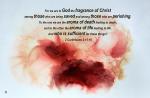
For we are a fragrance of Christ to God among those who are being saved and among those who are perishing: to the one an aroma from death to death, to the other an aroma from life to life. And who is adequate for these things? For we are not like the many, peddling the word of God, but as from sincerity, but as from God, we speak in Christ in the sight of God. (2 Corinthians 2:15-17).
(Reaching the Lost and Making Disciples for Jesus)
Family, Individual and Youth Discipleship and Development
Objectives: Reach the lost and gather the straying sheep, build up the Body of Christ, His Church.
We are to be built up into the priesthood of believers, commissioned and sent as missionaries and ambassadors of Christ, to
(# 1), the lost, and,
(# 2), the straying sheep of God, and
(# 3), for the building up of the Body of Christ.
(In other words, we need to tell and show the lost and remind the straying sheep of God, the Gospel message in word, by our behavior and deed. Then, to make disciples, teaching and training them to also become missionaries (disciple-makers) for Christ. By this we establish the Church (Ekklesia, the called out ones) within our Church Body.
Jesus taught that “Foxes have holes and Birds of the Air have nests”. He is saying that we are to go out and make disciples. We are not to retreat to the comfort and safety of our ‘fox dens’ or our ‘feathered nests’. He never advocated a stationary and static church, i.e., a “legacy type of church”.
Everything we do should point to making individuals, families (fathers, mothers and children) integral participants in Jesus’ Mission, in our local Body.
We must change what ‘coming to church’ or ‘attend church’ means. We come to Church in order to GO OUT from the Church to reach our community and world, and that is how we are to GROW!
To accomplish this, we probably need to consider reviewing or changing our attitude and paradigm of “coming to church”.
First of all, research shows that people come to church for specific reasons. And becoming an audience or an adherent is not on the list. But, they will leave if thier initial expectations are not met.
Here are the top 10 reasons given by Americans who attend religious services at least once a month, according to Pew. Survey. (For you information, respondents were allowed to give more than one reason.) The percentage refers to people who said this was a “very important” reason for their decision:
To become closer to God. (81%)
So their children will have a moral foundation. (69%)
To become a better person. (68%)
For comfort in times of trouble or sorrow. (66%)
They find the sermons valuable. (59%)
To be part of a faith community. (57%)
To continue their family’s religious traditions. (37%)
They feel a necessary obligation to go. (31%)
To meet new people or socialize. (19%)
Because the pastor knows my name. (added by author.)
People need to come to church to meet Jesus; to learn about Him, to come to know Him personally and intimately by the Word of God, and by our living example; they need to learn how to follow Him – which is both taught and caught, and learn to become fully devoted followers of Jesus. Then, they and we, together, GO and live out our relationship with Him let that be our witness! Go and order to Grow!
We need to understand the demographics and discover ways to become more visible and find UNIQUE ways to serve the community – and that boils down to being like Jesus and doing what He did and taught.
GO OUT with activities: Churches tend to hold ‘events’ in order to attract people to Church. So, we invite people to Chruch on a holiday or a speical occasion, maybe once very few months, hoping we will attract some to come back. But unless there is something to keep them coming back, (about 25% will come back a second time if everything goes just right), it’s a one-and-done matter.
It is God who draws people and saves them. We are simply His Hands, Feet and Voice. We go in His Name. But,
#1. We need “Meet them where they live”. We take the Church to them. It can no longer be “Come Grow With Us”. It has to be “Let’s GO and Grow in Christ Together”. Find ways to keep them coming back, every week.
Many church-growth programs actually pander to the community, so they attract those ‘already saved’ who are shopping churches. That is, I believe, why baptisms are so low. We aren’t reaching a lost world, we are reaching a saved and straying world!
We can continue to do what is working. PLUS, here are some EXAMPLES of IDEAS to go OUT and build:
(1). Build a youth soccer program – Soccer wrapped in the Gospel – A uniquely Christian approach – teach and coach joy, to be peacemakers, kind, good, patient, gentle, self-controlled, yet, proficient, competitive, hardworking, reaching for excellence. Imagine the (Concealed Name) Baptist Church Family Youth Soccer Program!
(Just FYI, I have had experience and qualifications as national youth license, 15 + years experience.
Area Demographics known. Here is an examples of another church doing these very things: Shepherds.Org.
(1.a). Pickleball is one of the fastest growing sports in America! Kids love it, Dads and Moms love it and if you try it, you will love it too! It is a perfect FAMILY activity! Build a Soccer Program wrapped in the Gospel – a uniquely Christian approach to this sport and influence our area for Christ!
This is a kid and family magnet. Imagine, the (Concealed Name) Baptist Church Family Pickleball Club!!
(And by the way, I have been a pickleball club director and I am currently rated as an advanced player and coach)
(1b.) Bible Quzzing is another exciting and fun ways to get our kids and teens into memorizing the Bible. This is an exciting activity with a purpose! You would be greatly suprised how fun this is and how much the kids love it!
Imagine the (Concealed Name) Baptist Church Quiz Team!! (And by the way, my wife has been a Quizzing coach and organizer when our kids were adolescents and teens).
(1c). Offering public neighborhood and citywide conferences on subjects such as
“Is The End Of The World A Possibility?” (Eschatology – End Times),
“Is Peace Possible in this crazy world – And How About Me and My Family?”,
“How Can I Know That God Really Exists – And How Does That Change Things for Me?”
Future planning: There is a plethora of other means and a multitude of ideas, but the main thing is that we build continuity into our Family, Teen and Children’s ministry. Something parents and kids will come back for, week after week, and not just a seasonal or occasional ‘one-and-done’ activity which repeats quarterly or annually.
ALL OF THESE THINGS, AND MORE, TO INFLUENCE AND REACH YOUR HOME AREA AND BEYOND FOR CHRIST!
(2) We must intentionally ADOPT our visitors and new members as “being part of our family”, from day ONE.
(a). Greeting our visitors and getting to know our new members in ways that make them feel at home, can be intimidating for our MEMBERS. So, perhaps we should hold classes and teach, help and train our MEMBERS the “HOW TO techniques and methods” on greeting, creating conversations and making our visitors feel at home and part of our Church Family. (Improve our ‘meet and greet the people around you’ only to go back to ‘sitting in our own little groups, staring forward and listening to the sermon after our greetings.)
(3). Coming to church AS A VISITOR can be uncomfortable, and even intimidating for most people. We must remember that our visitors are just that: visiting us. And we only get ONE CHANCE at making a FIRST IMPRESSION, and that it is a 25-70 deal at best. So, we must turn that around and make it about them. We need to let them know how important they are to us and to Jesus. We need to make them feel as if they are at home, and it is as if we are the visitors in their house! We have to change the paradigm.
(4). Perhaps we could form Parent-children mentoring (discipleship) sessions early in the visitation process or “new member’s class” process. For example: we begin meeting in special orientation sessions as a way to help them integrate.
(4a). Design short discussion games with parents and kids.
(4b). Separate into parent groups and youth groups. Teach from selected scriptures. Then, discuss achievements and needed improvement in behaviors, activities, family environments, etc., in light of selected scriptures.
Form and Technique: What is meant is that we must build the next generation by TRULY making disciples. I.e., “we must decrease in our influence so Jesus can increase through us and the others among us”. It means that we must teach, train, encourage and send; THEN we must begin to replace ourselves with THE NEXT GENERATION – on purpose!
We will be building a Family Ministry to young families and youth as part of the main Body here at (Concealed Name) Baptist Church, yet separate from the routine – think of it as a Missionary Church Plant WITHIN OUR OWN BODY!
Our focus must be on Jesus’ mission, calling, plan, methods and ways. We should minimize our own creativity. We must constantly be on mission, teaching, instructing, training and inspiring fathers, mothers and children to become mature as living examples, teaching, and training in righteousness, so that they, as servants of God are thoroughly equipped for every good work through the Spiritual Gifts God has granted each one for the building up of the Body: (also see Pastor Vern Collins, UMC Boone).
Lead them to Christ; disciple them in His Name, His calling, His mission, His purpose and His ways;
Lead them to become fully involved, inspired, excited, devoted followers of Jesus, and
Teach them to become disciple makers,
Executing Jesus’ mission, His plan, using His method for His purpose.
Then, send them. They, then, ARE the Church. “It is no longer ‘we four, and no more’”.
Encourage and assist them in building His Church (not ‘our church’), and sending His church out (not ‘our church’). WE MUST DECREASE SO HE, JESUS, CAN INCREASE.
We begin with those in our Church whom God has gifted to be disciple-makers. God has alredy Gifted and Equipped them. These will become our Church Planters (Family and Youth Ministry planters) within our Church. This will be and EXTENSION of our Body, new and separate, but fitted together with the Body.
God will provide the gifts and talents necessary, not only for our Church Planters but also for these new believers to – FROM DAY ONE – to become capable of leading the way forward!
God will provide the gifts and talents necessary, not only for our Church Planters but also for these new believers to – FROM DAY ONE – to become capable of leading the way forward! Please take a look at this list of Spiritual Gifts and the linked test below this list.
I am providing an example here, of how new believers become “fitted together with the Body” when establishing a Young Families and Youth Ministry by Planting a church within a Church. (see Boone UMC – Vern Collins link below). My son and his family were living in Boone, NC. Their pastor was a man named Vern Collins. I met him at my son and daughter-in-law’s house during a soccer related cookout. (My son and family were moving). Instead of leaving after the cookout, Vern stayed and helped them pack their moving van. Vern lives with and in Jesus’ Church body. They are his extended family. I visited their church after they moved and got to know Vern Collins just a little better. The Boone United Methodist church needed to attract and establish (grow) a youth group.
They started by building a group within the Church and ended up planting a new church INSIDE the existing Church and eventually they GREW TOGETHER and ‘co-mingled’. They are still doing that to this day! (Please view the LINK at the bottom of this page).:
We say that we are ambassadors for Christ which is just another way to say that we are missionaries for Christ. We are on mission, planting churches – first within our own Church Body, then OUTSIDE our walls in the future!
We say we are missionaries and ambassadors for Christ. So, let’s be that!
(And as an addition to my resume and experience: I have had decades experience working with youth, both in the church and outside the church).
Your Brother and Friend,
Mike Young (Pastor/Teacher/Evangelist/Church Planter).
Statistics show that we, the Church, are losing attendance, losing members, losing credibility, and we are losing the next generation to the world’s ways and beliefs. Some are dropping out from boredom, some from disappointment, others dont’ see the relevance. They are being influenced and trained by liberal and pagan social media outlets.
We have to engage them in Biblically sound and exciting ways. It has to be exciting, relevant, active, life challenging and life changing. It has to be the Gosple as Jesus taught it. People, families and kids want to be involved and not just an idle audience.
God is calling, and if we are willing, this is going to happen. We will be that “light of the world, a city set on a hill that cannot be hidden”.
Your pastor, brother and friend,
Mike Young
PS:
I would not be coming here to perpetuate a Legacy Church. I am called to do the will of God by following Jesus
By proclaiming and teaching His Message, His Methods and His Ways;
To execute His Plan by adopting and following his Purpose, Using His Methods.
I have no doubt in my mind that God is calling me, has commissioned and sent me to bring His Good News to the humble and afflicted;
That He has is sending me to bind up the wounds of the brokenhearted, and to release the mental, emotional, physical and spiritual captive from their confinement, condemnation and bondage and to set those prisoners free by the will and power of the Gospel of Jesus.
I am here to proclaim the favor of the LORD is to come upon this Church.
I am here to comfort all who mourn, to give them a new hope instead of living in the ashes of the past; I am bringing oil of gladness instead of mourning, and a cloak of praise instead of a disheartened spirit.
You would become known as oaks of righteousness, a planting of the LORD, that He may be glorified.
We will rebuild the ruins of the postmodern Church, and we will raise up and restore the former ways of Christ Jesus.
We will renew the ruined sanctuary of God, and the memory of the glories our God to this generation and this in this day.
Henceforth, people you haven’t known up until now, will come and will give to you freely, and they will become your laborers in God’s Work here.
You shall be called the priests of the LORD in this place; people will speak of you as the ministers of God.
You will enjoy a new health and new wealth.
Instead of our former embarrassments or shame we will share in a double portion of God’s Spiritual Blessings; And instead of past humiliation we will shout for joy over this new portion from God.
Everlasting joy will be ours – for those who will trust and follow God in all of His plans, purposes, methods and way.
Jesus Appears at the Sea of Galilee, Jesus Provides, The Love Question, Our Times are in His Hand.
It would seem that Jesus’ earthly ministry is coming to a close, but in reality, it is just beginning. The disciples have been taught in the ways of the Master and soon they will be sent to perpetuate the work of the Father, at the command and under the unction of the Son. They will be instructed to make disciples by the authority of Jesus Christ and through the filling of the Holy Spirit the entire world will experience the explosion of the Gospel across the globe – and nothing will ever be the same.
You don’t want to miss this, and you don’t want to miss out on this. Listen. Become a follower of Jesus and experience the most meaningful and amazing adventure of your life. There will be no spectators in heaven – only the participants will rise with Him in the end.
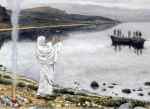
Jesus Appears at the Sea of Galilee
John 21:1,After these things Jesus revealed Himself again to the disciples atthe Sea of Tiberias, and He revealed Himself in this way: verse 2, Simon Peter, Thomas who was called Didymus, Nathanael of Cana in Galilee, the sons of Zebedee, and two others of His disciples were together. Verse 3. Simon Peter said to them, “I am going fishing.” They said to him, “We are also coming with you.” They went out and got into the boat; and that night they caught nothing.
Verse 4. But when the day was now breaking, Jesus stood on the beach; yet the disciples did not know that it was Jesus. Verse 5. So, Jesus said to them, “Children, you do not have any fish to eat, do you?” They answered Him, “No.” Verse 6. And He said to them, “Cast the net on the right-hand side of the boat, and you will find the fish.” So, they cast it, and then they were not able to haul it in because of the great quantity of fish. Verse 7. Therefore, that disciple whom Jesus loved said to Peter, “It is the Lord!” So, when Simon Peter heard that it was the Lord, he put on his outer garment (for he was stripped for work), and threw himself into the sea. Verse 8. But the other disciples came in the little boat, for they were not far from the land, but about one hundred yards away, dragging the net full of fish.
(Commentary Break): The personalities and the souls – the heartfelt emotional state of these disciples – is on full display here. It would seem that Peter, in resignation or just simple emotional exhaustion, decides to return to his former occupation of fishing. “I am going fishing.” The others with him said, ‘We are also coming with you.’ They went out and got into the boat; and that night they caught nothing.” You should be able to feel the forlorn resignation and the sense of failure, “and that night they caught nothing. But then – the day was now breaking – Jesus was standing.” Listen dear friends, it is not a stretch to say that when things are the darkest and all seems to have ended in failure, with Jesus the dawn is always breaking!
“So, Jesus said to them, ‘Children, you do not have any fish to eat, do you?’” It is so telling that Jesus calls these men, “children” (or “paidion” in the Greek). Jesus is referring to them as “half grown boys”, which they were by age, and “immature Christians”, which was also true. Such a sight that the Lord would endear Himself to these boys-soon-to-be-men in such a way.
Jesus states the obvious “you do not have any fish to eat, to you?” And instructs them to cast the net on the right-hand side of the boat, saying, “and you will find the fish.” So, they did as He said, and then they were not able to haul it in because of the great quantity of fish. Therefore, that disciple whom Jesus loved said to Peter, “It is the Lord!” And in the same way that Mary Magdalene did not immediately recognize the risen Christ, now they knew. And Peter, impetuous Peter, dives into the water and swims to the beach while the other bring the boat, dragging their haul of fish with them.
Such a picture of the soon-to-be Church. (End Commentary Break).
Verse 9. So, when they got out on the land, they saw a charcoal fire already made and fish placed on it, and bread. Verse 10. Jesus said to them, “Bring some of the fish which you have now caught.” Verse 11. So, Simon Peter went up and hauled the net to land, full of large fish, and although there were so many, the net was not torn.
Jesus Provides
Verse 12. Jesus said to them, “Come and have breakfast.” None of the disciples ventured to inquire of Him, “Who are You?” knowing that it was the Lord. Verse 13. Jesus came and took the bread and gave it to them, and the fish likewise. Verse 14. This was now the third time that Jesus revealed Himself to the disciples, after He was raised from the dead.
(Commentary Break): Jesus, the Lord, Priest, King and provider. All things were already set in place – a charcoal fire already made and fish placed on it, and bread – a foreshadowing of the things to come – “Go, therefore, and make disciples of all the nations, baptizing them in the name of the Father and the Son and the Holy Spirit, teaching them to follow all that I commanded you; and behold, I am with you always, to the end of the age.” (see Matthew 28:19-20) Please, dear friends, hold onto these things as you go and do these works that He has prepared ahead of time for you to walk in. He has all authority and He is always with you. (End Commentary Break).
The Love Question
Verse 15. Now when they had finished breakfast, Jesus said to Simon Peter, “Simon, son of John, do you love Me more than these?” He said to Him, “Yes, Lord; You know that I love You.” He said to him, “Tend My lambs.” Verse 16. He said to him again, a second time, “Simon, son of John, do you love Me?” He said to Him, “Yes, Lord; You know that I love You.” He said to him, “Shepherd My sheep.” Verse 17. He said to him the third time, “Simon, son of John, do you love Me?” Peter was hurt because He said to him the third time, “Do you love Me?” And he said to Him, “Lord, You know all things; You know that I love You.” Jesus said to him, “Tend My sheep.
(Commentary Break): This account of Jesus questioning Peter’s love is not just for our reading pleasure or for our entertainment. It is not idle information.
Jesus addresses Peter directly, indicating a personal and intimate conversation. This is significant as Peter had previously denied Jesus three times. The use of Peter’s original name, Simon, may suggest a return to foundational identity and calling.
Just days earlier, Peter had denied Jesus three times. Now, after the resurrection, Jesus publicly restores him. Three times Jesus asks, “Do you love Me?” Three times Peter answers, “Yes, Lord, You know that I love You.”
Three times Jesus responds with a commission: “Feed My lambs”, “Tend My sheep”, “Feed My sheep.” The threefold questioning mirrors Peter’s three denials — this is deliberate and deeply symbolic.
In Greek, two different words for love are used: Agapē / agapaō – sacrificial, unconditional love; Phileō – brotherly affection, friendship love.
The pattern: The first time Jesus asks: “Do you agapāō Me?”. Peter replies “I phileō You.” The second time Jesus asks, “Do you agapāō Me?”; and the second time Peter replies “I phileō You.”
So, the third time Jesus changes the wording to reflect Peter’s response, “Do you phileō Me?”; and Peter says, “Lord, You know everything; You know that I phileō You.”
Many interpreters see this as Jesus calling Peter to the highest form of love and Peter responding humbly, aware of his recent failure. So, Jesus meets Peter where he is on the third question.
It is with all of us, as it was with Peter, Jesus meets us where we are, even in our deepest moments. He reveals to us and causes us to see our true intentions.
None-the-less, each affirmation of love is followed by responsibility: “Feed My lambs”, “Tend My sheep”, and, “Feed My sheep”. This passage restores to Biblical servanthood and prepares for future roles in His church.
(Please note: This is meant for each and every Christian and not just for those we incorrectly and errantly call “leaders”. Each of us have a role, a calling, gifts of service, and besides, Jesus said, “do not be called ‘leaders’ for only One is your leader, that is Christ” (see Matthew 23:10).
No matter what your calling, gifting or office in service to Jesus and His Church, His question and His command remains the same: “Do you agapāō Me?” “Feed and tend My sheep”. Ours is to love one another and it is through this that the world will know that we are His disciples – through our service of teaching, protecting, guiding, nourishing and loving one another.
Peter denied Jesus publicly. We all run risk of denying Jesus in many ways.
Jesus will restore the repentant – publicly. Failure is not final when there is repentance.
Jesus does not ask, “Are you brave?, are you loyal, or are you gifted?” He asks: “Do you love Me?” Love for Christ is the qualification for serving Him, His Church and for shepherding His people.
John 21:15–17 teaches:
Christ restores fallen believers.
Service flows from love for Christ.
Loving, serving and shepherding God’s people is sacred stewardship.
Past failure does not disqualify a repentant servant.
(End Commentary Break).
Our Times Are in His Hand
Verse 18. Truly, truly I tell you, when you were younger, you used to put on your belt and walk wherever you wanted; but when you grow old, you will stretch out your hands and someone else will put your belt on you, and bring you where you do not want to go.” Verse 19. Now He said this, indicating by what kind of death he would glorify God. And when He had said this, He said to him, “Follow Me!”
(Commentary Break): The phrase “stretch out your hands” is often interpreted as a metaphor for crucifixion, a form of execution that was common in the Roman Empire. This imagery foreshadows Peter’s martyrdom, as tradition holds that he was crucified in Rome.
Jesus has told us that we must ‘crucify the flesh’ and ‘die to self’ in order to follow Him. The stretching out of hands can also symbolize submission and vulnerability. Theologically, it reflects the cost of discipleship and the ultimate surrender to God’s will, even unto death. This prophecy is fulfilled in the tradition that Peter was martyred for his faith, highlighting the theme of sacrifice and commitment in following Christ. (End Commentary Break).
Verse 20. Peter turned around and saw the disciple whom Jesus loved following them—the one who also had leaned back on His chest at the supper and said, “Lord, who is the one who is betraying You?” Verse 21. So, Peter, upon seeing him, said to Jesus, “Lord, and what about this man?” Verse 22. Jesus said to him, “If I want him to remain until I come, what is that to you? You follow Me!” Verse 23. Therefore, this account went out among the brothers, that that disciple would not die; yet Jesus did not say to him that he would not die, but only, “If I want him to remain until I come, what is that to you?”
(Commentary Break): The question “what about him?” suggests Peter’s curios interest in the fate of John, possibly in light of Jesus’ earlier prophecy about Peter’s own future martyrdom. This moment emphasizes the theme of individual callings and destinies within the Christian faith, as Jesus’ response will focus on the importance of following Him regardless of others’ paths. This interaction also serves as a reminder of the unique roles each disciple plays in the unfolding of God’s plan, echoing the diverse gifts and callings mentioned in 1 Corinthians 12. (End Commentary Break).
Verse 24. This is the disciple who is testifying about these things and wrote these things, and we know that his testimony is true.
Verse 25. But there are also many other things which Jesus did, which, if they were written in detail, I expect that even the world itself would not contain the books that would be written. (End Chapter 21 – End the Book of John).
John aptly closes this writing saying, “This is the disciple who is testifying about these things and wrote these things, and we know that his testimony is true”. This is not hearsay, but a first-hand account of these matters.
Jesus’ earthly ministry is coming to a close. Luke 24:50-53 and Acts 1:9-11, give us the primary account of Jesus’ ascension and what follows, Jesus says, “Truly, truly I say to you, the one who believes in Me, the works that I do, he will do also; and greaterworks than these he will do; because I am going to the Father”. (see John 14:12). So, it begins – the greater works of Christ – the world turned upside down – the beginning of the End is at hand.
The Empty Tomb, Jesus Among His Disciples, Why This Gospel Was Written
The accounts recorded in this chapter, specifically the resurrection of Jesus from the dead, have been called the most pivotally important event in all of Christianity. Without it, Christianity collapses; with it everything stands.
Paul makes this explicit in 1 Corinthians 15:7, “If Christ is not risen, your faith is futile; you are still in your sins.”
If Jesus did not rise: The cross failed, sin is not conquered, death still reigns, there is no justification. Christianity would not just be weakened — it would be false.
The resurrection is God’s public declaration that the sacrifice of Jesus was accepted, the cost of sin was paid in full and death was defeated.
With the resurrection, the cross becomes victory. It is the first fruits of the coming resurrection of all believers. (1 Corinthians 15:20).
As Jesus Christ rose bodily, so believers will rise bodily. No resurrection, no rapture. No resurrection, no kingdom. No resurrection, no new creation.
Christianity does not stand primarily on ethics. It does not stand primarily on teachings. It does not stand primarily on prophecy. It stands on an empty tomb.
If Christ is risen, everything changes. If Christ is not risen, nothing else matters.
The Empty Tomb
John 20:1, Now on the first day of the week Mary Magdalene came early to the tomb, while it was still dark, and saw the stone already removed from the tomb. Verse 2. So she ran and came to Simon Peter and to the other disciple whom Jesus loved, and said to them, “They have taken the Lord from the tomb, and we do not know where they have put Him.” Verse 3. So, Peter and the other disciple left, and they were going to the tomb. Verse 4. The two were running together; and the other disciple ran ahead, faster than Peter, and came to the tomb first; verse 5, and he stooped to look in, and saw the linen wrappings lying there; however he did not go in. Verse 6. So Simon Peter also came, following him, and he entered the tomb; and he looked at the linen wrappings lying there, verse 7, and the face-cloth which had been on His head, not lying with the linen wrappings but folded up in a place by itself. Verse 8. So the other disciple who had first come to the tomb also entered then, and he saw and believed. Verse 9. For they did not yet understand the Scripture, that He must rise from the dead. Verse 10. So the disciples went away again to their own homes.
(Commentary Break): If the Apostle John is writing this account of events, the perhaps the question comes up as to how does he know the specifics surrounding and following Jesus’ resurrection if he arrived at the tomb after Mary Magdalene and leaves for his home shortly after seeing the empty tomb? It is reasonable to assume that John gathered the information from others present at the scene and those who saw Jesus after He left the tomb. Secondly, these events display and confirm what Jesus has been telling His disciples would happen. Nonetheless, these events are so fantastic, so stupendous, as to be almost unbelievable even to the most dedicated and ardent follower of Jesus – even to this day. Yet, these events are no less important than the virgin birth of Jesus as the Christ. On these events hang the proving and the veracity of your faith. (End Commentary Break).
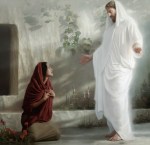
Verse 11. But Mary was standing outside the tomb, weeping; so, as she wept, she stooped to look into the tomb; verse 12, and she saw two angels in white sitting, one at the head and one at the feet, where the body of Jesus had been lying. Verse 13. And they said to her, “Woman, why are you weeping?” She said to them, “Because they have taken away my Lord, and I do not know where they put Him.” Verse 14. When she had said this, she turned around and saw Jesus standing there, and yet she did not know that it was Jesus. Verse 15. Jesus said to her, “Woman, why are you weeping? Whom are you seeking?” Thinking that He was the gardener, she said to Him, “Sir, if you have carried Him away, tell me where you put Him, and I will take Him away.” Verse 16. Jesus said to her, “Mary!” She turned and said to Him in Hebrew, “Rabboni!” (which means, Teacher). Verse 17. Jesus said to her, “Stop clinging to Me, for I have not yet ascended to the Father; but go to My brothers and say to them, ‘I am ascending to My Father and your Father, and My God and your God.’” Verse 18. Mary Magdalene came and announced to the disciples, “I have seen the Lord,” and that He had said these things to her.
(Commentary Break): Verses 11 through 18 are easy enough to read but far from easy to understand their meaning, implication and application. Remember that the Words of Scriptures are the Breathed Words of God – breathed into men by way of the Holy Spirit so as to inspire them to record them as the inerrant Truth of God. (2 Timothy 3:16).
First Mary encounters two angels, messengers of God, at a very emotionally intense moment. Then, suddenly she is face-to-face with Jesus “and yet she did not know that it was Jesus”. How could this have been? Many commentaries speculate that it may have been her emotional state, or perhaps she could not see Him clearly because of the early morning light, or perhaps a divine veiling of her perception. However, if we look deeper at the deeper meaning of the Greek language used here we see: (1), “she turned around and saw Jesus standing there” – “theóreó”,means she could see as a “spectator” or look on in order to try to speculate or to discern. Simply, her “mind’s eye” saw Him but did not recognize Him as Who He was in His Glorified Body.
(2), After Jesus identified Himself, she went and found the disciples and exclaimed to them, “I have seen the Lord” – “horaó”, meaning to perceive, to discern clearly, physically and mentally. Interestingly, this is spoken in the Aorist tense, which means she now sees Him as He was, as He is now and will always – for all times – see Him for Who He Is!
(3), Once the “eyes of our heart are enlightened” as it was with Mary, “you (and I) will know Him, and we will come to know what is the hope of His calling and what are the riches of His glory”. (Ephesians 1:18).
At first, Mary was an emotionally distraught spectator of life – distraught by what might have been – just as we all are or have been. Then she is confronted with the message of God, the Good News, which is truly being confronted with the Living Christ. This, too, is our opportunity; to go from being a spectator to being confronted with the Good News of God and by the Only One True and Living God. She then believed. She believed in the Risen Christ and ran to tell others of her great discovery and of this exceedingly Good News – which is what each and every true believer in Jesus will do. This is the initial sign of having been saved by God’s grace through our faith in Christ Jesus and His completed work on the cross. (End Commentary Break).
Jesus among His Disciples
Verse 19. Now when it was evening on that day, the first day of the week, and when the doors were shut where the disciples were together due to fear of the Jews, Jesus came and stood in their midst, and said to them, “Peace be to you.” Verse 20. And when He had said this, He showed them both His hands and His side. The disciples then rejoiced when they saw the Lord. Verse 21. So, Jesus said to them again, “Peace be to you; just as the Father has sent Me, I also send you.” Verse 22. And when He had said this, He breathed on them and said to them, “Receive the Holy Spirit. Verse 23. If you forgive the sins of any, their sins have been forgiven them; if you retain the sins of any, they have been retained.”
(Commentary Break): The drama of this moment is heightened as the doors were shut and the disciples were gathered together in fear of the Jews – huddled together, full of fear, (phobos – dread, exceeding terror) wondering, doubting and withdrawn from the world around them. The, suddenly in their midst stands Jesus speaking as He had spoken to the waves of the tumultuous and threatening seas, “Peace to you”. And just as the seas heard His Command and obeyed, the disciples, too, would soon be transformed by these words from frightened boy into galvanized warriors of the Cross!
Then He, Jesus, breathed on them and said “Receive the Holy Spirit” and with this act they were being filled with courage, the Word of God, the gifts of the Spirit of God and the power to go and make disciples. There are teachings going about that say being filled by and with the Holy Spirit is a “separate act of grace”, or a “second act of grace” or that you receive the Holy Spirit at salvation and the gifts and power of the Holy Spirit later. That might appear the case to some. But these very verses, when read at face-value and in context of the rest of scriptures, you see that when you come to Jesus. submit to Him and follow Him in faithful obedience, He will breathe the Holy Spirit into your life also. There is no such thing as a true believer and disciple of Jesus who is not filled with the Holy Spirit of God, and all of this comes at the moment you are saved and only when you give your life away, as did the disciples, and follow Him in faith. (You will be sharpened in your faith and the application of the gifts of the Spirit.
Verses like 2 Timothy 1:6 remind us to “fan into flame the gift of God,” while Romans 12:6-8 emphasizes using our different gifts according to the grace given to us, showing that growth and service are integral to our faith journey, and Proverbs 27:17 reminds us that “as iron sharpens iron, so one man sharpens another”. But always, it is Jesus Who does His works through us.“
Verse 24. But Thomas, one of the twelve, who was called Didymus, was not with them when Jesus came. Verse 25. So the other disciples were saying to him, “We have seen the Lord!” But he said to them, “Unless I see in His hands the imprint of the nails, and put my finger into the place of the nails, and put my hand into His side, I will not believe.”
Verse 26. Eight days later His disciples were again inside, and Thomas was with them. Jesus came, the doors having been shut, and stood in their midst and said, “Peace be to you.” Verse 27. Then He said to Thomas, “Place your finger here, and see My hands; and take your hand and put it into My side; and do not continue in disbelief, but be a believer.” Verse 28. Thomas answered and said to Him, “My Lord and my God!” Verse 29. Jesus said to him, “Because you have seen Me, have you now believed? Blessed are they who did not see, and yet believed.”
(Commentary Break): Jesus had appeared to the other disciples and breathed on them. Now, Jesus the patient Shepherd, comes back for one of His sheep who was wandering in disbelief. Thomas proclaims, “My Lord and my God!”, and Jesus reminds all of us, “Blessed are they who did not see me and yet believed.” I suppose we could read all sorts of things into His statement. First,ß Since Thomas was not present when Jesus had breathed on the other disciples, had he received the Holy Spirit? Considering that after the resurrection and ascension, the disciples (now including Thomas) were gathered together in Acts of the Apostles 1–2. At Acts of the Apostles 2:1–4, the Holy Spirit came powerfully at Pentecost: “They were all filled with the Holy Spirit”, and since
Thomas is listed among the apostles in Acts 1:13, meaning he was present when the Spirit was poured out, the answer is yes. Secondly, Thomas’s belief is based on physical evidence, as he had insisted on seeing and touching Jesus’ wounds to believe in His resurrection. This reflects a common human tendency to rely on empirical evidence. The statement underscores the importance of faith, contrasting belief based on sight with belief based on trust in Jesus’ words and promises. This pronouncement extends beyond Thomas to future generations of believers who would come to faith without physical evidence of Jesus’ resurrection. It emphasizes the blessedness of faith that does not rely on sight, aligning with Hebrews 11:1, which defines faith as confidence in what we hope for and assurance about what we do not see. This blessing is a promise of spiritual reward and assurance for believers throughout history. It seems, Thomas was used as an example for future believers. (End Commentary Break).
Why This Gospel Was Written
Verse 30. So then, many other signs Jesus also performed in the presence of the disciples, which are not written in this book; verse 31, but these have been written so that you may believe that Jesus is the Christ, the Son of God; and that by believing you may have life in His name. (End Chapter 20).
Jesus was fully man and fully God and the final verses of chapter 20 says as much. What was recorded by the disciples and the Apostles and is now canonized as our Bible, apparently were just a sampling, albeit among the most important and most salient signs and works of Jesus, “but these have been written so that you may believe that Jesus is the Christ, the Son of God (verse 31); and we will see in the next chapter that “there are also many other things which Jesus did, which, if they were written in detail, I suspect that even the world itself would not contain the books that would be written”.
Let’s believe that we may have the abundant life on found in Jesus; vibrant, effervescent, full of purpose and promise; a life worth living!
Humankind, from their first appearance in the Bible, have sinned from their fallen nature. They have always been savage-minded, undisciplined and selfish, from the Garden of Eden through the creation of the Jewish nation until this day.
Scriptures warn us that “sin is crouching at your door and its desire is to have you”, and for us to “Be of sober spirit, be on the alert. Your adversary, the devil, prowls around like a roaring lion, seeking someone to devour.”
We will see (and experience) in this book and chapter the inherent evil of humankind. Mankind putting his himself and his self-centered thoughts and desires above the Thoughts, Plans and Desires of the One True and Good God.
(If this book and chapter was subject to modern book and movie rating warnings, it would be classified as “M.A.”, mature audiences only, due to its graphic nature of violence.)
All of that said, and despite the insanely cruel violence, God had decreed that these things must come to pass in order to redeem humankind from their wild barbarism and self-destruction, to tame them and reconcile them to Himself.
God has provided for mankind even in his and her rebellion toward Him, from the beginning. And each time there has been a price to pay in blood. God provided clothing for Adam and Eve when they were sent out of the Garden of Eden, and animals had to die to provide that clothing. The Jewish laws provided that justice was found through “an eye for an eye, tooth for tooth, hand for hand, foot for foot”, even a death for a death, as a means of proportional justice, meaning that the punishment should match the offense – and was often exacted in blood the resulted in conflict, wars and death. As a result the Jewish law provided a way to soothe the conscience of the consequential sense of guilt and shame by the sacrificial blood of bulls and goats. This would temporarily assuage and relieve the conscience (i.e., sins were covered), but needed to be repeated.
Finally, God provided an end to blood sacrifices by supreme sacrifice of His Son to permanently wipe away the stain and negate the power and penalty of sin. Here is that cosmic event:
The Crown of Thorns
John 18:1,So Pilate then took Jesus and had Him flogged. Verse 2. And the soldiers twisted together a crown of thorns and placed it on His head, and put a purple cloak on Him; verse 3, and they repeatedly came up to Him and said, “Hail, King of the Jews!” and slapped Him in the face again and again. Verse 4. And then Pilate came out again and said to them, “See, I am bringing Him out to you so that you will know that I find no grounds at all for charges in His case.” Verse 5. Jesus then came out, wearing the crown of thorns and the purple robe. And Pilate said to them, “Behold, the Man!” Verse 6. So when the chief priests and the officers saw Him, they shouted, saying, “Crucify, crucify!” Pilate said to them, “Take Him yourselves and crucify Him; for I find no grounds for charges in His case!” Verse 7. The Jews answered him, “We have a law, and by that law He ought to die, because He made Himself out to be the Son of God!”
Verse 8. Therefore when Pilate heard this statement, he was even more afraid; verse 9, and he entered the Praetorium again and said to Jesus, “Where are You from?” But Jesus gave him no answer. Verse 10. So Pilate said to Him, “Are you not speaking to me? Do You not know that I have authority to release You, and I have authority to crucify You?” Verse 11. Jesus answered him, “You would have no authority over Me at all, if it had not been given to you from above; for this reason the one who handed Me over to you has the greater sin.” Verse 12. As a result of this, Pilate made efforts to release Him; but the Jews shouted, saying, “If you release this Man, you are not a friend of Caesar; everyone who makes himself out to be a king opposes Caesar!”
Verse 13. Therefore when Pilate heard these words, he brought Jesus out, and sat down on the judgment seat at a place called The Pavement—but in Hebrew, Gabbatha. Verse 14. Now it was the day of preparation for the Passover; it was about the sixth hour. And he said to the Jews, “Look, your King!” Verse 15. So they shouted, “Away with Him, away with Him, crucify Him!” Pilate said to them, “Shall I crucify your King?” The chief priests answered, “We have no king except Caesar.”
The Crucifixion
Verse 16. So he then handed Him over to them to be crucified. Verse 17. They took Jesus, therefore, and He went out, carrying His own cross, to the place called the Place of a Skull, which in Hebrew is called, Golgotha. Verse 18. There they crucified Him, and with Him two other men, one on either side, and Jesus in between. Verse 19. Now Pilate also wrote an inscription and put it on the cross. It was written: “JESUS THE NAZARENE, THE KING OF THE JEWS.” Verse 20. Therefore many of the Jews read this inscription, because the place where Jesus was crucified was near the city; and it was written in Hebrew, Latin, and in Greek. Verse 21. So the chief priests of the Jews were saying to Pilate, “Do not write, ‘The King of the Jews’; rather, write that He said, ‘I am King of the Jews.’” Verse 22. Pilate answered, “What I have written, I have written.”
Verse 23. Then the soldiers, when they had crucified Jesus, took His outer garments and made four parts: a part to each soldier, and the tunic also; but the tunic was seamless, woven in one piece. Verse 24. So they said to one another, “Let’s not tear it, but cast lots for it, to decide whose it shall be.” This happened so that the Scripture would be fulfilled: “THEY DIVIDED MY GARMENTS AMONG THEMSELVES, AND THEY CAST LOTS FOR MY CLOTHING.” Therefore the soldiers did these things.
Verse 25. Now beside the cross of Jesus stood His mother, His mother’s sister, Mary the wife of Clopas, and Mary Magdalene. Verse 26. So when Jesus saw His mother, and the disciple whom He loved standing nearby, He said to His mother, “Woman, behold, your son!” Verse 27. Then He said to the disciple, “Behold, your mother!” And from that hour the disciple took her into his own household.
Verse 28. After this, Jesus, knowing that all things had already been accomplished, in order that the Scripture would be fulfilled, said, “I am thirsty.” Verse 29. A jar full of sour wine was standing there; so they put a sponge full of the sour wine on a branch of hyssop and brought it up to His mouth. Verse 30. Therefore when Jesus had received the sour wine, He said, “It is finished!” And He bowed His head and gave up His spirit.
Care of the Body of Jesus
Verse 31. Now then, since it was the day of preparation, to prevent the bodies from remaining on the cross on the Sabbath (for that Sabbath was a high day), the Jews requested of Pilate that their legs be broken, and the bodies be taken away. Verse 32. So the soldiers came and broke the legs of the first man, and of the other who was crucified with Him; Verse 33. but after they came to Jesus, when they saw that He was already dead, they did not break His legs. Verse 34. Yet one of the soldiers pierced His side with a spear, and immediately blood and water came out. Verse 35. And he who has seen has testified, and his testimony is true; and he knows that he is telling the truth, so that you also may believe. Verse 36. For these things took place so that the Scripture would be fulfilled: “NOT A BONE OF HIM SHALL BE BROKEN.” Verse 37. And again another Scripture says, “THEY WILL LOOK AT HIM WHOM THEY PIERCED.”
(Commentary Break): It is one thing to get an account of an event or of events from hearsay or third-party accounts, but this is a first-hand, eyewitness account of these events. So, the Apostle John gives his oath as to the truth and accuracy of these events – “so you also may believe”. (End Commentary Break).
Verse 38. Now after these things Joseph of Arimathea, being a disciple of Jesus, but a secret one for fear of the Jews, requested of Pilate that he might take away the body of Jesus; and Pilate granted permission. So he came and took away His body. Verse 39. Nicodemus, who had first come to Him by night, also came, bringing a mixture of myrrh and aloes, about a hundred litras weight.
(Commentary Break): It seems odd to this author to be named as a “secret disciple” such as Joseph of Arimathea, or as one “who had first come to Jesus by night” (out of fear for loss of position, reputation or status. And like so many other names who might appear once in the Bible, are not heard from again. Their moment was fleeting. But the question remains, were they saved? Did a simple encounter with Jesus result in their salvation, or were they like the “moth would fly around a flame”- and in this case, the Light of God. Drawn but never committed? Rather than have to speculate, it is best to be certain, “for men.(and women) will come to Him in that day and say, ‘did I not prophesy in Your Name and in Your name cast out demons, and in Your Name perform many miracles?’ And then I will declare to them, ‘I never knew you; depart from Me, you who practice lawlessness’”. We must, as Jesus commanded, pick up our cross and follow Him. (End Commentary Break).
Verse 40. So they took the body of Jesus and bound it in linen wrappings with the spices, as is the burial custom of the Jews. Verse 41. Now in the place where He was crucified there was a garden, and in the garden was a new tomb in which no one had yet been laid. Verse 42. Therefore because of the Jewish day of preparation, since the tomb was nearby, they laid Jesus there. (End of chapter 19).
Following Jesus means will draw close to Him, as to be looking over His shoulder, watching His every move so we can be like Him. And we will be seen with Him and will be identified with Him. People will likely know that you have been with Him. So, when we follow Jesus we may and most certainly will encounter criticisms, persecutions, trials, stresses and tribulations. We may suffer losses in this world from being His disciple. But in those costs, we will gain an unspeakable joy, an unconditional love and a peace that will surpass this world’s understanding. We will have gained an eternal safety, and a spiritual health that cannot be diminished or taken from us. We will be made whole and into the perfect image of Christ, living in His presence for all eternity. Yes. It is worth the cost a thousand times over!
PS: As I have said on many occasions, the “Commentary Breaks” on these pages and on most of the commentary-oriented studies I write, are not always designed as nor are they meant to be just an exegetical analysis or a critical explanation of the text, for I provide links to sources such as GotQuestions.Org and BibleHub.com. These pages and “Commentary Breaks” are meant to ask the questions “what does it say; why was it said or done; what does it mean; and what does it mean to me – i.e., what am I to do in response?” This is an inductive study method, which focuses on observation, interpretation, and application of Scripture. This approach encourages readers to engage deeply with the text, allowing it to reveal its own meaning through careful analysis and personal reflection.
But first, let me ask “Why and how do you read the Bible?”
Do you read it as one would read a novel; looking for interesting stories, mysteries? Or do you read it as a self-help book, looking for moral and ethical lessons? Or perhaps you read the Bible as a “How To” book, looking for instructions on how to pray, how to be saved, how to witness, how to be a better person, how to receive from God?
But what if you read the Bible as if it were factually true? I mean, not only without error, but literally true and factually accurate in ways we fail to recognize? What if the Bible is truly a gateway to an unseen (Spiritual) realm from which all things originate? A place where you can have peace in the midst of the tribulations of this physical world, knowing for certain that “He who dwells in you has overcome this world”?
Jesus was fully human and fully divine – fully God. He could and did experience all the feelings and emotions of humankind, but without sin. And still, He is fully God. And He – God – came to this world for you, to show you the way to an abundant and an eternal life, in heaven with God. Just imagine:
Revelation 22:1, And he showed me a river of the water of life, clear as crystal, coming from the throne of God and of the Lamb (Jesus), verse 2, in the middle of its street. On either side of the river was the tree of life, bearing twelve kinds of fruit, yielding its fruit every month; and the leaves of the tree were for the healing of the nations. Verse 3. There will no longer be any curse; and the throne of God and of the Lamb will be in it, and His bond-servants will serve Him; verse 4, they will see His face, and His name will be on their foreheads. Verse 5. And there will no longer be any night; and they will not have need of the light of a lamp nor the light of the sun, because the Lord God will illuminate them; and they will reign forever and ever. And Jesus is the only way and the only One Who is able to keep this promise and to lead us to safety.
The Bible gives us examples of how God may come to us in the most unlikely of places at the most unexpected times and yet speak to us in the most relatable of ways to bring us to the most amazing of all Truth.
How is it possible that you could experience such wonders? It is by faith.
You see, the Bible says that God is able to do all things and that He is sovereign, omnipotent, omniscient and omnipresent and that He has a divine purpose and plan. His plan to find you, bring you back to Himself and give you an eternal home with Him, through His Son, Jesus. (see Luke 19:10).
Let’s look at just one such example found in the book of John, chapter 4, verses 1 through 46.
John 4:1,So then, when the Lord knew that the Pharisees had heard that He was making and baptizing more disciples than John, verse 2, (although Jesus Himself was not baptizing; rather, His disciples were), verse 3, He left Judea and went away again to Galilee.
(Commentary Break): This event or narrative of these verses is often repeated as a ‘story’ about Jesus and the woman at the well in order to observe and to muse about the historical religious significance of the site, insights of Jesus Words to this woman at the well. But little is said about the reason why Jesus followed the route he took, or why He stopped at the well, except that He was tired from His long journey. Let’s step back and look at the larger picture and consider that there is a ‘backstory’ or a larger mission.
It is all by design. There is nothing that humanly happens in this life that is not both divinely decreed and intersected by human free will. The possibilities, mathematically speaking, are humanly incalculable. The Bible says God is sovereign, omnipotent, omniscient and omnipresent. As such, He is never anyplace at any time without a divine purpose and plan. God sees and knows each and every possibility and the outcomes all at once and “His Will is done, on this earth even as it is in heaven”.
Therefore, as it says in verse 1, “the Lord knew”, so He left Judea and went away again to Galilee; (on purpose and with a purpose). Why did He leave at this time? Was it because He knew that because His influence was surpassing that of John the Baptist the Pharisees had taken notice and this was not the time for a confrontation with the Pharisees? Perhaps. But there is a greater reason and cause at hand.
Please remember that Jesus is on earth – He, in fact, has been sent to earth by The Father – to do the will of His Father. Jesus has said in many ways and at many times that He is on a schedule, His time is valuable and is limited because He has a Mission to accomplish – “to seek and save the lost” and “I seek not my own will, but the will of my Father who sent Me”, and “For even the Son of Man did not come to be served, but to serve, and to give His life as a ransom for many.”
So then, when the Lord knew (ginosko, from the Greek language, – a deep, complete, penetrating, intimate and perceptive knowledge), in the aorist tense – i.e., He knew beforehand, He knows presently and He will always know),
He leftJudea (aphiēmi, from the Greek language,– left, abandoned, mission there was finished), in the aorist tense – i.e., He knew He would be leaving, He is certain the time had come, He would never doubt it), and He
Went away(aperchomai – to depart in of an evanescent state of things – vanishing as a vapor, imperceptible),
Again(palin – through the idea of oscillatory repetition; a renewal or repetition of the action).
to Galilee (Galiloea – A circle of gentiles or ‘the heathen circle’, a region of Palestine).
Jesus was ‘invading’ the heart of ‘the heathen circle’. Let’s step back to Matthew 4:12-16 and see a broader view and that the importance of Galilee is that this is the place, when Jesus heard that John had been taken into custody, He withdrew into Galilee;This happened so that what was spoken through Isaiah the prophet would be fulfilled:
“The land of Zebulun and the land of Naphtali, By the way of the sea, on the other side of the Jordan, Galilee of the Gentiles—The people who were sitting in darkness saw a great Light, And those who were sitting in the land and shadow of death, Upon them a Light dawned.”
Genesis 1:1 tells us that God said “let there be light”; and the Words of God in Matthew 4:16 are no less significant, no less creative and no less prophetic that those from Genesis 1.
Then In Matthew 4 verse 17 we read, “From that time Jesus began to preach and say, “Repent, for the kingdom of heaven is at hand.”
In Matthew 4:17, the Bible tells us, FIRST that “From that time” what time is this? This can be considered as one of the most important historical time markers in the Bible – it is a line of demarcation.
This is the point Jesus began His earthly ministry as commissioned by God the Father, and This is beginning of the invasion of earth by the kingdom of heaven! The greatest of all spiritual wars has begun!
GOD is announcing that He has come back to reclaim what is His and those who are His! He is here to take His land and to take His kids back from the devil’s captivity – you and me and millions more like us.
This event is a NEW dawn, a NEW beginning – no less fantastic that when in the beginning God said, “LET THERE BE LIGHT”, GOD is now saying “A GREAT LIGHT HAS DAWNED”.
And like we often recite from the “Lord’s Prayer”, “Your Kingdom come, Your will be done, on earth as it is in heaven”, Jesus is saying that time is at hand!
And He had to pass through Samaria (dei, from the Greek language – is saying it is necessary, there is need of, it behooves, is right and proper).
At first glance it might see that the only pathway from Judea to Galilee was through Samaria. But that is not what this is saying. It is saying that this
Was an ongoing necessity which was lying in the nature of the case.
Was a necessity brought which was on by circumstances or by the conduct of others toward us.
Was a necessity which was in reference to what is required to attain some end.
Was a necessity which was of law and command, of duty, equity.
Was a necessity established by the counsel and decree of God, especially by that purpose of his which relates to the salvation of men by the intervention of Christ and which is disclosed in the Old Testament prophecies.
Represents continual or repeated action. Where the present tense might indicate “He kept on passing through,” (End Commentary Break).
Verse 5. So He came to a city of Samaria called Sychar, near the parcel of land that Jacob gave to his son Joseph;
(Commentary Break): For commentary on verse five please see BibleHub.com). (End Commentary Break).
verse 6, and Jacob’s well was there. So Jesus, tired from His journey, was just sitting by the well. It was about the sixth hour (12:00 o’clock noon time).
(Commentary Break): For commentary on verse six please see BibleHub.com). (End Commentary Break).
Verse 7. A woman of Samaria came to draw water. Jesus said to her, “Give Me a drink.”
(Commentary Break): This is not a metaphor nor is it just a story. It is an account of an actual event. However, there is a purpose, a lesson, a teaching and an eternal Truth to be gained from this encounter.
First, let’s consider that The woman of Samaria is “every man and every woman” – the nature of this woman is you and me. Secondly, we can see ourselves in the lives, thoughts and behaviors of Jesus’ disciples as we hurry about tending to our own physical needs. Finally, Jesus’ words and actions are the Words and Actions of God and are the model for every Christian and disciple of Jesus as we are the appointed representatives and ambassadors of Christ.
As the “Samaritan woman”, we all will come to “draw water” (to slack or to satisfy our physical, mental, emotional or spiritual thirst or to thereby nourish ourself) at one time or another. (As a footnote, in this case, although it was sociologically normal for a man to make demands of a woman, it was not acceptable for a Jewish man to condescend to speak to a Samaritan, and especially to a Samaritan woman. They were at least to be ignored. How often are these social or psychological standards imposed on us, today, but in a sense of feeling worthy or of feeling unworthy? (For a more detailed commentary of verse 7, please seeBibleHub.com). (End Commentary Break).
Verse 8. For His disciples had gone away to the city to buy food.
Verse 9. So the Samaritan woman said to Him, “How is it that You, though You are a Jew, are asking me for a drink, though I am a Samaritan woman?” (For Jews do not associate with Samaritans.)
Verse 10. Jesus replied to her, “If you knew the gift of God, and Who it is who is saying to you, ‘Give Me a drink,’ you would have asked Him, and He would have given you living water.” Verse 11. She said to Him, “Sir, You have no bucket and the well is deep; where then do You get this living water? Verse 12. You are not greater than our father Jacob, are You, who gave us the well and drank of it himself, and his sons and his cattle?” Verse 13. Jesus answered and said to her, “Everyone who drinks of this water will be thirsty again; verse 14, but whoever drinks of the water that I will give him shall never be thirsty; but the water that I will give him will become in him a fountain of water springing up to eternal life.”
(Commentary Break): The stage is set. The conversation has begun. First, Jesus goes straight to the point by explaining, “If you knew the gift of God, and Who it is who is saying to you, ‘Give Me a drink,’ you would have asked Him, and He would have given you living water.”
Jesus is thinking in His heavenly ‘spiritual language’, so-to-speak, as He translates into the human language of this Samaritan woman. (This is done because, as Isaiah 55:8-11 tells us, “For My thoughts are not your thoughts, Nor are your ways My ways,” declares the Lord. “For as the heavens are higher than the earth, So are My ways higher than your ways, And My thoughts than your thoughts. For as the rain and the snow come down from heaven, And do not return there without watering the earth, And making it produce and sprout, And providing seed to the sower and bread to the eater; So will My word be which goes out of My mouth; It will not return to Me empty, Without accomplishing what I desire, And without succeeding in the purpose for which I sent it.”).
The gift of God– dórea – a gift, freely given and hence not acquired by merit or “entitlement” expresses a brand of giving that highlights the beneficent desire of the giver. This “gift of God” refers to the salvation and eternal life offered through Jesus Christ. This phrase emphasizes the grace and generosity of God, who offers salvation freely to those who believe. It echoes Ephesians 2:8-9, which speaks of salvation as a gift from God, not a result of works. The concept of God’s gift is central to the Gospel message, underscoring the unmerited favor bestowed upon humanity.
Who it is– Only God could offer a Gift of God. Jesus is identifying Himself as God. He is God with us, Immanuel.
Living Water– This is the gift of the indwelling Holy Spirit. The Holy Spirit plays a vital role in the believer’s life. He convicts the world of sin, righteousness, and judgment (John 16:8-11), and regenerates those who believe in Christ, making them new creations (John 3:5-6; Titus 3:5). The Spirit sanctifies believers, helping them grow in holiness and conform to the image of Christ (2 Thessalonians 2:13; 1 Peter 1:2).
Jesus is telling this woman, as He is telling each one of us who are confronted by Him, “If you knew the gift of God, and Who it is who is saying to you, ‘Give Me a drink,’ you would have asked Him, and He would have given you living water.”
The indwelling presence of the Holy Spirit is the evidence and the proof that one is saved– SOZO, (sode’-zo) – in the Bible, means to be rescued from destruction and brought into divine safety”. To deliver or protect— (From Strong’s Bible Concordance).
SAVED: To be made safe, to be made healthy, to be made whole (complete with purpose). Delivered from the evil one and from the coming Messianic Judgment of God – NOW and for all of eternity,
Made safe, to be made healthy, to be made whole In your body. In your mind. In your soul and spirit.
Made safe, to be made healthy, to be made whole In your home. With your family, your children, your spouse and relatives. In your work. With your friends. In every aspect of your life.
Made safe, to be made healthy, to be made wholeeven in times of distress, tribulation, trials, sickness, poverty and chaos. You are made to prosper even as your soul prospers!
(This is not a magic formula or a spell. It is the Word of God through your faithful, submissive obedience in following Jesus.
This is the Good News that God gave John to proclaim.
This is the Good News and the reason God sent us His Son. Jesus.
This is the Good News that Jesus proclaims to the world, then and now. (End Commentary Break).
Verse 15. The woman said to Him, “Sir, give me this water so that I will not be thirsty, nor come all the way here to draw water.”
Commentary Break): And still, this woman only understands from an earthly and unregenerate perspective of a lost soul. (End Commentary Break).
Verse 16. He said to her, “Go, call your husband and come here.” Verse 17. The woman answered and said to Him, “I have no husband.” Jesus said to her, “You have correctly said, ‘I have no husband’; verse 18, for you have had five husbands, and the one whom you now have is not your husband; this which you have said is true.” Verse 19. The woman said to Him, “Sir, I perceive that You are a prophet.
(Commentary Break): Jesus uses the common and what is thought to be hidden to open the eyes of her mind and to bring this woman to the Truth. (End Commentary Break).
Verse 20. Our fathers worshiped on this mountain, and yet you Jews say that in Jerusalem is the place where one must worship.” Verse 21. Jesus said to her, “Believe Me, woman, that a time is coming when you will worship the Father neither on this mountain nor in Jerusalem. Verse 22. You Samaritans worship what you do not know; we worship what we do know, because salvation is from the Jews. Verse 23. But a time is coming, and even now has arrived, when the true worshipers will worship the Father in spirit and truth; for such people the Father seeks to be His worshipers. Verse 24. God is spirit, and those who worship Him must worship in spirit and truth.” Verse 25. The woman said to Him, “I know that Messiah is coming (He who is called Christ); when that One comes, He will declare all things to us.” Verse 26. Jesus said to her, “I am He, the One speaking to you.”
(Commentary Break): Please use these links For a full commentary on verse 20, verse 21, verse 22. Verse 23 through verse 26 gives us one of the most profound and amazing statements found in the Bible. Jesus has clearly announced to humanity that He is the One – the prophesied Messiah, the promised King of Israel and of the Savior of the world. “I know that Messiah is coming (He who is called Christ); when that One comes, He will declare all things to us.” Verse 26. Jesus said to her, “I am He, the One speaking to you.” (End Commentary Break).
Jesus is still speaking to us, today. Representative of each time that “Jesus began to preach and say”, Matthew 4:17 tells us thatthe word used there, from the Greek language, is ‘kerusso’. This is NOT a casual statement nor is it just a narration. It is a word of formality, gravity and an authority which must be listened to and obeyed; something which has been done, first in the Spiritual realm and to be manifest in the natural. It is not a general statement nor is it a request. It is PROPHETIC command. Kerusso!
Next, let’s notice that Jesus says “Repent”. What is often overlooked but should be glaringly obvious is that Jesus does not tell us WHAT to repent from. We typically assume we are to repent of our sins. But that is not what He actually says. He simply says, “Repent”.
But REPENT from what?
“Repent, (‘metanoeo’), from the Greek, means to change one’s mind – to change one’s mind for the better.
And if it is that we are to REPENT of our sins, it is just as important to know that the word Sin, from the Greek word ‘hamartia’ – literally means to be without a share in; to miss the mark. To miss the mark both of all that God has intended for your life and all that He has for you now, and for all of eternity.
It is commonly accepted that Jesus meant that we are to heartily amend, with abhorrence of our past sins. And it can mean that and it DOES mean that. BUT IT MEANS SO MUCH MORE.
So, when Jesus says to REPENT, the overall meaning, the connotation of this word it to CHANGE AND CONDITION YOUR MIND TO THINK LIKE JESUS, TO SEE THINGS FROM HIS PERSPECTIVE AND TO RESPOND IN ALL CIRCUMSTANCE AND SITUATIONS OF LIFE AND DEATH AS JESUS DOES.
This requires a radical redefining or our understand. It demands that we turn our minds to what Jesus says and what He means – even if it makes us uncomfortable.
Jesus is saying that REPENTANCE is a radical reformation and shift in our paradigms. It is a change in our attitudes, and of our mindset, our will and emotions from how we naturally see things to HOW JESUS SEES THINGS. It is a change in the all the choices we make in life so WE CAN SEE THEM AS JESUS SEES THEM.
Jesus is saying we must change how see or view and deal with our relationships with others, our families, marriage, and even our disputes. How we react to being wronged, how we give of ourselves, of our time of our resources. How we view work, money, wealth, and anxiety. How we view our community, our country and the world and how we view the lost – from how we see them to HOW HE SEES THEM. We must see the world around us and what Jesus is commanding of us AS HE SEES IT. THAT IS TRUE AND COMPLETE REPENTANCE.
We begin to see that the Words of Jesus are life giving words. They protect us, they guide and direct us. They strengthen us and provide us with purpose and hope.
And finally, in this verse, Jesus says, for the kingdom of heaven is nowat hand(The words ” the Kingdom of Heaven” are so descriptive that you must take the definition of each word and consider the impact and importance.
The Kingdom of God is now at hand, describes the long awaited arrival of the Messiah who is now to establish His Kingdom on earth. As the “Lord’s Prayer” even says, “Thy Kingdom come, Thy will be done, on earth as it is in heaven”. A Kingdom of forgiveness, of grace, mercy, justice and eternal salvation. A Kingdom conquering death, disease, sin and darkness.
His Kingdom is a royal power, a kingship, dominion, rule and the right or authority to rule over a kingdom; the royal power of Jesus as the triumphant Messiah and the royal power and dignity conferred on Christians in the Messiah’s kingdom.” This is our calling and our role as Christians, Disciples of Jesus,
And finally, the phrase, the kingdom is now “At hand.” (“At hand” comes from a Greek word of with a meaning like the ‘crook of your arm’ and with the action like a mounting wave which has the power to knock you off your feet and roll you over and over; indicating a distance which is as close as your hand is to your wrist, AND as Luke 17:21 puts it, “the kingdom of God is now within you”. Romans 10:8 ALSO tells us, that “THE WORD (OF GOD) IS NEAR YOU, IN YOUR MOUTH AND IN YOUR HEART”.
Jesus is saying, today, we are to “Repent, for the Kingdom of Heaven is now at hand”. (End Commentary Break).
John 4:27,And at this point His disciples came, and they were amazed that He had been speaking with a woman, yet no one said, “What are You seeking?” or, “Why are You speaking with her?” Verse 28. So the woman left her waterpot and went into the city, and said to the people, Verse 29. “Come, see a man who told me all the things that I have done; this is not the Christ, is He?” Verse 30. They left the city and were coming to Him.
(Commentary Break): Look and see: you are at various times do the works of Jesus; at other times you are the woman; still at other times you are the people in the city. At all times, as it says in verse 30, we are to be coming to Him. (End Commentary Break).
Verse 31. Meanwhile, the disciples were urging Him, saying, “Rabbi, eat something.” Verse 32. But He said to them, “I have food to eat that you do not know about.” Verse 33. So the disciples were saying to one another, “No one brought Him anything to eat, did he?” Verse 34. Jesus said to them, “My food is to do the will of Him who sent Me, and to accomplish His work.
(Commentary Break): What are you looking for? Do you have natural eyes or spiritual eyes? You will only see that of which you seek. The disciples were thinking of earthly matters and that is all they could see – Jesus is speaking of heavenly matters. Let’s pray that God enlightens the eyes of our hearts. (End Commentary Break).
Verse 35. Do you not say, ‘There are still four months, and then comes the harvest’? Behold, I tell you, raise your eyes and observe the fields, that they are white for harvest. Verse 36. Already the one who reaps is receiving wages and is gathering fruit for eternal life, so that the one who sows and the one who reaps may rejoice together. Verse 37. For in this case the saying is true: ‘One sows and another reaps.’ Verse 38. I sent you to reap that for which you have not labored; others have labored, and you have come into their labor.”
(Commentary Break): “Already the one who reaps is receiving wages and is gathering fruit for eternal life, so that the one who sows and the one who reaps may rejoice together.” These “wages” refer to the spiritual rewards and fulfillment that come from participating in God’s work. This echoes the principle found in 1 Corinthians 3:8, where Paul speaks of each worker receiving their reward according to their labor. The imagery of reaping suggests a time of joy and completion, as seen in the agricultural practices of the time, where harvest was a season of celebration.
The Samaritans
Verse 39. Now from that city many of the Samaritans believed in Him because of the word of the woman who testified, “He told me all the things that I have done.” Verse 40. So when the Samaritans came to Jesus, they were asking Him to stay with them; and He stayed there two days. Verse 41. Many more believed because of His word; verse 42, and they were saying to the woman, “It is no longer because of what you said that we believe, for we have heard for ourselves and know that this One truly is the Savior of the world.”
And so by these and even greater works the world came to know Jesus. No flashing lights, no stage smoke, no twanging of guitars or banging of symbols. No singers jumping up and down to the rhythmic beat of passions drums. And encounter with the Living Word of Truth.

 WARNING – this could be considered controversial.