THE BOOK OF JOHN, Chapter 20
The Empty Tomb, Jesus Among His Disciples, Why This Gospel Was Written
The accounts recorded in this chapter, specifically the resurrection of Jesus from the dead, have been called the most pivotally important event in all of Christianity. Without it, Christianity collapses; with it everything stands.
Paul makes this explicit in 1 Corinthians 15:7, “If Christ is not risen, your faith is futile; you are still in your sins.”
If Jesus did not rise: The cross failed, sin is not conquered, death still reigns, there is no justification. Christianity would not just be weakened — it would be false.
The resurrection is God’s public declaration that the sacrifice of Jesus was accepted, the cost of sin was paid in full and death was defeated.
With the resurrection, the cross becomes victory. It is the first fruits of the coming resurrection of all believers. (1 Corinthians 15:20).
As Jesus Christ rose bodily, so believers will rise bodily. No resurrection, no rapture. No resurrection, no kingdom. No resurrection, no new creation.
Christianity does not stand primarily on ethics. It does not stand primarily on teachings. It does not stand primarily on prophecy. It stands on an empty tomb.
If Christ is risen, everything changes. If Christ is not risen, nothing else matters.
The Empty Tomb
John 20:1, Now on the first day of the week Mary Magdalene came early to the tomb, while it was still dark, and saw the stone already removed from the tomb. Verse 2. So she ran and came to Simon Peter and to the other disciple whom Jesus loved, and said to them, “They have taken the Lord from the tomb, and we do not know where they have put Him.” Verse 3. So, Peter and the other disciple left, and they were going to the tomb. Verse 4. The two were running together; and the other disciple ran ahead, faster than Peter, and came to the tomb first; verse 5, and he stooped to look in, and saw the linen wrappings lying there; however he did not go in. Verse 6. So Simon Peter also came, following him, and he entered the tomb; and he looked at the linen wrappings lying there, verse 7, and the face-cloth which had been on His head, not lying with the linen wrappings but folded up in a place by itself. Verse 8. So the other disciple who had first come to the tomb also entered then, and he saw and believed. Verse 9. For they did not yet understand the Scripture, that He must rise from the dead. Verse 10. So the disciples went away again to their own homes.
(Commentary Break): If the Apostle John is writing this account of events, the perhaps the question comes up as to how does he know the specifics surrounding and following Jesus’ resurrection if he arrived at the tomb after Mary Magdalene and leaves for his home shortly after seeing the empty tomb? It is reasonable to assume that John gathered the information from others present at the scene and those who saw Jesus after He left the tomb. Secondly, these events display and confirm what Jesus has been telling His disciples would happen. Nonetheless, these events are so fantastic, so stupendous, as to be almost unbelievable even to the most dedicated and ardent follower of Jesus – even to this day. Yet, these events are no less important than the virgin birth of Jesus as the Christ. On these events hang the proving and the veracity of your faith. (End Commentary Break).
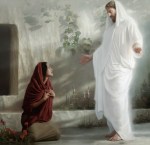
Verse 11. But Mary was standing outside the tomb, weeping; so, as she wept, she stooped to look into the tomb; verse 12, and she saw two angels in white sitting, one at the head and one at the feet, where the body of Jesus had been lying. Verse 13. And they said to her, “Woman, why are you weeping?” She said to them, “Because they have taken away my Lord, and I do not know where they put Him.” Verse 14. When she had said this, she turned around and saw Jesus standing there, and yet she did not know that it was Jesus. Verse 15. Jesus said to her, “Woman, why are you weeping? Whom are you seeking?” Thinking that He was the gardener, she said to Him, “Sir, if you have carried Him away, tell me where you put Him, and I will take Him away.” Verse 16. Jesus said to her, “Mary!” She turned and said to Him in Hebrew, “Rabboni!” (which means, Teacher). Verse 17. Jesus said to her, “Stop clinging to Me, for I have not yet ascended to the Father; but go to My brothers and say to them, ‘I am ascending to My Father and your Father, and My God and your God.’” Verse 18. Mary Magdalene came and announced to the disciples, “I have seen the Lord,” and that He had said these things to her.
(Commentary Break): Verses 11 through 18 are easy enough to read but far from easy to understand their meaning, implication and application. Remember that the Words of Scriptures are the Breathed Words of God – breathed into men by way of the Holy Spirit so as to inspire them to record them as the inerrant Truth of God. (2 Timothy 3:16).
First Mary encounters two angels, messengers of God, at a very emotionally intense moment. Then, suddenly she is face-to-face with Jesus “and yet she did not know that it was Jesus”. How could this have been? Many commentaries speculate that it may have been her emotional state, or perhaps she could not see Him clearly because of the early morning light, or perhaps a divine veiling of her perception. However, if we look deeper at the deeper meaning of the Greek language used here we see: (1), “she turned around and saw Jesus standing there” – “theóreó”, means she could see as a “spectator” or look on in order to try to speculate or to discern. Simply, her “mind’s eye” saw Him but did not recognize Him as Who He was in His Glorified Body.
(2), After Jesus identified Himself, she went and found the disciples and exclaimed to them, “I have seen the Lord” – “horaó”, meaning to perceive, to discern clearly, physically and mentally. Interestingly, this is spoken in the Aorist tense, which means she now sees Him as He was, as He is now and will always – for all times – see Him for Who He Is!
(3), Once the “eyes of our heart are enlightened” as it was with Mary, “you (and I) will know Him, and we will come to know what is the hope of His calling and what are the riches of His glory”. (Ephesians 1:18).
At first, Mary was an emotionally distraught spectator of life – distraught by what might have been – just as we all are or have been. Then she is confronted with the message of God, the Good News, which is truly being confronted with the Living Christ. This, too, is our opportunity; to go from being a spectator to being confronted with the Good News of God and by the Only One True and Living God. She then believed. She believed in the Risen Christ and ran to tell others of her great discovery and of this exceedingly Good News – which is what each and every true believer in Jesus will do. This is the initial sign of having been saved by God’s grace through our faith in Christ Jesus and His completed work on the cross. (End Commentary Break).
Jesus among His Disciples
Verse 19. Now when it was evening on that day, the first day of the week, and when the doors were shut where the disciples were together due to fear of the Jews, Jesus came and stood in their midst, and said to them, “Peace be to you.” Verse 20. And when He had said this, He showed them both His hands and His side. The disciples then rejoiced when they saw the Lord. Verse 21. So, Jesus said to them again, “Peace be to you; just as the Father has sent Me, I also send you.” Verse 22. And when He had said this, He breathed on them and said to them, “Receive the Holy Spirit. Verse 23. If you forgive the sins of any, their sins have been forgiven them; if you retain the sins of any, they have been retained.”
(Commentary Break): The drama of this moment is heightened as the doors were shut and the disciples were gathered together in fear of the Jews – huddled together, full of fear, (phobos – dread, exceeding terror) wondering, doubting and withdrawn from the world around them. The, suddenly in their midst stands Jesus speaking as He had spoken to the waves of the tumultuous and threatening seas, “Peace to you”. And just as the seas heard His Command and obeyed, the disciples, too, would soon be transformed by these words from frightened boy into galvanized warriors of the Cross!
Then He, Jesus, breathed on them and said “Receive the Holy Spirit” and with this act they were being filled with courage, the Word of God, the gifts of the Spirit of God and the power to go and make disciples. There are teachings going about that say being filled by and with the Holy Spirit is a “separate act of grace”, or a “second act of grace” or that you receive the Holy Spirit at salvation and the gifts and power of the Holy Spirit later. That might appear the case to some. But these very verses, when read at face-value and in context of the rest of scriptures, you see that when you come to Jesus. submit to Him and follow Him in faithful obedience, He will breathe the Holy Spirit into your life also. There is no such thing as a true believer and disciple of Jesus who is not filled with the Holy Spirit of God, and all of this comes at the moment you are saved and only when you give your life away, as did the disciples, and follow Him in faith. (You will be sharpened in your faith and the application of the gifts of the Spirit.
Verses like 2 Timothy 1:6 remind us to “fan into flame the gift of God,” while Romans 12:6-8 emphasizes using our different gifts according to the grace given to us, showing that growth and service are integral to our faith journey, and Proverbs 27:17 reminds us that “as iron sharpens iron, so one man sharpens another”. But always, it is Jesus Who does His works through us.“
Verse 24. But Thomas, one of the twelve, who was called Didymus, was not with them when Jesus came. Verse 25. So the other disciples were saying to him, “We have seen the Lord!” But he said to them, “Unless I see in His hands the imprint of the nails, and put my finger into the place of the nails, and put my hand into His side, I will not believe.”
Verse 26. Eight days later His disciples were again inside, and Thomas was with them. Jesus came, the doors having been shut, and stood in their midst and said, “Peace be to you.” Verse 27. Then He said to Thomas, “Place your finger here, and see My hands; and take your hand and put it into My side; and do not continue in disbelief, but be a believer.” Verse 28. Thomas answered and said to Him, “My Lord and my God!” Verse 29. Jesus said to him, “Because you have seen Me, have you now believed? Blessed are they who did not see, and yet believed.”
(Commentary Break): Jesus had appeared to the other disciples and breathed on them. Now, Jesus the patient Shepherd, comes back for one of His sheep who was wandering in disbelief. Thomas proclaims, “My Lord and my God!”, and Jesus reminds all of us, “Blessed are they who did not see me and yet believed.” I suppose we could read all sorts of things into His statement. First,ß Since Thomas was not present when Jesus had breathed on the other disciples, had he received the Holy Spirit? Considering that after the resurrection and ascension, the disciples (now including Thomas) were gathered together in Acts of the Apostles 1–2. At Acts of the Apostles 2:1–4, the Holy Spirit came powerfully at Pentecost: “They were all filled with the Holy Spirit”, and since
Thomas is listed among the apostles in Acts 1:13, meaning he was present when the Spirit was poured out, the answer is yes. Secondly, Thomas’s belief is based on physical evidence, as he had insisted on seeing and touching Jesus’ wounds to believe in His resurrection. This reflects a common human tendency to rely on empirical evidence. The statement underscores the importance of faith, contrasting belief based on sight with belief based on trust in Jesus’ words and promises. This pronouncement extends beyond Thomas to future generations of believers who would come to faith without physical evidence of Jesus’ resurrection. It emphasizes the blessedness of faith that does not rely on sight, aligning with Hebrews 11:1, which defines faith as confidence in what we hope for and assurance about what we do not see. This blessing is a promise of spiritual reward and assurance for believers throughout history. It seems, Thomas was used as an example for future believers. (End Commentary Break).
Why This Gospel Was Written
Verse 30. So then, many other signs Jesus also performed in the presence of the disciples, which are not written in this book; verse 31, but these have been written so that you may believe that Jesus is the Christ, the Son of God; and that by believing you may have life in His name. (End Chapter 20).
Jesus was fully man and fully God and the final verses of chapter 20 says as much. What was recorded by the disciples and the Apostles and is now canonized as our Bible, apparently were just a sampling, albeit among the most important and most salient signs and works of Jesus, “but these have been written so that you may believe that Jesus is the Christ, the Son of God (verse 31); and we will see in the next chapter that “there are also many other things which Jesus did, which, if they were written in detail, I suspect that even the world itself would not contain the books that would be written”.
Let’s believe that we may have the abundant life on found in Jesus; vibrant, effervescent, full of purpose and promise; a life worth living!
Your Brother and Friend,
Mike Young
PREVIOUS: THE BOOK OF JOHN, Chapter 19, The Crown of Thorns, The Crucifixion.
(Please bookmark this page for future episodes).
Discover more from Whitestone Fellowship
Subscribe to get the latest posts sent to your email.

