Devotional, Devotion, Prophecy, Bible Study, Bible discussion, End of Days, End Times, Enter Ministry, Underground Church, Church, Fellowship, Tribulation, Salvation, Ordained, Love, Heaven, Miracles
Author: Michael Young, Sr.
I am a practicing Christian, a disciple of Jesus, a husband of over 50 years, a father and a grandfather, a business man, a veteran and a friend to all who will have me.
I have served or am serving, at various times, as an Evangelist, a Pulpit fill pastor, an Associate Pastor of Evangelism and as Senior Pastor of a church plant. My passion is for practicing and teaching the Bible, building small groups, reaching the lost with the message of the Gospel of Jesus, recovering the straying Sheep of God and the gathering together the Called of God, in neighborhoods, business settings and in churches by equipping other Christians.
I have authored a few small books and I have a background in professional business management, finance and investments.
I am glad to meet you, even if it is virtually. Write me at any time and let's become friends.
How can you be sure that God is all that the Bible says? If you look closely enough, you can see God’s Hand has moved in the affairs of humankind throughout the ages.
This is an abbreviated chronology and timeline of Biblical Historical events. You will not only see how God has moved and interacted with His creation but you can see His Master Plan, Purpose, Methods and Ways from before creation through the End of the Age and into the creation of a new heaven, a new earth and a new Jerusalem.
Those who have overcome, are with God eternally – which includes you and me – and, we will know that God’s Plan for Perfection is being completed.
“Be diligent to present yourself approved to God as a worker who does not need to be ashamed, accurately handling the word of truth.” 2 Timothy 2:15
The pastor of a Southern Baptist mega-church in Fort Meyers, Florida, which we attended 15 years ago, pastor Dr. Richard Powell, announced that the next Sunday’s sermon would be titled “Dangerous Christianity”.
The title of this upcoming sermon created a stir of excitement in the congregation. I felt a positive anticipation rising in me. DANGEROUS CHRISTIANITY was exactly what I needed. It was exactly what I wanted to dish out to the devil: DANGER FROM GOD!
The next Sunday came, and we sat in our comfortable theater-style cushioned seats, eagerly waiting to hear about “Dangerous Christianity“.
“Beware, Devil”, I thought, “we are going to be a threat to you and yours from now on!”
The pastor started by saying,
“It is Dangerous to take the Bible literally. Believing that everything in the Gospel is meant for your benefit can be DANGEROUS to your faith.”
I listened, and I thought, “Did I just hear what I think I heard?”
He repeated his opening statement.
Curious and a bit concerned, I listened to his “religious lecture”, but I didn’t hear too much after the introduction.
I kept thinking, over and over, that this “man of God” just said that the Bible presented a danger to the Believer’s faith, if he or she takes it literally.
Grammar, figures of speech, parts of speech, literary style, usage of nouns, pronouns, and verbs all aside, about all I remember about this “religious lecture” was the opening statement.
I understand metaphors, similes, idioms and hyperbole, and the Bible uses these figures of speech in various places to communicate an idea, a thought or a message.
But, the Bible is GOD BREATHED and is meant for every man, woman, boy and girl to understand. And the Bible indicates what is meant to be literal and what is not literal.
So, I decided to see if there was such a thing as “Dangerous Christianity” in the Bible, and here is what I found:
Genesis 22:17 “Indeed I will greatly bless you, and I will greatly multiply your seed as the stars of the heavens and as the sand which is on the seashore; and your seed shall possess the gate of their enemies.”
1. Christians are a danger to possess the gate of our enemies!
Psalms 125:1-2 (A Song of Ascents). Those who trust in the LORD Are as Mount Zion, which cannot be moved but abides forever. As the mountains surround Jerusalem, So the LORD surrounds His people From this time forth and forever.
2. Christians are a danger to anyone or anything that would try to separate us from God.
Isaiah 54:17 “No weapon that is formed against you will prosper; And every tongue that accuses you in judgment you will condemn. This is the heritage of the servants of the LORD, And their vindication is from Me,” declares the LORD.
3. Christians are a danger to weapons formed to be used against us and our accusers will be condemned!!
John 10:28-29, and I give eternal life to them, and they will never perish; and no one will snatch them out of My hand. “My Father, who has given them to Me, is greater than all; and no one is able to snatch them out of the Father’s hand.
4. Christians are a danger to death or any kind of separation from our Father’s Hand.
Romans 8:35 Who will separate us from the love of Christ? Will tribulation, or distress, or persecution, or famine, or nakedness, or peril, or sword? 36 Just as it is written, “FOR YOUR SAKE WE ARE BEING PUT TO DEATH ALL DAY LONG; WE WERE CONSIDERED AS SHEEP TO BE SLAUGHTERED.” 37 But in all these things we overwhelmingly conquer through Him who loved us. 38 For I am convinced that neither death, nor life, nor angels, nor principalities, nor things present, nor things to come, nor powers, 39 nor height, nor depth, nor any other created thing, will be able to separate us from the love of God, which is in Christ Jesus our Lord.
5. Christians are a danger to tribulation, or
distress, or
persecution, or
famine, or
nakedness, or
peril, or sword or
death,
because we are more than conquers through Christ!!
Hebrews 12:28 Therefore, since we receive a kingdom which cannot be shaken, let us show gratitude, by which we may offer to God an acceptable service with reverence and awe;
6. Christians are a danger to upheaval or turmoil.
Matthew 16:19 “I will give you the keys of the kingdom of heaven; and whatever you bind on earth shall have been bound in heaven, and whatever you loose on earth shall have been loosed in heaven.”
7. Christians are a danger to the evil of this world because we pray in Jesus’ Name and
Jesus possesses the keys to the kingdom of heaven and
Jesus binds evil,
Jesus binds death,
Jesus binds poverty,
Jesus binds sickness,
Jesus binds doubt,
Jesus binds fear,
Jesus binds hopelessness and the like.
Ephesians 6:10-13, Finally, be strong in the Lord and in the strength of His might. Put on the full armor of God, so that you will be able to stand firm against the schemes of the devil. For our struggle is not against flesh and blood, but against the rulers, against the powers, against the world forces of this darkness, against the spiritual forces of wickedness in the heavenly places. Therefore, take up the full armor of God, so that you will be able to resist in the evil day, and having done everything, to stand firm.
8. Christians are a danger to schemes of the devil.
Mark 16:17 “These signs will accompany those who have believed: in My name they will cast out demons, they will speak with new tongues;
9. Christians are a danger to demons.
Matthew 10:8 “Heal the sick, raise the dead, cleanse the lepers, cast out demons.”
11. Christians are a danger to sickness, death, disease and evil!!
Now, that is what I call DANGEROUS CHRISTIANITY.
Let’s exercise our gifts of the Spirit, the rights as brothers of Jesus, joint-heirs of the Son, and as sons of God and remember that it is The Spirit doing His Work through us! Let’s let the power of God and His love, kindness, patience, gentleness, self-control, goodness, and faithfulness flow through us.
Let’s speak the Logos of God. Let’s speak the “Rhema of God”. Let’s walk in the Spirit of God and carry His Word before us.
Let’s live a Dangerous Christianity and bring glory to our God.
Your Brother and Friend,
Mike Young
PS – Can you think of other ways we can be Dangerous Christians for the Glory of God and a credit to His Kingdom?
I am not ashamed of the gospel, for it is the power of God for salvation to everyone who believes, to the Jew first and also to the Greek. Romans 1:16
For the message of the cross is foolishness to those who are perishing, but to us who are being saved it is the power of God. 1 Corinthians 1:18
Too many Christians are suffering physically, emotionally, personally. They suffer from ignorance of the Truth of Life contained in Biblical scriptures or a tragic misunderstanding of those scriptures.
Too many of our religious teachers and leaders are saying the right words but setting another example. And, sadly, the Child of God is following that error of example and suffering.
Betty and I were on a cruise to the Hawaiian Islands to celebrate the beginning of our 50th year of our marriage.
Each morning of our cruise held something different, interesting and exciting, if you watched for it. This particular morning, we walked the ship’s deck for exercise, then, Betty headed to the physical fitness salon and I headed one of the various hot tubs on deck.
I had just eased myself into a hot bubbling tub of relaxation when a large man and his wife appeared at the edge of the hot tub.
He greeted me with a cheery “Hello”, as he crowded himself into the spa. His voice was deep and resonate, like that of a TV announcer. His wife appeared a bit shy and just nodded her greeting.
We began to chat and exchange pleasantries. I discovered he and his wife were approximately my age. They were licensed clinical social workers and retired Southern Baptist missionaries to Argentina. He had also acted as a pastor for a short time. I privately thought “that explains his ‘preacher sounding voice’; deep, resonate and measured with cadence”.
I asked more about his time as a missionary but he was vague on the subject, except to say they ‘were only there four years’. He suggested that he was disappointed that they had been largely ineffective.
Then he surprised me by saying, “I believe Jesus may come back soon and the Church isn’t ready”. When I asked why he believed this, he said “I tried being a Southern Baptist but I can’t do that any longer.
“Funny”, I thought, “how he makes a statement, then follows it up with an seemingly unrelated comment”.
I also tried the Assemblies of God”. Then he sort of rambled on about traditions and practices of various denominations.
Then he said “I used to be a conservative Christian” and stopped talking.
(There he goes again?????)
His thinking seemed random, but, his comment somehow caused me to recall a small historic mission in Lahaina on Maui, which we had visited the day before. It is known as the Master’s Reading Room. I asked if they had visited this mission during our stop on Maui, Hawaii. He said they had visited it and in his best baritone voice, he gave me a quick history lesson. He concluded his lecture, which sounded very much like a sermon, by recounting how, before the missionaries arrived in Lahaina, the sailors who came to this port would maraud this small town and “have their way with the local women”. But, when the missionaries arrived they ‘put a real kink in the sailor’s behavior’.
“A real kink in that behavior”, I wondered. What an interesting choice of words. “So was that a “good kink”, or a “bad kink” I asked.
“Good, I suppose”, my new friend replied. “It lasted for a long time”.
I couldn’t help myself at this point. “I have another question”, I posed to this man, “but before I ask it, I wonder if you could put any bias aside and consider what I am asking from an objective point of view.”
He said he would try.
“OK, then, here is the question: Why is it, in this post modern world, are we Christians unable or unwilling to, as you put it, “PUT A KINK” in the bad behavior that is engulfing our society?
Why have we become, as you put it, largely ineffective?”
He looked surprised but quickly answered with a question “Because we, as the Church, have become afraid of offending anyone, and have bought into the methods and ways of this world?”
I probed him further. “Perhaps that is a result of a deeper problem? But not the cause? Isn’t that just an excuse or an explanation for a lack of faith? So, I ask you again, what do you think is the cause?”
This question clearly made my friend uncomfortable and, for the first time in our half hour together, left him speechless.
So I continued. “I’ll tell you what I think is the cause for so many Christians being unwilling or unable to preach the Gospel Message of Christ – which by its very nature ‘puts a kink in sinful behavior’:
WE DON’T BELIEVE IT!”
“Oh, I don’t know about that” he blurted.
“Really?” I continued. “As a Licensed Clinical Social Worker, you should know that everything one does is based on what he or she believes to be right for them. A person’s actions and behaviors are based on their core set of beliefs.
“You eat what you eat because of your preferences, which are a reflection of your core beliefs. You wear what you wear, live where you live, say what you say all for the same reason.
“Likewise, you cannot effectively DO what Christ commanded if you do not fully believe it – that is, unless you are a deliberate fraud and a liar. I don’t believe that is the case with you. So, you must find a way out your dilemma.
“Dilemma?”, he queried.
“Yes, dilemma”, I countered. Your dilemma is that your say you believe IN Jesus and that you believe IN the Bible, but you aren’t DOING what they say. So, you either don’t believe what they say or you don’t understand.
“So, you change the meaning of God’s Word to something more palatable. You spin God’s Word to have a contemporary meaning. Something with which you agree from your own point of view.
“You aren’t actually doing what Jesus says to do, are you?”
“Well, I’ve tried to follow Him”, my friend replied. “But the Bible is open to many interpretations, you know.”
“Jesus said what He meant and meant what He said. His voluntary death on the Cross proved that.
“His Words are the plain Truth. Written in a language every one of His Own can understand.
“Let me give you an example. Our instructions from Him are to
Go, and
Preach The Gospel,
Teach the Gospel,
Make disciples,
Baptize,
Lay hands on the sick,
Feed the hungry,
clothe the naked,
tend to the widow and the orphans.
“So, I ask you, when was the last time you even laid hands on a sick person?
“When was the last time you, personally, led someone to Christ?
“When was the last time you preached the same Gospel Jesus preached?”
“Could this be why you are frustrated and growing cold. You are not DOING what Jesus said to do!”
My friend protested with the strangest of remarks. “I used to be a conservative Christian but now I am a liberal. And I don’t agree with how the bible in being taught. Two big examples are on abortion and homosexuality. You conservatives are too strict in your interpretation on these subjects for the 21st century.”
“Perhaps you are disappointed and ineffective because you are believing and teaching your own version of what Jesus said”, I finished.
“I see what you are saying”, my friend replied, “but, there are so many social issues. After all, my wife and I are trained licensed clinical social workers, too.”
“I see I may not have changed your mind. But, the fact remains and you have admitted that you are frustrated, your ministry is largely ineffective and that you have lost your enthusiasm for the things of God.
“You are right. His Return is near and you seem to be worried about the church? But, how about YOUR readiness and how about your wife’s readiness? Are you ready to face Him and explain why you ‘did it your way’?
“I encourage you to actually follow Him – starting today – by doing what He said to do. And see if your First Love doesn’t return.”
I could see that our conversation was over. My friend thanked me and said he had been in the hot tub long enough and made his exit.
I am pretty sure the hot tub wasn’t the only thing he had enough of!
This true life encounter reminded me that we can find all kinds of reasons and make all kinds of excuses for not following the simple Teachings of Jesus. We can find many reasons on which to blame our ineffectiveness.
We can deny that the present-day church is far from the example Jesus gave us. But, we have drifted far from our moorings. And you cannot deny that…
Much of The Church is being turned into a corporate entity, voluntarily shackled to, licensed by and muted by our government.
The Church is increasingly being LEAD by men and women and their bias, worldly methods and humanistic ideals.
The Church increasingly is being driven by contemporary methods, for contemporary purposes and causes.
The Church is no longer a threat. It is being rendered largely ineffective. It is becoming an artifact of antiquity.
Don’t agree?
Read the Bible for yourself. Read the accounts of Jesus’ teaching and ministry. Read about His methods, His purposes, His results. Read how He told us to continue in His Works; then compare.
He did not call many of the ‘hirelings’ who inhabit our pulpits today.
He called His People to DO His Work. His is still calling.
You can hear His call to us, through the Apostle, Peter. A Call to ALL OF US. Follow Him and DO HIS WORKS. From:
Peter, an apostle of Jesus Christ, To those who reside as aliens, scattered throughout Pontus, Galatia, Cappadocia, Asia, and Bithynia, who are chosen according to the foreknowledge of God the Father, by the sanctifying work of the Spirit, to obey Jesus Christ and be sprinkled with His blood:
You are A CHOSEN RACE, A royal PRIESTHOOD, A HOLY NATION, A PEOPLE FOR God’s OWN POSSESSION,
so that you may proclaim the excellencies of Him who has called you out of darkness into His marvelous light;
for you once were NOT A PEOPLE, but now you are THE PEOPLE OF GOD; you had NOT RECEIVED MERCY, but now you have RECEIVED MERCY.
This is the time, folks.
No excuses. Do not tarry. He is calling!
LET’S DO IT NOW!
Let’s Remain in His Grip!
Your Brother and friend,
Mike Young
(NEXT: coming soon – Dangerous Christianity – part 2)
Marxist-Communism purports to be the economic savior of the common man and woman – the economic savior because Marxist-Communism denies and derides the existence and the ways of God.
Marx and the several variants of Marxism, advocate the abolition of private property, the establishment of a classless society, and the collective ownership of the means of production. It falsely claims to eliminate class distinctions and distribute wealth according to individual needs rather than market competition. All of which, when implemented would inevitably lead to anarchy, lawlessness and societal chaos unless the ‘state’ steps in and plays the role of savior-policeman by imposing a suffocating two-tiered social caste of State and Worker, This in turn brings ruthless dictatorial rule of law and order enslavement, forced labor and the threat of death. (Over 250 million have been reportedly murdered by Marxism, Leninism and Communism), which leads to a hopeless poverty for the underclass.
Observe the pattern: They (Marxist-Communists) create a problem, propose to solve the problem by imposing a remedy that leads to autocratic rule – Marxist-Communism in this case. This has always been the pattern for dictatorial tyrants.
Yet here we are. Forty-four percent of Americans are now leaning toward Socialism (which is the “first necessary step” to Marxist-Communism). As the saying goes, “those who cannot remember the past are condemned to repeat it”.
(Oh, and NEWSFLASH: When was the last time you heard of someone running from a capitalist society in order to escape to a Socialist, a Marxist-Communist government – it always comes to them.)
Three snapshots of social constructs:
A Democratic Republic and capitalism provides the potential for economic opportunity for all people. However, unless it is guided by Christian-inspired ethics and morals, leads to greed and economic oppression.
A Socialist government and society purports to offer equal distribution of goods and incomes. However, unless ruled by harsh elitist regulatory government, leads to anarchy, chaos and death. But in the end always leads to autocratic oppression, lack, want and hopelessness.
A Marxist-Communist system advocates the abolition of private property, the establishment of a classless society, and the collective ownership of the means of production. It aims to eliminate class distinctions and distribute wealth according to individual needs rather than market competition. The results have always been political oppression through threats of isolation or death, economic inefficiencies, and social inequalities, often resulting in authoritarian regimes that suppress individual rights. Critics argue that its focus on class struggle and economic determinism can lead to significant social dislocation and failure to address the complexities of human behavior and governance,
In case you are wondering where your country is on the trek to destruction, consider these things which must occur as you slide into the jaws of Marxist-Communism:
“Take away a nation’s heritage, and they are more easily persuaded.“ (You can see this has and is happening as our historical landmarks are torn down, religious symbolism destroyed, rewriting of history).
“Communism begins where atheism begins. “ (You can see this as Church attendance is falling to dramatic lows; over 50% of those attending church don’t believe the Bible is true or that Jesus was born of a virgin, and more.)
“The education of all children, from the moment that they can get along without a mother’s care, shall be in state institutions.” (You can see this through Government control of education, ‘no child left behind’, Critical race theory taught at all levels of schools, national association of teachers (Marxists in nature), Federal Education Department.)
“We have no compassion, and we ask no compassion from you. When our turn comes, we shall not make excuses for the terror.” (You can see this through Black Lives Matter, Antifa, burning down our cities, killing people, Defund Police movement, murder in our streets, schools and churches, and the LEFT blames the gun.)
“The meaning of peace is the absence of opposition to socialism.” (This is the rally cry of the American democrat party.)
“If you can cut the people off from their history, then they can be easily persuaded.” (You can see this through the revision of text books, historical data, historical sites.)
“The democratic concept of man is false, because it is Christian. The democratic concept holds that each man is a sovereign being. This is the illusion, dream, and postulate of Christianity.” (You can see this through the perversions and the Pagan practices which is being taught in schools, government and many churches.)
There are, besides, eternal truths, such as Freedom, etc., that are common to all states of society. (Communism abolishes eternal truths, it abolishes all religion, and all morality, instead of constituting them on a new basis; it therefore acts in contradiction to all past historical experience.)
“The Communists everywhere support every revolutionary movement against the existing social and political order of things. (They openly declare that their ends can be attained only by the forcible overthrow of all existing social conditions.)
A heavy or progressive or graduated income tax is necessary for the proper development of Communism.” (Historically, the democrats call this a ‘fair tax’, but imposes it on everyone at every income level.)
“The first requisite for the happiness of the people is the abolition of religion.” (The 501-( c)-3, provision in the tax code, implemented by democrat president Lyndon B. Johnson, is one of the greatest attempts to mute or silence the pulpits in America.)
“The unity is brought about by force.“ (This is being done by the democrats by weaponizing the Departments of Justice, Education and the I R S.)
“From each according to his abilities, to each according to his needs.“ (This is the motto and rally cry of Communism, and it is the written mandates of Social Security, socialized medicine (Obamacare), and scores of other social entitlements.)
“There is no greater stupidity than for people to marry and so surrender themselves to the small miseries of domestic and private life.“ (So the Progressives adopted Marxist idealism and modified divorce laws to make marriage and divorce a convenience or an inconvenience. Our children suffer and perpetual the harms done.)
“Taxes are the source of life for the bureaucracy, the army and the court, in short, for the whole apparatus of the executive power. Strong government and heavy taxes are identical.“ (This has ALWAYS been the rally cry of Democrats!).
Now, please read these quotes by Vladimir Lenin:
“Give me your four-year-olds, and in a generation I will build a socialist state.“ (Obviated by the various Federal Government sponsored programs in primary education).
“We can and must write in a language which sows among the masses hate, revulsion, and scorn toward those who disagree with us.” (Once again this vitriol is obvious in our Leftist press and media; pitting Americans against Americans.)
“The press should be not only a collective propagandist and a collective agitator, but also a collective organizer of the masses.“ (Again, an obvious fact of life in American media.)
“Why should freedom of speech and freedom of press be allowed? Why should a government which is doing what it believes to be right allow itself to be criticized? It would not allow opposition by lethal weapons. Ideas are much more fatal things than guns. Why should any man be allowed to buy a printing press and disseminate pernicious opinions calculated to embarrass the government?” (Hence, the muzzling of free speech and the implementation of ‘hate speech laws’).
“The way to crush the bourgeoisie is to grind them between the millstones of taxation and inflation.“ (Just look at the history of taxation and the resulting inflation by the Democrat party in general and the Biden administration in particular!)
“One man with a gun can control 100 without one.“ (Hence, ever tightening gun control laws.)
“As an ultimate objective, “peace” simply means communist world control.” (The liberals and democrats cry ‘peace at any cost’, then wage war on their own citizens!)
“Atheism is a natural and inseparable part of Marxism, of the theory and practice of scientific socialism. Our program necessarily includes the propaganda of atheism. “
“It is, of course, much easier to shout, abuse, and howl than to attempt to relate, to explain.“ (A tactic of Democrats everywhere).
“Medicine is the keystone of the arch of socialism.” (Obamacare).
“One of the basic conditions for the victory of socialism is the arming of the workers Communist and the disarming of the bourgeoisie to the middle class.” (Again, the constant demand for gun control by the Democrat Party.)
“The best way to control the opposition is to lead it ourselves.” (Think, RHINOS. Republican in name only, they are the Trojan horse of the American Democrat Party (i.e., Marxists), and they are everywhere!)
“There are no morals in politics; there is only expedience. A scoundrel may be of use to us just because he is a scoundrel.” (Bill Clinton, Joe Biden, Hunter Biden for examples.)
Here are their false promises, their “Trojan horse”, and it is now living in your home, in your schools, in your healthcare systems, in your churches (please click the image):
PS: The American Democrat Party and both George H. Bush and George W. Bush are wolves in sheep’s clothing – Leftist Marxists acting as conservatives and Christians.
Here are several misconceptions about certain Bible verses, events and doctrines. Please read and listen carefully:
FIRST MISCONCEPTION: It is often said that at Jesus’ Second Advent, He will physically return to the earth.
That is incorrect.
Acts 1:9-11, And after He had said these things, He was lifted up while they were watching, and a cloud took Him up, out of their sight. And as they were gazing intently into the sky while He was going, then behold, two men in white clothing stood beside them, and they said, “Men of Galilee, why do you stand looking into the sky? This Jesus, who has been taken up from you into heaven, will come in the same way as you have watched Him go into heaven.”
Many Bible teachers and pastor say that this verse says that Jesus will return to earth “in the same way as you have watched Him go into heaven”, except there is no mention of earth or of Jesus setting foot back on the earth at this time. It does say that “Jesus, who has been taken up from you into heaven, will come in the same way as you have watched Him go into heaven.”
“Taken Up…into heaven…will come (back) in the same way…as (He went) into heaven.” It is not about “a landing place”. It is about the ascension and the return. How can we be certain?
Matthew 24:29-31, “But immediately after the tribulation of those days the sun will be darkened, and the moon will not give its light, and the stars will fall from the sky, and the powers of the heavens will be shaken. And then the sign of the Son of Man will appear in the sky, and then all the tribes of the earth will mourn, and they will see the Son of Man coming on the clouds of the sky with power and great glory. 31 And He will send forth His angels with a great trumpet blast, and they will gather together His [a]elect from the four winds, from one end of the sky to the other.
Many Bible teachers and pastors say this is not Jesus’ second coming because He does not step onto the earth. But this is His second appearing (or coming). Clearly “He appears in the sky…all tribes of the earth will see the Son of Man coming on the clouds of the sky”.
(Please note: Matthew 24:30-31, the phrases “the Son of Man” and “clouds of heaven” are capitalized. This highlights the significance of Jesus’ return and His divine nature. The capitalization serves to draw attention to the key elements of the prophecy regarding His second coming.)
Revelation 19:11-16, “And I saw heaven opened, and behold, a white horse, and He who sat on it is called Faithful and True, and in righteousness He judges and wages war. His eyes are a flame of fire, and on His head are many crowns; and He has a name written on Him which no one knows except Himself. He is clothed with a robe dipped in blood, and His name is called The Word of God. And the armies which are in heaven, clothed in fine linen, white and clean, were following Him on white horses. From His mouth comes a sharp sword, so that with it He may strike down the nations, and He will [a]rule them with a rod of iron; and He treads the wine press of the fierce wrath of God, the Almighty. And on His robe and on His thigh He has a name written: “KING OF KINGS, AND LORD OF LORDS.”
Notice, “heaven opened…and He (Jesus) sat on a white horse…And the armies which are in heaven…were following Him…and a sharp sword comes from His mouth so He may strike down the nations and rule them”.
Jesus will wage this war and execute His Wrath from the heavens and the beast and his armies will be on the earth. Jesus and His armies are in the heavens. This is the battle of Armageddon.
Please take note of the sequence of These End Time events:
(These events originate in heaven and are poured out onto the earth)
The First Six Bowls of Wrath – Revelation 16:1-12.
The Battle of Armageddon – Revelation 16:13-16.
The Seventh Bowl of Wrath – Revelation 16:17-21.
The Doom of Babylon (The mother of great harlots) – Revelation 17:1-13.
Victory of The Lamb of God – Revelation 17:14-18.
The Four-fold Hallelujah – Revelation 19:1-6
Marriage of the Lamb – Revelation 19:7-10
The Coming of Christ – Revelation 19:11-19
Doom of the Beast and the False Prophet – Revelation 19:20-21
Satan Bound – Revelation 20:1
(This even takes place on the earth)
The Thousand Years – Revelation 20:2-6
The Millennium in the Bible refers to a future period of a thousand years during which Jesus Christ is prophesied to reign on earth, characterized by peace and righteousness. This time is often associated with the fulfillment of God’s promises and the ultimate restoration of creation.
The millennium (also known as the millennial kingdom) is the 1,000-year reign of Jesus after the tribulation and before the Great White Throne Judgment of the wicked. During the millennium, Jesus will reign as king over Israel and all the nations of the world (Isaiah 2:4; 42:1). The world will live in peace (Isaiah 11:6–9; 32:18), Satan will be bound (Revelation 20:1–3), and, at the beginning, everyone will worship God (Isaiah 2:2–3). The purpose of the 1,000-year reign is to fulfill various promises God made to the world. Some of these promises, called covenants, were given specifically to Israel. Others were given to Jesus, the nations of the world, and creation. Jesus’ 1,000-year reign will be a time of promises kept.
(These events originate in heaven and are executed on the earth)
Satan Freed and then Doomed – Revelation 20:7-10
Judgment at the White Throne of God – Revelation 20:11-15
(These events originate in the New Heaven and are lived out on The New Earth)
The New Heaven and Earth – Revelation 21:1-9
The New Jerusalem – Revelation 21:10-27
THE SECOND MISCONCEPTION: Many bible teachers and pastors will say and Christians will believe that (1) there is nothing left to happen from prophetic scriptures before Jesus returns the rapture occurs.
This is incorrect.
2 Thessalonians 2:1-4, “Now we ask you, brothers and sisters, regarding the coming of our Lord Jesus Christ and our gathering together to Him, that you not be quickly shaken from your composure or be disturbed either by a spirit, or a message, or a letter as if from us, to the effect that the day of the Lord has come. No one is to deceive you in any way! For it will not come unless the apostasy comes first, and the man of lawlessness is revealed, the son of destruction, who opposes and exalts himself above every so-called god or object of worship, so that he takes his seat in the temple of God, displaying himself as being God.”
Notice: “Regarding the coming of our Lord Jesus Christ and our gathering together to Him (the rapture)…it will not come unless the (1) apostasy comes first (which is probably now beginning), (2) the man of lawlessness (the antichrist) is revealed…and he (the antichrist) takes his seat in the temple of God, displaying himself as being God.
THE THIRD MISCONCEPTION: Many bible teachers and pastors will say and Christians will believe that (1) That the Mark of the Beast is given before the rapture. The popular idea in many church denominations is that the Antichrist will give his “Mark of the Beast”before The Tribulation period but that he will not be revealed until after the rapture of the Church.
According to the sequence found in the Bible, the Antichrist gives his ‘Mark’ after the Seal Judgments, after the Rapture, and just after the 6th Tribulation Trumpet Judgment and at the advent of 7th Trumpet Judgment,which is the Mid-Point of the Great Tribulation, which is after three and one half years of the final 7 years of the Great Tribulation period.
(The placement of Mark of the Beast, as mentioned in the scriptures clearly tells us it is immediately following the 6th Judgment Trumpet).
Why are these things important?
Because understanding brings the necessary knowledge and knowledgebrings Godly Wisdom.
The Bible emphasizes the importance of understanding, stating that it is a valuable pursuit and often linked to wisdom. Key verses highlight that understanding comes from God and is essential for living a righteous life, such as Proverbs 4:7, which says, “The beginning of wisdom is this: Get wisdom. Though it cost all you have, get understanding.”
The Bible emphasizes that knowledge begins with the fear of the Lord, and it is seen as a valuable gift from God. It teaches that seeking knowledge and wisdom is essential for understanding and living a righteous life. The word knowledge in the Bible denotes an understanding, a recognition, or an acknowledgment. To “know” something is to perceive it or to be aware of it. Many times in Scripture, knowledge carries the idea of a deeper appreciation of something or a relationship with someone. The Bible is clear that the knowledge of God is the most valuable knowledge a human being can possess. But it is also clear that simply being aware of God’s existence is not sufficient; the knowledge of God must encompass the deep appreciation for and relationship with Him.
The Bible describes wisdom as a valuable quality that comes from God, emphasizing that it is better than gold and brings understanding and peace. Key verses highlight that wisdom begins with the fear of the Lord and is characterized by purity, gentleness, and a focus on the well-being of others.
In the Bible, wisdom is not just about knowledge or intelligence. It encompasses moral discernment and the ability to apply knowledge in a way that is good and beneficial. Wisdom is often described as a gift from God, emphasizing its spiritual nature.
Characteristics of Biblical Wisdom
Moral: Wisdom is demonstrated through good actions and moral choices.
Relational: It affects how we treat others, emphasizing empathy and understanding.
Spiritual: True wisdom comes from God and involves trusting in Him rather than solely relying on human understanding.
The Value of Wisdom
The Bible repeatedly emphasizes that wisdom is more precious than material wealth. It leads to a fulfilling life and helps individuals navigate challenges with insight and grace. Seeking wisdom is encouraged as a lifelong pursuit, integral to a faithful and meaningful life.
In the cases mentioned the remedy for common misconceptions or an inaccurate understanding of the Bible is Godly wisdom which is the key to Godly success in enduring and navigating the End of Days and to eternal life.
The Bible encourages us to be like the Bereans, as seen in Acts 17:11, where they are described as receiving the message eagerly and examining the Scriptures daily to verify the truth of what they were taught. This example highlights the importance of studying the Bible for oneself rather than accepting teachings without question.
Perhaps you follow horoscopes, use Ouija boards, or believe fortunetellers. You might even give credence to Nostradamus’ predictions and make coincidence as a guiding principle for your life.
Yet, you neglect or intermingle these things with the Bible?
There is absolutely no basis for the aforementioned magic, magicians, witchcraft or false prophets to be considered reliable. But the Bible is a record of spiritual truth and experiences that date back over 3,400 years. A compilation of Words from the “Spiritual Breath of God” which were recorded by men who have been imbued and led by the Holy Spirit of God. So serious were these men and women, that they risked their lives, and many gave their lives in the face of the fiercest of opposition in order to preserve and propagate this eternal truth. Many men and women continue to this day.
A careful, thoughtful and meditative reading of the Bible will reveal what it claims to be is the absolute Truth. It is not just a cognitive or an emotional experience, it is deep and profound and transformative.
It has the ability to change you, to move you, your body, mind and soul, from where you are in life to the place that will fulfill your potential and more. This transformation will give you thoughts that are useful, wise, and productive and relationships that will assist you along your way. You will have the potential to become greater than the sum of all the parts of your life.
The Bible tells us that Jesus is the embodiment of this Truth so He is the perfect guide and will be ever present within you. Jesus even said, “I am the Truth, the Life and the Way.” Jesus is the Word of God made into flesh.
Jesus and the Bible are revelatory. He has told us that we are in Him, He is in us and we, both, are in God the Father. They tell and show us that we are indeed connected to the entire universe through God, and since we are “joint heirs with Jesus” we have inherited the right to tell any “mountain to move from here to there, and it will move; and nothing will be impossible for you.” (see Matthew 17:20) All of this, of course, fits only within the context of God’s Plan and Purpose.
Now and finally, in the twenty-first century, science seems to be catching up with what the Bible has been telling us for thousands of years.
Although the reader of the Bible must make a decision to believe the Bible (we will call that faith), the Bible records the beginning of time and existence as we know it. “In the beginning, God created the heavens and the earth.” (Genesis 1:1).
Now and finally, it would seem, science is just beginning to line up with the Bible’s version of the creation of all things except they exempt the idea of a Creator. They somehow seemingly have the idea that a Creator must be anthropomorphic, (having the form of a man or having human attributes), which is ridiculous, since God is indescribable and undefinable. So, they suppose “it just happens” – which is even more ridiculous if you think about it.
But, the more science speculates and theorizes by way of quantum physics, the more mind-bending speculations they have about time, space and the nature of humans, the brain, mind and body.
One example is the idea of quantum entanglement and prayer. Quantum entanglement is a phenomenon where two or more particles become interconnected in such a way that the state of one particle instantly influences the state of the other, regardless of the distance separating them. This concept challenges classical physics and is a fundamental aspect of quantum mechanics.
Another example is the idea of a literal but spiritual heaven in conjunction with our natural physical world. This concept is often discussed in relation to parallel universes, particularly in interpretations like the Many-Worlds interpretation, which suggests that every quantum event creates branching realities, leading to multiple, non-interacting universes.
Neuroscience may be one of the most exciting new frontiers, proposing astounding ideas and discoveries about the powers of the brain for prayer, healing, and communicating with an unseen spiritual world and God.
However, it is not enough to just suspect these things to be true and even if you believe or want to believe they are true, it changes nothing unless you act on them. The Bible even gives you instructions on how to believe and how to achieve these things for yourself. You must desire them, watch for them and focus your mind on them. You must practice them.
Here are just a few Biblical examples of what I am saying:
Joshua 1:7-8 says, “Only be strong and very courageous; be careful to do according to all the Law which Moses My servant commanded you; do not turn from it to the right or to the left, so that you may achieve success wherever you go. This Book of the Law shall not depart from your mouth, but you shall meditate on it day and night, so that you may be careful to do according to all that is written in it; for then you will make your way prosperous, and then you will achieve success.”
(Please note: The context of this success is that God has promised the Israelites a new, prosperous and productive life in a new land – the promised land of plenty, which is all encompassing for the human experience. It is not about pleasing the flesh for self-gratification or hedonism.)
Philippians 4:8-9 says, “Finally, brothers and sisters, whatever is true, whatever is honorable, whatever is right, whatever is pure, whatever is lovely, whatever is commendable, if there is any excellence and if anything worthy of praise think about these things. As for the things you have learned and received and heard and seen in me, practice these things, and the God of peace will be with you.”
Romans 8:5-8 says, “For those who are in accord with the flesh set their minds on the things of the flesh, but those who are in accord with the Spirit, the things of the Spirit. For the mind set on the flesh is death, but the mind set on the Spirit is life and peace, because the mind set on the flesh is hostile toward God; for it does not subject itself to the law of God, for it is not even able to do so, and those who are in the flesh cannot please God.”
Matthew 19:26 says, “And looking at them, Jesus said to them, “With people this is impossible, but with God all things are possible.”
Matthew 7:7-12 says, “Ask, and it will be given to you; seek, and you will find; knock, and it will be opened to you. For everyone who asks receives, and the one who seeks finds, and to the one who knocks it will be opened. Or what person is there among you who, when his son asks for a loaf of bread, will give him a stone? Or if he asks for a fish, he will not give him a snake, will he? So if you, despite being sinful, know how to give good gifts to your children, how much more will your Father who is in heaven give good things to those who ask Him! In everything, therefore, treat people the same way you want them to treat you, for this is the Law and the Prophets.”
Matthew 17:20 says, “And He said to them, “Because of your meager faith; for truly I say to you, if you have faith the size of a mustard seed, you will say to this mountain, ‘Move from here to there,’ and it will move; and nothing will be impossible for you.”
Matthew 21:21 says, “And Jesus answered and said to them, “Truly I say to you, if you have faith and do not doubt, you will not only do what was done to the fig tree, but even if you say to this mountain, ‘Be taken up and cast into the sea,’ it will happen.”
You must train your brain, your mind, heart and soul to seek God first, then these things will begin to come about. Then it is up to you to serve God and others with these amazing gifts in order for them to continue in your life. For if you spend them only on yourself – on your own flesh, as the Bible puts it – they will vanish.
A final note: You cannot ‘just try it’ and get much in the way of results. It takes extensive focus and practice. It takes deep and persistent meditation and prayer. In other words, it takes faith.
“Be diligent to present yourself approved to God as a worker who does not need to be ashamed, accurately handling theword of truth.” (2 Timothy 2:15).
The time is near. Could it possibly be that we are already in the Last Days? If so, when did they begin?
Let’s take a look at what Jesus and His first disciples had to say about the Last Days, the End of Days, the End of the Age
Matthew 24:4-31, Jesus describes a panorama of the tribulation and the Last Days. Jesus was sitting on the Mount of Olives, the disciples came to Him privately, saying, “Tell us, when will these things happen, and what will be the sign of Your coming, and of the end of the age?” And Jesus answered and said to them, (see Matthew 24:3-4),
(1). “In the Last Days, there will be a rise of false Christs and false prophets. (This was an ongoing problem since as early as A.D. 35. See Matthew 24:4-5).
(5). In the Last Days, there will be a falling away from the faith. (This has been an ongoing problem since as early as A.D. 35, and has been increasing to this very day. See Matthew 24:10).
These things, false Christs, wars and rumors of war, famines, earthquakes and plagues, persecutions, martyrs, which Jesus calls the ‘Birth Pangs’ of the tribulation, are nothing new; and from these cited verses, we can plainly see that the first 5 tribulation Seals have been broken, and the effects had begun atthe time of the birth of Jesus, and have been overlapping and increasing in their intensity since those early days.
Acts 2:14-17, the Apostle Peter says, “let this be known to you, and give ear to my words.For these people are not drunk, as you suppose, since it is only the third hour of the day. But this is what was uttered through the prophet Joel: ‘And in the last daysit shall be‘.(Spoken and written in or around A.D. 30 to A.D. 60).
1 Peter 1:20, (the Apostle Peter), saying, “He, (Jesus), was foreknown before the foundation of the world, but was made manifest in the last times for the sake of you.”(Spoken and written in or around A.D. 30 to A.D. 60).
1 Peter 4:7, (the Apostle Peter), saying, “The end of all things is at hand.” (Spoken and written in or around A.D. 30 to A.D. 60).
2 Peter 3:3. (the Apostle Peter), saying, “knowing this first of all, that scoffers will come in the last days.”(Spoken and written in or around A.D. 30 to A.D. 60).
If these verses say all these things began occurring in or around A.D. 30 to A.D. 60, and Peter called those days the LAST TIMES, THE LAST DAYS, and it is THE END OF ALL THINGS. Now, what do you think?
1 Corinthians 10:11, the Apostle Paul says, “Now these things happened to them as an example and warning [to us]; they were written for our instruction [to admonish and equip us], upon whom the ends of the ages have come.” (Spoken and written in or around A.D. 30 to A.D. 60).
Hebrews 1:2, (the Apostle Paul), saying, “but in these last days he has spoken to us by his Son.” (Spoken and written in or around A.D. 30 to A.D. 60).
Hebrews 9:26, (the Apostle Paul), saying, “But as it is, Jesus has appeared once for all at the end of the ages to put away sin by the sacrifice of himself.” (Spoken and written in or around A.D. 30 to A.D. 60).
If these verses say all these things began occurring in the LAST TIMES, THE DAYS, and it is THE END OF ALL THINGS. Now, what do you think?
2 Timothy 3:1, Timothy says, “But understand this, that in the last days there will come times of difficulty.” (Spoken and written in or around A.D. 30 to A.D. 60).
If these verses say all these things began occurring in the LAST TIMES, THE DAYS, and it is THE END OF ALL THINGS. Now, what do you think?
1 John 2:18, the Apostle John says, “Children, it is the last hour, and as you have heard that antichrist is coming, so now many antichrists have come. Therefore, we know that it is the last hour.”(Spoken and written in or around A.D. 30 to A.D. 60).
Revelation 1:9, (The Apostle John), saying, “I, John, your brother and fellow participant in the tribulation.” (Spoken and written in or around A.D. 95 to A.D. 100).
If these verses say that John was a fellow participant IN THE TRIBULATION in the year A.D. 95. What do you think now?
These testimonies clearly tell us that the Last Days, also known as The End of All Things, The End of the Ages, The Last Hour, The Last Times and the tribulation, began at or around the time of the birth of Christ; and these mark the first 5 tribulation Seals being broken. They have been ongoing, overlapping and intensifying since those days. (We are still awaiting the breaking of the Sixth tribulation seal, also known as the Great and Terrible Day of The Lord, the Wrath of the Lamb and the Great Tribulation).
WHAT DOS THIS MEAN TO US?
THIS IS IMPORTANT TO UNDERSTAND BECAUSE THE CONCLUSION OF THESE THINGS WILL HAPPEN IN A MOMENT AND THERE WILL BE NO SECOND-CHANCES. THE TIME IS UPON US.
Furthermore, Jesus taught and warned, in Matthew 24:37-41, “For the coming of the Son of Man will be just like the days of Noah.For as in those days before the flood they were eating and drinking, marrying and giving in marriage, until the day that Noah entered the ark,and they did not understand until the flood came and took them all away; so will the coming of the Son of Man be. At that time there will be two men in the field; one will be taken and one will be left. Two women will be grinding at the mill; one will be taken and one will be left.”
The word “flood” is used about 28 times in the Bible. It is used eleven times in the Book of Genesis and refers to God’s Judgment on the world for sin by way of the Great Flood.
The word “flood” is used either in general terms or symbolically, twice in Job, five times in Psalms, once in Proverbs, Isaiah and Nahum, once in Luke.
It is used in reference to God’s Judgments, once in Daniel, twice in Matthew, once in Luke once in 2 Peter and once in Revelation. All of these references are related to the End of Days in some way, except for 2 Peter.
The Bible mentions a flood in conjunction with God’s Judgment and the “End of Days” as mentioned, in Daniel 9, Matthew 24 and Revelation 12.
Let’s focus on the narrative of a flood in Matthew 24:37 which speaks specifically about the “Flood”, comparing what is past and what coming.
The flood in Matthew 24:37 is a direct reference to the Great Flood of Noah’s day, which “took them all away” who were not safe in the Ark.
Matthew uses the same wording and warnings as found in the Genesis Flood account:
Matthew 24:39, tells us, “And, they did not understand until the flood came and took them all away; so, will the coming of the Son of Man be.
Verse 40. “Then there will be two men in the field; one will be taken and one will be left.
Verse 41. “Two women will be grinding at the mill; one will be taken and one will be left.
Verse 42. “Therefore, be on the alert, for you do not know which day your Lord is coming.
Verse 43. “But be sure of this, that if the head of the house had known at what time of the night the thief was coming, he would have been on the alert and would not have allowed his house to be broken into.
Verse 44. “For this reason, you also must be ready; for the Son of Man is coming at an hour when you do not think He will.
Verse 45. “Who then is the faithful and sensible slave whom his master put in charge of his household to give them their food at the proper time?
Verse 46. “Blessed is that slave whom his master finds so doing when he comes.”
In Noah’s day, although Noah warned them, they did not understand until the flood came and took them all away.
So, it will be with the coming of “The Son of Man, which is Jesus. But now we understand the warnings and will have no excuse. Still, if you do not heed the warnings, you will be taken away.
The warning is, “those who are not ready will be left”. They will be left. No excuses and no second chances, not even during the Tribulation.
“Blessed is that slave whom his master finds so doing when he comes:
Be on the alert; he would have been on the alert and would not have allowed his house to be broken into
Be the faithful and sensible slave whom his master put in charge of his household to give them their food at the proper time.
This is to be our response. Get Ready and Stay Ready!
WHAT DOES IT MEAN TO BE ON THE ALERT AND TO BE READY?
Repent of your sin and fully trust in Jesus alone as the payment for your sin. Believe in Him, and you will not perish (John 3:16). The Lord knows who are His, and He will leave none of them behind (John 10:14).
Be found living your life as Jesus has modeled and taught. This is only possible if you are guided by the Holy Spirit, Who empowers you with His gifts, Guidance and the Fruits of love, joy, peace, patience, kindness, goodness, faithfulness, gentleness and self-control.
Be found telling about and demonstrating the Good News of Jesus; making disciples, baptizing them in the name of the Father, the Son and the Holy Spirit, teaching them to do all that Jesus has commanded.
I realize this is just a synopsis of all that the Bible teaches. But it is a starting point. Now it is up to you and to me to continue to pray and study about God’s Plan and our part in His Plan.
Let me conclude by saying that everything that occurs in these Last Days is part of God’s Plan. You don’t really have to fully understand each and every event or occurrence and how they fit into this Plan. You just have to know, by faith, that God is sovereign and that His thoughts are higher than our thoughts and His ways are higher that our ways. His word which goes out of His mouth will not return to Him empty, but will accomplish exactly what He has planned. It will succeed in the Purpose for which He has sent it. Therefore, your and I can go out with joy and be led in peace. This is what God says, “Guard justice and do righteousness, for My salvation is about to come and My righteousness is to be revealed. Blessed is a man or woman who does this, and who takes hold of it; Who keeps from profaning the Sabbath, and keeps his hand from doing any evil. I will give you an everlasting name which will not be eliminated.”
Daniel chapter 12 also tells of this Plan. God says “Now at that time Michael, the great prince who stands guard over the sons of your people, will arise. And there will be a time of distress such as never occurred since there was a nation until that time; and at that time your people, everyone who is found written in the book, will be rescued.
Then one asked, “How long will it be until the end of these wonders?”And I heard the man dressed in linen, who was above the waters of the stream, as he raised his right hand and his left toward heaven, and swore by Him who lives forever that it would be for a time, times, and half a time (i.e., 3 and one half years); and as soon as they finish smashing the power of the holy people, all these events will be completed.But as for me, I heard but did not understand; so I said, “My lord, what will be the outcome of these events?”And he said, “Go your way, Daniel, for these words will be kept secret and sealed up until the end time. Many will be purged, cleansed, and refined”.
(Note: this three and one half years represent the breaking of the Sixth tribulation seal through the blowing of the Sixth tribulation trumpet, which completes the first half of the Great Tribulation. The second half of the tribulation (another three and one half years) begins at the end of the Sixth tribulation trumpet and concludes after the Seventh tribulation Bowl. This concludes the entire Seven years of Great Tribulation).
And finally, this is the culmination of God’s Plan and Purpose for all of creation and for all people over all the ages. A time of tribulations began at the time of the birth of Jesus. Jesus called this time the “beginning of birth pains”, (see Matthew 24:4-8) which will culminate with a final 7 years of Great Tribulation which the world has never seen before and never will see again.
His Plan may seem like a maze to us. His plan is full of opportunities and obstacles. You must constantly be asking yourself which path to take to reach the goal? And this becomes increasingly impossible unless you know His Ultimate Goal. And, because God has designed this maze for your life, you are simply the sojourner, trying to find your way.
Jesus knows the way. In fact, Jesus is the way! He can and will lead you to safety. But you must follow Him.
This entire matter could be compared to the age old philosophical question, “why am I here, and what is the purpose of my life?” Well, if you are willing, we can answer that question:
You are here because God put you here, or more accurately, God created a man and a woman, (Adam and Eve), who, over time, put you here. That is the “how” of why you are here.
You are here because God put you here to test you. Yes, to test you, (see 1Peter 1:3-7), and for those who ‘endure to the end’ of this testing, they will be ‘saved’, (see Matthew 24:13). That is the ‘why’ of why you are here.
God is testing you to prove you. Yes, to prove you. God’s intention is that you be saved and transformed into the image of Christ Jesus. (See Romans 12:2 and 2 Corinthians 3:18).
For us, this is a journey of discovery and revelation of God’s Grand Plan and Design, from creation through the End of the Age, then into a New Heaven and a New Earth.
This will lead to the reasons for WHAT God is doing in these Last Days and WHY He is doing it this way. My prayer is that, after reading this, everything you may have wondered regarding the reasoning behind God’s Plan for the world and your life, will fall into place.
In order to know God’s plan for your life – and the entirety of the cosmos, you must know the entire plan. Knowing is just the beginning, because once you know The Plan then you will know that you have to choose to join HIM in what HE is doing or go your own way. Okay?
So, let’s look at exactly what is God’s Plan for everyone and everything? What is His purpose? Let me put it as succinctly and briefly as possible:
God Created – and said “It is good” and “very good”. (see Genesis 1)
(Humankind rebelled, but it was no surprise to the omniscient God. See Genesis 3).
God will Destroy that which is not perfected. (see Matthew 24-25)
God will Create a new Heaven and a New Earth for all those whom He perfected, to live in perfection with Him. (see Revelation 21).
If you will come to understand this, then all your successes and failures, all the pleasantries and the tragedies, all the good and all of the bad things of life, even death and eternity, will begin to make perfect sense.
Notice that I do not say it will be easy. It will not and is not easy. It is hard. But, if you look hard enough, you can come to see the purpose in every circumstance, the pleasant and the unpleasant, the good and the bad. You will see the outcome as the proving of your faith, even if you have to wait years after these events that come upon you to see the results (see 1st Peter 1:3-7).
I will present, first, a very brief and a very simple overview of a biblical time line to help you understand. I will begin with the Creation of the heavens and the earth, and take you on a journey through time, until the destruction, and the creation of a New Heaven and a new earth. We will see the complete Plan of God, as found in the Bible. (And, don’t worry. It will be an abbreviated history of how God has created the world, dealt with the people He created, and why the world has gone the way it has gone and how it will conclude.)
One last note. This is not designed to please everyone, and it will not fit every different denominational doctrine. Instead, this is meant to
Inform you, to
Inspire you, and to
Ignite you to move toward the One Living God and to join Him in what He is doing!
I hope that my Christian friends, and others who read this, don’t find it objectionable solely because I have omitted certain events. However, it is my intention to inform and inspire, NOT overwhelm the reader with volumes of information.
PERFECTION – In the beginning, God created.
He began with the imperfect and created the Masterpiece, first in the heavens and then on the earth. His work completed in just seven days; He would allow His Masterpiece to mature for a millennium until it became His Perfection.
This is a journey of discovery and revelation of God’s Grand Plan and Design, from creation through the End of the Age, then into a New Heaven and a New Earth.
This is an introductory study and an explanation on the reasons for WHAT God is doing in these Last Days and WHY He is doing it this way. My prayer is that, after reading this, everything you may have wondered regarding the reasoning behind God’s Plan for the world and your life, will fall into place.
This will take you on a journey into the reasons for WHAT God is doing in these Last Days and WHY He is doing it this way, and it will reveal His PURPOSE.
My prayer is that, after reading this, everything you may have wondered regarding the reasoning behind God’s Plan for the world and your life, will fall into place. God’s plan is unfolding exactly as He purposed; from
The Creation, through
The Garden of Eden, and
The Fall of Man to,
The Great Flood,
The Tower of Babel,
The Exodus from Egypt,
The possessing of The Promised Land,
The Destruction of the First Temple, and
The Jewish Captivity in Babylon,
The birth of Jesus,
The death, burial and resurrection of Jesus,
The Destruction of the Second Temple,
Our steady march through time has been exactly as Bible prophecy has foretold. We have entered an era leading to the destruction and, eventually, a rebirth of the heavens and the earth.
The world has entered the final epoch of time, known by various names, such as, “The Last Days”, “The End The of Age” the “Latter Days” and “The Tribulation Period”, which was marked by the birth of Jesus. There are reportedly visible and observable signs and ancient writings to help you, if you believe in such things. However, most people either don’t recognize the signs or writings or don’t believe. Even among those who believe these prophecies are coming to pass and see the signs, few know what they are seeing, where they are leading or what to do in response.
Daniel 12:1, “Now at that time Michael, the great prince who stands guard over the sons of your people, will arise. And there will be a time of distresssuch as never occurred since there was a nation until that time; and at that time your people, everyone who is found written in the book, will be rescued. Verse 2. And many of those who sleep in the dust of the ground will awake, these to everlasting life,but the others to disgrace and everlasting contempt. Verse 3. And those who have insight will shine like the glow of the expanse of heaven, and those who lead the many to righteousness, like the stars forever and ever.Verse 4. But as for you, Daniel, keep these words secret and seal up the book until the end of time; many will roam about, and knowledge will increase.”
Verse 5. Then I, Daniel, looked, and behold, two others were standing, one on this bank of the stream and the other on that bank of the stream. Verse 6. And someone said to the man dressed in linen, who was above the waters of the stream, “How long will it be until the end of these wonders?” Verse 7. And I heard the man dressed in linen, who was above the waters of the stream, as he raised his right hand and his left toward heaven, and swore by Him who lives forever that it would be for a time, times, and half a time; and as soon as they finish smashing the power of the holy people, all these events will be completed. Verse 8. But as for me, I heard but did not understand; so I said, “My lord, what will be the outcome of these events?” Verse 9. And he said, “Go your way, Daniel, for these words will be kept secret and sealed up until the end time. Verse 10. Many will be purged, cleansed, and refined, but the wicked will act wickedly; and none of the wicked will understand, but those who have insight will understand. Verse 11. And from the time that the regular sacrifice is abolished and the abomination of desolation is set up, there will be 1,290 days. Verse 12. Blessed is the one who is patient and attains to the 1,335 days! Verse 13. But as for you, go your way to the end; then you will rest and rise for your allotted portion at the end of the age.”
And there will be a time of such as never occurred since there was a nation until that time; and at that time your people, (These words are repeated by Jesus in Matthew 24:21), and,
everyone who is found written in the book, will be rescued. Verse 2. And many of those who sleep in the dust of the ground will awake, these to everlasting life, but the others to disgrace and everlasting contempt. Verse
Verse 3. And those who have insight will shine like the glow of the expanse of heaven,
and those who lead the many to righteousness, like the stars forever and ever. Verse 4. But as for you, Daniel, keep these words secret and seal up the book until the end of time; many will roam about, and knowledge will increase.” Verse 5. Then I, Daniel, looked, and behold, two others were standing, one on this bank of the stream and the other on that bank of the stream. Verse 6. And someone said to the man dressed in linen, who was above the waters of the stream,
“How long will it be until the end of these wonders?” Verse 7. And I heard the man dressed in linen, who was above the waters of the stream, as he raised his right hand and his left toward heaven, and swore by Him who lives forever that
(a) it would be for a time, times, and half a time; and as soon as they finish smashing the power of the holy people (i.e., 3 and one half years), all these events will be completed. Verse 8. But as for me, I heard but did not understand; so, I said, “My lord, what will be the outcome of these events?” Verse 9. And he said, “Go your way, Daniel, for these words will be kept secret and sealed up until the end time.
6. Verse 10. Many will be purged, cleansed, and refined, but the wicked will act wickedly; and none of the wicked will understand, but those who have insight will understand.
7. Verse 11. And from the time that the regular sacrifice is abolished and the abomination of desolation is set up, there will be 1,290 days. Verse 12.
(a) Blessed is the one who is patient and attains to the 1,335 days! Verse 13. But as for you, go your way to the end; then you will rest and rise for your allotted portion at the end of the age.”
Not surprisingly, the main interest in this subject continues to be in the sensationalism of the matter; and sadly, both fictional and religious writers are profiteering and capitalizing on the subject financially. All-the-while, assuming these things are true, they are grossly ignoring the urgency and the catastrophic ramifications which are being played out.
This subject is classified as “Eschatology”, which is the study of final events of history, or the ultimate destiny of humanity. The word comes from the Greek word, éschatos, meaning “last” and ‘logy’ meaning “the study of”. Most of the major religious denominations which teach this doctrine believe it will come on the world suddenly, with an increasing intensity and will last for just seven years. This view is a myopic view of the Bible’s history time line, but a careful study of the Bible tells a much different version of these events.
A study of the ‘long view’ of the Bible on this subject, will show that the End of This Age was planned before creation. God, indeed “has a plan for your life” as He has had a plan for the entire world, but it is not the “Sunday school version” you heard about. This is real, dangerous, exciting and both deadly and life-giving.
It has taken many millenniums for this travail to unfold, and we may still have many years to go. But I suppose that when you are dealing with an Eternal God who has no beginning and no end, time is not a factor. God can take all the ‘time’ He wants to execute His plan. Please come with me and let’s continue to explore God’s Plan for you and me and the entire cosmos.
Have you heard that “God has a plan for your life”? Many Christians will turn to Jeremiah 29:11-13, which says
Jeremiah 29 verses 11 through 13 are widely read, widely quoted and very popular verses. I know many people ‘claim’ these verses as a promise from God to bless their life with a future and a hope. But this is just one example of how people will misunderstand God’s Plan by using an egocentric view of life. I.e., it’s all about ‘me’.
However, if you look at the context of these verses, you can see how many folks take these verses out of context. Read what comes just before and after these verses.
Jeremiah 29:8, “For thus says the LORD of hosts, the God of Israel, ‘Do not let your prophets who are in your midst and your diviners deceive you, and do not listen to the dreams which they dream.
Verse 9. ‘For they prophesy falsely to you in My name; I have not sent them,’ declares the LORD.
Verse 10. “For thus says the LORD, ‘When seventy years have been completed for Babylon, I will visit you and fulfill My good word to you, to bring you back to this place.
Verse 11. ‘For I know the plans that I have for you,’ declares the LORD, ‘plans for welfare and not for calamity to give you a future and a hope.
Verse 12. ‘Then you will call upon Me and come and pray to Me, and I will listen to you.
Verse 13. ‘You will seek Me and find Me when you search for Me with all your heart.
Verse 14. ‘I will be found by you,’ declares the LORD, ‘and I will restore your fortunes and will gather you from all the nations and from all the places where I have driven you,’ declares the LORD, ‘and I will bring you back to the place from where I sent you into exile.’
Jeremiah chapter 29 is an historical account of the Israelites in exile, as judgment and punishment from God for their disobedience. The prophet Jeremiah confronts the false prophet, Hananiah, who had boldly proclaimed that God was going to free Israel from Babylon in two years.
So, what you are reading and seeing in these verses is God’s great plan and purpose, which is both personal and universal.
The Bible tells us that God has a plan. In fact, the Bible shows us His Master Plan, and you can see and learn about His plan if you are willing to take the time to study and search. And, I will suggest that God’s plan is much bigger than you or me. His plan is about the entire human race, the earth, the sun, the stars and the entire cosmos. And, His Plan is revealed in the first words in the Book of Genesis and continues through the last words in Revelation.
Now, don’t get me wrong. You and I are included in His plan, and we are destined to navigate His plan. But we cannot do that correctly or effectively unless WE KNOW THE WAY AND THE PURPOSE of His Plan.
Jeremiah 29:8-14 gives us a glimpse of God’s Master Plan, Purpose, Design and Method for all of His creation and His created, through these supremely prophetic scriptures. They are both
For All Creation For All People
Universal in scope for all humanity Personal for the individual
Universal as His Plan for all creation Prophetic and specific for the individual
Universal in Purpose Practical in application
Conditional Unconditional
Jeremiah 29:8 warns us “For thus says the LORD of hosts, the God of Israel, ‘Do not let your prophets who are in your midst and your diviners deceive you, and do not listen to the dreams which they dream. Verse 9. ‘For they prophesy falsely to you in My name; I have not sent them,’ declares the LORD.
Jesus has also warned us, in our day, to “See to it that no one misleads you. For many will come in My name, saying, ‘I am the Christ,’ and they will mislead many people” whether through contemporary false teachers, false prophets or by institutional deception – that is, through the church. Jeremiah 29:8-9 is a universal truth to this day, and it is a personal truth for each person who has ever lived or will ever live on this planet.
Verse 10. “For thus says the LORD, ‘When seventy years have been completed for Babylon, I will visit you and fulfill My good word to you, to bring you back to this place (Jerusalem).
Seventy years is the sentence God imposed on the sinful and rebellious Israelites. Significantly and prophetically, the number 70 in the Bible often symbolizes completeness and perfection. In other words, God’s judgment will bring about a more complete, and a more prefect people. It appears in various contexts. For example, In Daniel, the prophecy of “Seventy Weeks” outlines a timeline for significant events related to the Jewish people and the coming of the Messiah (Daniel 9:24).
In this case, the Israelites were to be exiled to Babylon for 70 years, representing a period of judgment and purification (Jeremiah 29:10). This is just one example of God’s method of executing His Plan and Purpose of conforming His people into His image through judgment and correction to prepare us for an eternity with Him and one another in a New Heaven, a New Earth and in the New Jerusalem.
With this as context and background, God then says,
Verse 11), ‘For I know the plans that I have for you,’ declares the LORD, ‘plans for welfare and not for calamity to give you a future and a hope”,
This is a means of reassurance. God is speaking in the present time but is referring to a future time. God is saying that, for those who believe in and follow Him, have a future hope of eternal security.
The result of this 70 years of captivity is found in the following verses
Verse 12, Then you will call upon Me and come and pray to Me, and I will listen to you. Verse 13. You will seek Me and find Me when you search for Me with all your heart. Verse 14. ‘I will be found by you,’ declares the LORD, ‘and I will restore your fortunes and will gather you from all the nations and from all the places where I have driven you,’ declares the LORD, ‘and I will bring you back to the place from where I sent you into exile.’
God states and promises that He will bring you back to the place from where I sent you into exile, which is Jerusalem. This was completed for the Israelites after the 70 years of Babylonian exile.
This is also seen in individual lives today, in the lives of those who have rebelled against God, then repented because of their own times of judgment and captivity, then restored to a right relationship with God.
God’s plan for the entire world is universal in scope, purpose, and is conditional upon believing in and submitting to the Lordship of Jesus. Everyone will experience the tribulations, trials, testing and exile from God during their lifetime.
But for those who believe in the Lord God and submit themselves to His authority and Lordship, will find His unconditional love and mercy. To these, His prophetic plan is personal
Daniel chapter 12 also tells of this plan. God says, “Now at that time Michael, the great prince who stands guard over the sons of your people, will arise. And there will be a time of distress such as never occurred since there was a nation until that time; and at that time your people, everyone who is found written in the book, will be rescued.
God’s “called out ones”, that is those people who believe in, follow and are called out of the world’s system and ways, called out from “living in darkness to living in God’s Light”, called out from impure living to holy living, called out of Satan’s kingdom into God’s Kingdom, called out from the sinfulness of humanity for honorable use by God.
Those who worship and glorify God, build up the unity of the fellowship, learn through teaching and discipleship. Those who actively evangelize and serve with compassion and proclaim the Kingdom of God, who are being transformed and sanctified by the word of God, equipping others for eternity.
Those who make disciples, glorify Christ, build up the saints of God, worship in community, serve God and represent His justice.
Then, shouldn’t (The Church), be the same as,
, The Purpose of the Church, and , The Mission of the Church?
These are the
Of The Church
So, what would you call a large group of people who are loving, and who show unselfish concern for other; people who are joyful and show an inner peace; people who are patient, and show not only the ability to wait, they wait with kindness, people who are good, faithful, and gentle, showing great self-control?
People who show a loving attitude and behavior that allows them to endure with patience and serenity; a people showing a love that is kind and thoughtful, that is not jealous or envious; a people showing a kind of love does not brag and is not proud or arrogant. People who are not rude; not self-seeking, not provoked nor are overly sensitive and not easily angered; People with a loving attitude that does not take into account a wrong endured. They do not rejoice at injustice, but rejoice with the truth when right and truth prevail.
People with a love toward others that bears all things regardless of what comes upon them, believes all things, that is looking for the best in each person, hopes all things, remaining steadfast during difficult times, and endures all things without weakening. People with a love that never fails, never fades and never ends.
Then the sum is that The Church which exists to glorify God, disciple believers, proclaim the message of salvation, demonstrate compassion, and uphold the truth of Scripture. Grounded in the consistent testimony of Scripture, the church continues to stand as a radiant beacon of faith and hope to the world, pointing all people to a loving Creator and the resurrected Redeemer.
Thus, the Church is a dynamic and ongoing endeavor, rooted in the teachings of Scripture and empowered by the Holy Spirit. It encompasses evangelism, discipleship, worship, community service, and social justice, all aimed at glorifying God and advancing His kingdom on earth. Through faithful obedience to this mission, the Church fulfills its calling as the body of Christ, bearing witness to the transformative power of the Gospel.
Now, let’s be honest and frank with ourselves: Is this what you find when you “go to church”?
Is this what you practice when you “go to church”?
If not, then something is terribly wrong with our own equation of Church, and please dear friends, you and I may just need to do or re-do the math. These A, B, Cs should equal Church.
Overview of Dispensationalism and Covenant Theology
Dispensationalism and covenant theology are two different frameworks for interpreting the Bible.
Dispensationalism emphasizes distinct periods in God’s plan for humanity, viewing Israel and the church as separate entities, while
Covenant Theology sees a unified plan of salvation through covenants, viewing the church as the continuation of Israel’s promises.(see Wikipedia and puritanboard.com).
Dispensationalism and Covenant Theology are two distinct frameworks for interpreting the Bible, particularly regarding God’s relationship with humanity.
Dispensationalism
Definition: A theological system that divides history into different “dispensations” or periods where God interacts with humanity in various ways.
Key Features:
Two Peoples of God: Distinguishes between Israel and the Church, each with separate destinies.
Historical Divisions: Classic dispensationalism typically identifies seven dispensations, while modern forms may simplify this.
Israel’s Role: Views Israel as an ethnic group with specific promises, while the Church is seen as a new entity with distinct blessings.
Eschatology: Emphasizes a future, literal fulfillment of promises to Israel, including a millennial kingdom.
Covenant Theology
Definition: A theological framework that sees the Bible as a unified story of God’s covenantal relationship with humanity.
Key Features:
One People of God: Believes in a single people of God throughout history, with the Church as the continuation of and with Israel.
Covenants: Focuses on a series of covenants (e.g., Covenant of Works, Covenant of Grace) that reveal God’s redemptive plan.
Fulfillment in Christ: Sees the promises made to Israel fulfilled in Jesus, with the Church inheriting spiritual blessings.
Eschatology: Generally views the fulfillment of God’s promises as spiritual rather than strictly physical or national.
Comparison Table
Aspect
Dispensationalism
Covenant Theology
View of History
Divided into distinct dispensations
Unified narrative through covenants
People of God
Israel and Church are separate
One people of God (Israel and Church)
Eschatology
Literal future promises to Israel
Spiritual fulfillment in Christ
Covenant Understanding
Less emphasis on covenants
Central to understanding God’s plan
These theological perspectives offer different interpretations of Scripture and the nature of God’s promises, shaping the beliefs and practices of their adherents. (see Dispensational_and_Covenant_Theologies.pdf ).
WHAT IS COVENANT THEOLOGY
Understanding how God works out His purposes throughout the timeline of history helps believers to develop a worldview for living in harmony with His will. Having a divine perspective on the past, present, and future helps us to know what God expects of us in this present day and age. Scholars have called this area of study a philosophy of history. Although the Bible is not a philosophy of history per se, Scripture does help us to understand how God is working throughout the annals of time.
Theologians have developed two distinct approaches to understanding the philosophy of history as it is depicted in God’s Word. Those two systems are known as Dispensationalism and Covenant Theology.
Covenant Theology can be stated briefly as a system which understands the philosophy of history based on theological covenants. Covenant Theologians depict all of history as being covered by two or three theological covenants. The covenant of works, the covenant of grace, and (sometimes) the covenant of redemption is used to explain all relationships between God and man from the beginning of creation to the end of time. Since the foundation of Covenant Theology is based on two or three covenants that cannot be found in Scripture, we need to examine these theological covenants.
WHAT IS DISPENSATIONAL THEOLOGY
Briefly stated, we could say that Dispensationalism represents all Scripture and history as being covered by several dispensations of God’s rule.
Dispensationalism is built upon the foundation of consistent, literal interpretation. Literal interpretation means taking God’s Word at face value. Therefore, literal interpretation also results in recognizing distinctions in the Bible. No interpreter of Scripture denies the fact that there are distinctions in Scripture. However, the extent to which one recognizes distinctions is the evidence of his consistent use of the principle of literal interpretation. Taking the Word of God at face value means the recognition of distinctions in Scripture. Distinctions in Scripture naturally leads to dispensations.
The Seven Dispensations
Most normative dispensationalists understand the Bible to be organized by these 7 dispensations. Each dispensation begins with God giving man a specific responsibility. Each one ends in failure as man disobeys the responsibility that was given to Him. As a result, man is judged because of his failure.
Innocence (Genesis 1:1-3:6)
Conscience (Genesis 3:7-8:14)
Human Government (Genesis 8:15-11:9)
Promise (Genesis 11:10-Exodus 18:27)
Law (Exodus 19:1-Acts 1:26)
Grace (Acts 2:1-Revelation 20:3)
The Millennial Kingdom (Revelation 20:4-20:15)
Okay, okay, okay. Enough already! So, how does this affect you or me, and how should it direct us, that is our Christian thought as it relates to salvation, and as it develops into our behavior? Does it give us a standard for conduct, for witnessing, for believing, for the foundations of faith in Jesus? Does it or should it affect our view of God, the Trinity, humankind, how we are to be prepared for the return of Jesus?
The major idea or question I should take away from this is, How does this affect the outcome of my life and my eternity, and will I be ready for Jesus return?
I cannot affect or change whether history has occurred in dispensations or according to God’s Covenants. I cannot alter the eschatological timelines. I cannot change God’s fixed timing of the beginning of the final seven years of the Great Tribulation. I can only prepare myself, now, for what is to come – and that, only according to what Jesus has said and by what the Bible tells me.
Read and study keywords in the language it was written; discover the intention of the author who penned the subject matter; find the context of the matters-at-hand by searching throughout the Bible; understand the differences between a literal face-value-reading of scriptures, the use of similes, metaphors and parables and then read and accept what the Bible says at its face value.
My personal take on these matters?
The sometimes stark and important differences between dispensationalism and covenant theology leads me to believe neither is completely correct and neither is completely incorrect. So, I choose to believe:
There are distinct periods in God’s plan for humanity, viewing Israel and the church as separate entities, while at the same time seeing a unified plan of salvation through covenants, viewing the church, (Christians), as having been grafted into the family, the Elect of God, and is therefore the completion and the continuation of God’s promises. It is not replacement theology, (supersessionism), but completion theology, (the fulfillment of God’s Plan, Purpose and Promises).
Although, due to denominationalism, Dispensationalism and Covenant Theology are considered as two vastly distinct frameworks for interpreting the Bible, particularly regarding God’s relationship with humanity, and may have differing paths to follow, they have a common destiny.
Israel as an ethnic group has specific promises, and while the Church is seen as a new entity with distinct blessings, both become one in Christ in the end.
There is a future, literal fulfillment of promises for all believers, including a millennial kingdom.
All believers comprise a single people of God throughout history, with the Church as the continuation of Israel.
There are a series of covenants (e.g., Covenant of Works, Covenant of Grace) that reveal God’s redemptive plan.
The promises made to Israel fulfilled in Jesus, with the Church inheriting spiritual blessings.
So, I find some helpful and useful direction in both Dispensationalism and in Covenant Theology which inform me about my responsibility to Christ to follow Him and to obey Him regardless of our positioning on His eschatological timetable – and I find confusion from both.
But here is what I do see in the Bible – chapter upon chapter, verse upon verse (please click this link):
The Lord’s Supper, Jesus Washes the Disciple’s feet, Jesus Predicts His Betrayal
There is no coincidence in the timing of these events taking place just before the Feast of the Passover – a significant Jewish festival commemorating the Israelites’ deliverance from Egyptian slavery, as described in Exodus 12. This event is central to Jewish identity and religious practice, involving the sacrifice of a lamb and the eating of unleavened bread. This highlights the connection between Jesus as the Lamb of God and the sacrificial lamb of Passover. The setting underscores the impending sacrifice of Jesus, aligning with the prophetic symbolism of the Passover lamb.
It is sad to say, but as twenty-first century believers, having read and heard the words of this chapter preached so often that we can lose our amazement and wonder that the One Who is calling Himself the Messiah, the Christ, having performed so many miracles and having fulfilled so many of the Messianic prophesies to this point, is now explaining that He is set to step out of this natural realm, and into the wonders and powers of the Kingdom of Heaven and to be seated at the Right Hand of the Father! Put another way, if Jesus time and activities on this earth were not enough to convince even the hardest of hearts, He will now do something that has never even entered the mind of any person. He is saying that He will be crucified and die for the sins of this world; be buried and lie in the grave for three days; He will come back to life and, once again, walk among the living and then will rise from the earth, into the heavens in the sight of many. (see Acts 1:1-5, 9-11).
Let’s read, meditate, pray and be amazed once again!
The Lord’s Supper
John 13:1,Now before the Feast of the Passover, Jesus, knowing that His hour had come that He would depart from this world to the Father, having loved His own who were in the world, He loved them to the end.
(Commentary Break): The final sacrifice for sins is now forecast by the Sacrificial Lamb Himself. Imagine, if you can, that Jesus knows that He is going to suffer crucifixion as a man and that all the sins of the entire world will be put on him; as God, that He will ascend from and transcend this natural world and return to a reality not made or created but on which is eternally pre-existent, the Kingdom of Heaven; and that He will be seated at the Right Hand of God the Father, interceding for us until He brings us to the home He has prepared for us.
Secondly, the phrase “having loved His own who were in the world, He loved them to the end” should give us pause. This is the same love that He commanded us to show our Christian brothers and sisters, and I would hope it would provoke us to spend time in prayer and study at how Jesus interacted with and treated His disciples. We may then stop being confused by the world’s definition of “love” will then come to know what true love looks like – a balance between an unconditional selfless, and sacrificial love. (agape), and a love that is met with loving reverential obedience (see John 14;15). (End Commentary Break).
Verse 2. And during supper, the devil having already put into the heart of Judas Iscariot, the son of Simon, to betray Him, verse 3, Jesus, knowing that the Father had handed all things over to Him, and that He had come forth from God and was going back to God, verse 4, got up from supper and laid His outer garments aside; and He took a towel and tied it around Himself.
Jesus Washes the Disciples’ Feet
Verse 5. Then He poured water into the basin, and began washing the disciples’ feet and wiping them with the towel which He had tied around Himself. Verse 6. So He came to Simon Peter. He said to Him, “Lord, You are washing my feet?” Verse 7. Jesus answered and said to him, “What I am doing, you do not realize right now, but you will understand later.” Verse 8. Peter said to Him, “Never shall You wash my feet!” Jesus answered him, “If I do not wash you, you have no place with Me.” Verse 9. Simon Peter said to Him, “Lord, then wash not only my feet, but also my hands and my head!” Verse 10. Jesus said to him, “He who has bathed needs only to wash his feet; otherwise he is completely clean. And you are clean — but not all of you.” Verse 11. For He knew the one who was betraying Him; it was for this reason that He said, “Not all of you are clean.”
Verse 12. Then, when He had washed their feet, and taken His garments and reclined at the table again, He said to them, “Do you know what I have done for you? Verse 13. You call Me ‘Teacher’ and ‘Lord’; and you are correct, for so I am. Verse 14. So if I, the Lord and the Teacher, washed your feet, you also ought to wash one another’s feet. Verse 15. For I gave you an example, so that you also would do just as I did for you. Verse 16. Truly, truly I say to you, a slave is not greater than his master, nor is one who is sent greater than the one who sent him. Verse 17. If you know these things, you are blessed if you do them.
(Commentary Break): The washing of feet in the postmodern church is widely misunderstood and misrepresented – and is often used as a means of manipulation.
Biblically, it symbolizes purification and the need for spiritual cleansing, pointing to the greater cleansing that Jesus would accomplish through His death and resurrection. This act also prefigures the humility and sacrifice that Jesus would demonstrate on the cross. Peter’s reaction is a reminder of the human tendency to resist divine plans that challenge our expectations.
Jesus, the Master and Teacher, models humility by performing a servant’s task. As followers of Christ, we are called to lead by serving others, regardless of our position.
Peter’s initial resistance to Jesus washing his feet reflects a common struggle to understand God’s ways. We must trust in Jesus’ actions and teachings, even when they challenge our expectations.
The act of foot washing symbolizes the need for spiritual cleansing. As believers, we must regularly seek forgiveness and purification from sin.
Jesus’ example calls us to embrace servanthood in our daily lives, serving others with love and humility as an expression of our faith.
Peter’s interaction with Jesus teaches us to be open to correction and growth in our spiritual journey, allowing Jesus to transform our understanding and actions. (End Commentary Break).
Verse 18. I am not speaking about all of you. I know the ones whom I have chosen; but this is happening so that the Scripture may be fulfilled, ‘HE WHO EATS MY BREAD HAS LIFTED UP HIS HEEL AGAINST ME.’ Verse 19. From now on I am telling you before it happens, so that when it does happen, you may believe that I am He. Verse 20. Truly, truly I say to you, the one who receives anyone I send, receives Me; and the one who receives Me receives Him who sent Me.”
(Commentary Break): Here, Jesus asserts His divine knowledge and authority in choosing His disciples. This choice is not merely about selection for ministry but also encompasses the foreknowledge of their actions and destinies. Theologically, this reflects the doctrine of divine election, where God’s choices are purposeful and sovereign. It also reassures the faithful disciples of their secure place in His plan.
This is a direct reference to Psalm 41:9, where David laments betrayal by a close friend. In the cultural context, sharing bread was a sign of fellowship and trust, making the act of betrayal even more poignant. The phrase “lifted up his heel” suggests an act of treachery and hostility. By applying this scripture to Judas, Jesus identifies Himself with the suffering servant motif and foreshadows His impending betrayal, linking His experience to the broader narrative of redemptive history.
We should be mindful that receiving Jesus’ messengers is equated with receiving Jesus Himself. This reflects the intimate connection between Christ and His followers, as well as the unity of the body of Christ. It underscores the idea that the acceptance of the gospel message is tantamount to accepting Christ personally, a theme echoed in Matthew 10:40.
This reinforces the personal relationship between the believer and Jesus. It suggests that faith in Christ is not merely an intellectual assent but involves a personal acceptance and relationship. This is consistent with the emphasis on abiding in Christ (see John 15:4-5). This also emphasizes and establishes the direct link between the acceptance of Jesus and the acceptance of God, highlighting the unity of the Father and the Son and those whom He has called. This connection is central to understanding the nature of Jesus’ ministry and the divine plan of salvation. (End Commentary Break).
Jesus Predicts His Betrayal
Verse 21. When Jesus had said these things, He became troubled in spirit, and testified and said, “Truly, truly I say to you that one of you will betray Me.”
(Commentary Break): It is interesting that although Jesus is fully aware of the coming events, “He became troubled in spirit” as he testified “Truly, truly I say to you that one of you will betray Me.” The phrase indicates Jesus’ deep emotional distress. This mirrors other moments in the Gospels where Jesus experiences human emotions, such as in the Garden of Gethsemane. Whether His distress emanates from disappointment of betrayal by a trusted disciple, or from the coming suffering and death He will face, it highlights His dual nature as fully God and fully man. The Greek word used here, “tarassō,” conveys a sense of agitation and turmoil, emphasizing the weight of the impending betrayal. A similar distress is often felt by those serving God and even for the same or similar events, but we can take some measure of comfort by rejecting the shame of failure see that our Lord has walked this path before us. (End Commentary Break).
Verse 22. The disciples began looking at one another, at a loss to know of which one He was speaking. Verse 23. Lying back on Jesus’ chest was one of His disciples, whom Jesus loved. Verse 24. So Simon Peter nodded to this disciple and said to him, “Tell us who it is of whom He is speaking.” Verse 25. He then simply leaned back on Jesus’ chest and said to Him, “Lord, who is it?” Verse 26. Jesus then answered, “That man is the one for whom I shall dip the piece of bread and give it to him.” So when He had dipped the piece of bread, He took and gave it to Judas, the son of Simon Iscariot. Verse 27. After this, Satan then entered him. Therefore Jesus said to him, “What you are doing, do it quickly.” Verse 28. Now none of those reclining at the table knew for what purpose He had said this to him. Verse 29. For some were assuming, since Judas kept the money box, that Jesus was saying to him, “Buy the things we need for the feast”; or else, that he was to give something to the poor. Verse 30. So after receiving the piece of bread, he left immediately; and it was night.
(Commentary Break): These verses speak for themselves. They are reminiscent of a modern mystery novel, but this is no novel and it certainly is not fiction. It does tell us however, that even some of those who are seen as walking with Jesus, spending their time with His disciples, may not be one of His. In these Last Days, we are told that there will be a rise of false teachers and false prophets, an increase in deception and great apostasy. We may not always be able to tell who is a true follower and disciple of Jesus except perhaps by their fruit. Even in cases that require church discipline, we are to approach the matter with caution and great patience. And when uncertain, we are told to keep our eyes and hearts fixed on Jesus, and to leave it to the Lord to sort out the wheat from the tares. (End Commentary Break).
Verse 31. Therefore when he had left, Jesus said, “Now is the Son of Man glorified, and God is glorified in Him; verse 32, if God is glorified in Him, God will also glorify Him in Himself, and will glorify Him immediately. Verse 33. Little children, I am still with you a little longer. You will look for Me; and just as I said to the Jews, now I also say to you: ‘Where I am going, you cannot come.’ Verse 34. I am giving you a new commandment, that you love one another; just as I have loved you, that you also love one another. Verse 35. By this all people will know that you are My disciples: if you have love for one another.”
(Commentary Break): Again, this requires a good understanding of what true gapáō love means. It is “to prefer, to love; for the believer, preferring to “live through Christ” (1 John 4:9,10), i.e. embracing God’s Will, choosing His choices and obeying them through His power. Agapáō preeminently refers to what God prefers as He “is love” (1 John 4:8,16). (See agapē).
With the believer, agapáō, (to love), means actively doing what the Lord prefers, with Him and by His power and direction). True agapáō, (“loving”), is always defined by God. It is a “discriminating affection which involves choice and selection” (1 John 4:8,16,17), it is Christ living His life through the believer. (End Commentary Break).
Verse 36. Simon Peter said to Him, “Lord, where are You going?” Jesus answered, “Where I am going, you cannot follow Me now; but you will follow later.” Verse 37. Peter said to Him, “Lord, why can I not follow You right now? I will lay down my life for You.” Verse 38. Jesus replied, “Will you lay down your life for Me? Truly, truly I say to you, a rooster will not crow until you deny Me three times. (End Chapter 13).
It is as Jesus has said, all true believers and followers of Jesus will follow Him later. We must stay on the alert and be on guard that we do not become complacent or arrogant saying “I will lay my life down for you, Jesus”, for I do not know if my testing may cause me to deny Him at some point. But I do know that if I continue to follow Him, doing the very things He has commanded us to be doing, I will be kept humbled and dependent on Him and in His strength and not dependent on my own ways.
Genesis 6:1-4, Now it came about, when mankind began to multiply on the face of the land, and daughters were born to them, that the sons of God saw that the daughters of mankind were beautiful (or good); and they took wives for themselves, whomever they chose.Then the Lord said, “My Spirit will not remain with man forever (or rule in; or strive with), because he is also flesh (or, in his going astray, he is flesh); nevertheless (or, therefore) his days shall be 120 years.” The Nephilim (or, the fallen ones) were on the earth in those days, and also afterward, when the sons of God came in to the daughters of mankind, and they bore children to them. Those were the mighty men who were of old, men of renown.
Dr. Chuck Missler discusses the Nephilim as beings linked to UFO phenomena and explores their biblical significance, suggesting they may have a disturbing agenda for Earth. He emphasizes the relevance of these topics in contemporary discussions about extraterrestrial life and biblical prophecy.
This subject has not gone away. On the contrary, much new evidence has surfaced with global implications. Chuck explores the Biblical relevance and disturbing agenda of the apparent extraterrestrial life forms that have been forcing themselves into our global consciousness, and reveals their most disturbing agenda.
“For there shall arise false Christs, and false prophets, and shall shew great signs and wonders; insomuch that, if it were possible, they shall deceive the very elect.” (Matthew 24:24)
If this is true – and more and more evidence is suggesting it is true – what happens to your view of the Bible and your view of God? (You and I really need to get ahead of this – NOW!)
(I was taking notes on this subject as a means for me to explore and understand why I and others are feeling so restless about Church. Then, I decided to turn it into an article. So, I would ask, why do you go to church? And, do you feel you are completing the Great Commission in your life and experience?).
Acts 2:42 could be considered a purpose statement for the church: “They devoted themselves to the apostles’ teaching and to the fellowship, to the breaking of bread and to prayer.” According to this verse, the purposes/activities of the church should be 1) teaching biblical doctrine, 2) providing a place of fellowship for believers, 3) observing the Lord’s supper, and 4) praying. (GotQuestions.Org). The Apostle Paul gave an excellent illustration to the believers in Corinth. The church is God’s hands, mouth, and feet in this world—the body of Christ (1 Corinthians 12:12-27). We are to be doing the things that Jesus Christ would do if He were here physically on the earth. The church is to be “Christian,” “Christ-like,” and Christ-following.
The purpose of the Church is deeply rooted in God’s plan of redemption and ongoing work in the world:
Spiritual Worship and Glorification of God. (BibleHum.com).
In sum, the church exists to glorify God, disciple believers, proclaim the message of salvation, demonstrate compassion, and uphold the truth of Scripture. Historical, archaeological, and manuscript findings reinforce that the earliest believers actively embraced these purposes, laying the foundation for the church’s ongoing mission. Grounded in the consistent testimony of Scripture, the church continues to stand as a radiant beacon of faith and hope to the world, pointing all people to a loving Creator and the resurrected Redeemer. (BibleHub.com).
The Mission of the Church
The mission of the church is to make disciples. (GotQuestions.Org).
The mission of the church is to glorify Christ. (GotQuestions.Org).
The mission of the church is to build up the saints. (GotQuestions.Org).
Conclusion: The mission of the Church is a dynamic and ongoing endeavor, rooted in the teachings of Scripture and empowered by the Holy Spirit. It encompasses evangelism, discipleship, worship, community, service, and social justice, all aimed at glorifying God and advancing His kingdom on earth. Through faithful obedience to this mission, the Church fulfills its calling as the body of Christ, bearing witness to the transformative power of the Gospel.
Interestingly enough, however, here are the top 10 reasons on “Why I Attend Church”, given by Americans who attend religious services at least once a month, according to a Pew Research survey. Respondents were allowed to give more than one reason. The percentage refers to people who said this was a “very important” reason for their decision:
To become closer to God. (81%)
So their children will have a moral foundation. (69%)
To become a better person. (68%)
For comfort in times of trouble or sorrow. (66%)
They find the sermons valuable. (59%)
To be part of a faith community. (57%)
To continue their family’s religious traditions. (37%)
They feel a necessary obligation to go. (31%)
To meet new people or socialize. (19%)
Because the pastor knows my name. (added by author.)
Is the Church in a conundrum here? Are people going to church for the ‘Right Reasons’? (And, just as interesting, people stop going to church if they do not get what is on the list of 10 reasons they came to church in the first place – or because the music is too loud or too contemporary; the sermons are too long, the seats are uncomfortable, etc.)
And conversely, are churches following the Biblical model and mandate of the Mission and Purpose of the Church?
No matter the source you turn to for the answer, Pew Research, Barna Research, The Heritage Foundation, Gallup, etcetera, the answer is the same. The Church is adrift from God’s Biblically stated Mission and Purpose, pandering to the wishes and wants of the spiritually hungry in order to draw a crowd (for the cash?).
2 Timothy 4:3-4 warned this day was coming, “For the time will come when they will not tolerate sound doctrine; but wanting to have their ears tickled, they will accumulate for themselves teachers in accordance with their own desires, and they will turn their ears away from the truth and will turn aside to myths”.
How can we, or should we, get back to the basics? If so, we should start from ‘the ground up’. How did it all get started?
It could be said that the forerunner of the Christian church was the Tabernacle also known as the Tent of the Congregation or the Tent of the Meeting. It was the portable earthly dwelling of God used by the Israelites from the Exodus until the conquest of Canaan. Moses was instructed at Mount Sinai to construct and transport the tabernacle with the Israelites on their journey through the wilderness and their subsequent conquest of the Promised Land. After 440 years, Solomon’s Temple in Jerusalem superseded it as the dwelling-place of God (also see The Tabernacle, Learn Religions).
The Tabernacle was an outward expression of an inward confession and conviction. The Lord spoke to Moses and to Aaron after the Israelite fled captivity in Egypt, and gave them explicit instructions on setting up their wilderness camp. Numbers 2 consists entirely of God giving commandments as to how the Israelite camp should be arranged. From the NASB:
On the east, toward the sunrise, the divisions of the camp of Judah are to encamp under their standard. The tribe of Issachar will camp next to them. The tribe of Zebulun will be next. All the men assigned to the camp of Judah, according to their divisions, number 186,400. They will set out first. (The rest of the tribes are described).
So the Israelites did everything the Lord commanded Moses; that is the way they encamped under their standards, and that is the way they set out, each of them with their clan and family.
If you want to read more about the significance and the symbolism of the Tabernacle and the of Holies, click here: The Tabernacle, or here, Explore the Tabernacle.
Why does the Bible record all the things that happened during those 40 years? The Scripture tells us it was for an example, a foreshadowing. These things happened to them for our admonition. Paul makes a point in 1 Corinthians 10:11 that everything written then is for our application now. Every one of the events in Numbers has a lesson for us. And that’s why it is so important to study this book in detail.
The word ”example” in Greek is ‘tupos’, which is ”a figure, an image, a pattern, a pre-figuring.” That’s where we get the term ”type,” or model. Engineers speak of a prototype, which is from the same root. Types are common in the Bible, where some event, some object, or some situation is a lesson, in advance, of what’s coming. Once again, the Tabernacle and the wilderness camp was an outward expression of an inward conviction and confession.
The center of the Tabernacle was the Holy of Holies, the Holy Place, the outer chamber, which was surrounded first by priests of the tribe of Levi, then by the clan or tribes of Israel, the warriors and their families. It is easy to imagine the layers of protection provided from the outer to the innermost, the Holy of Holies. Possibly a pattern for the Christian’s human psyche and even the intent for the Christian church. But with the coming of Christ, the outermost is the Church Body or the Body of Christ. The courtyard resembles the priestly duties of spiritual gifts at work of each and every Christian. The Holy are of the Tabernacle is accessible by those who are fully dedicated in prayer and service to God through Christ Jesus and the Holy of Holies is the presence of God within each believer.
Should we, today, model and build our church buildings in such a fashion? Probably not. Jesus removed the barriers and indwells the believer. We are now One with Him.
However, it is worthy to note that the early church met in homes as reflected in Acts 2:37-42, 46-47, “Brothers, what are we to do?”Peter said to them, “Repent, and each of you be baptized in the name of Jesus Christ for the forgiveness of your sins; and you will receive the gift of the Holy Spirit. For the promise is for you and your children and for all who are far away, as many as the Lord our God will call to Himself.” And with many other words he solemnly testified and kept on urging them, saying, “Be saved from this perverse generation!” So then, those who had received his word were baptized; and that day and that day there were added about three thousand souls.
They were continually devoting themselves to the apostles’ teaching and to fellowship, to the breaking of bread and to prayer.
Verse 46. Day by day continuing with one mind in the temple, and breaking bread from house to house, they were taking their [ax]meals together with gladness and sincerity of heart, praising God and having favor with all the people. And the Lord was adding to their number day by day those who were being saved.
Then, shortly after the establishment of the Christian Church things began to change. Partly due to convenience and partly due to influences outside the church. Sacred Christian architecture in the West, in particular Western Europe, was being influenced by a variety of architectural styles that initially derived from Roman pagan designs to new forms that attempted to break away from Roman influences. Christian church architecture indicates the cultural influences on Christianity but also reflected men’s spiritual ideas dominant in the period churches were built.
After 313 AD, as Christianity became accepted by the Roman government under Constantine, early churches were beginning to be established in Western Europe and the Roman Empire. By this point, churches had already existed throughout the Sassanian Empire and Armenia, but had yet to be established, at least formally, in the Roman Empire. Initially, late Roman Empire churches often utilized converted pagan temples, as these were readily available structures that could accommodate many people. It was also convenient to use existing worship areas for the masses that had converted – this too, was and is an outward expression of an inward belief and conviction and confession. The drift to apostasy had begun!
There are many today that will say that the style, appearance or type of building is irrelevant. A building is just a “tool for ministry”. And, I might agree. But I am not referring to architecture. I am referring to intent and priorities. Is it our intention to follow the teachings and of Jesus and the Bible and to pay close attention to the significance of the meanings contained in the symbolism of the Tabernacle and of the Temple, or are we willing to go our own way in order to draw a crowd? Well, it isn’t working for the ‘mainline’ protestant churches in the twenty-first century, and this drift did not begin in the twenty-first century. It began shortly after the establishment of the early Church. Today we see the fruit of our arrogance.
Let me begin by saying that I know very few will have read this. I also know that I have little to no influence on the church or on those who lead and formulate policy for the church. So, why bother? Am I just ranting? Perhaps. But like the man who would stroll the beach after the tides would recede, picking up starfish, one at a time, tossing them back into the water. When asked why he would bother since thousands and thousands are stranded, dying on the beach, he picked up one more and said, it means something to this one. So it is with me.
We need to let our faith in Christ, and our understanding and belief in The Word, be expressed – pressed out – our expression, conviction and confession.
The Holy of Holies in the Tabernacle, should be expressed by how we speak, how we deport ourselves, how we live and how we treat others. It is Christ in us, our hope of glory, on display.
The outer courts and where we invite and receive those who are drawn to Christ, where we proclaim the Gospel message and make disciples. This work takes place both outside and inside the Temple.
Although the architecture of modern-day church buildings may differ from the Tabernacle and the Temple, and the spiritual significance and symbolisms have been fulfilled with the coming of the Christ Jesus. It remains true that our beliefs and faith are expressed within the Church – be it a building, a program or a person. All of these things should not conform to the world, but must be transformed by the renewing of our minds so the we may prove what is the will of God, that which is good, acceptable and perfect! Or do you not know that your body is a templeoftheHolySpirit within you?
In conclusion, we should allow the Holy of Holies to influence, guide, direct and establish our ways. It should be ‘from the inside to the outside’. Every act and service of our worship is a result of our focus on the Holy of Holies, from the Holy places, to our priesthood as believers, to our encampment around our Tabernacles, through our inner courts, outer courts and into this world. Anything and everything else, is just a sideshow.
Your Brother and Friend,
Mike Young
PS:Examples of sideshows: Easter bunnies and egg hunts at church. Halloween at church disguised as Fall festivals – they are a copy of paganism and witchcraft. Christmas parties at church focused on materialism. There are times allotted for these things in the world, but not in the sanctuary, not in the Church. Remember, the Church is an Expression of what you and I really and truly believe, and the world is watching and all-to-often, scoffing and mocking.
Did God actually say, “Those who bless Israel, I will bless, and those who curse Israel, I will curse.”?
Yes and no. Let me explain.
Genesis 12:1-2 actually says,Now the Lord said to Abram, (who was later renamed as Abraham), “Go from your country and your kindred and your father’s house to the land that I will show you. And I will make of you a great nation, and I will bless you and make your name great, so that you will be a blessing.”
Then, Genesis 12:3 actually says, “I will bless those who bless you (referring to Abram, a.k.a., Abraham), and him who dishonors you (that is, Abram, a.k.a., Abraham) I will curse, and in you (referring to Abram, a.k.a., Abraham), all the families of the earth shall be blessed.”
God said He would bless those who would bless Abram (who is also known as Abraham). It could be said that since Jacob was later renamed Israel, that Genesis 12:3 may have been referring to the nation of Israel.
This should lead us to ask who, or which, would God have us bless? Abraham? Jacob? Or, the nation of Israel? And in which of these are we to be blessed?
Read the prophetic verse from Hosea 11:1, to find the answer: “When Israelwas a child, I loved him, and out of Egypt I called my son.”
The meaning of “When Israel was a child”:
This phrase refers to the early stages of the nation of Israel, particularly during the time of the patriarchs and the Exodus. The imagery of Israel as a child highlights the nation’s infancy and dependence on God. In biblical context, this period includes the covenant with Abraham and the formative experiences of the Israelites in Egypt. The metaphor of a child is used to emphasize innocence and the nurturing relationship God had with Israel.
The meaning of “I loved him”:
God’s love for Israel is a central theme throughout the Old Testament. This love is covenantal, rooted in the promises made to Abraham, Isaac, and Jacob. It is an unconditional love that persists despite Israel’s frequent disobedience. The love mentioned here is not just emotional, but also involves God’s actions in history, such as delivering Israel from slavery and guiding them through the wilderness.
The meaning of “and out of Egypt I called My son”:
This phrase directly references the Exodus, when God delivered the Israelites from slavery in Egypt. It is a foundational event in Israel’s history, symbolizing liberation and the beginning of their identity as God’s chosen people.
The term “My son” signifies a special relationship, echoing the language used in Exodus 4:22-23, where God calls Israel His firstborn son. This phrase is also seen as a typological prophecy, later applied to Jesus Christ in Matthew 2:15, where it is fulfilled in the return of Jesus from Egypt, drawing a parallel between Israel’s history and the life of Christ.
Matthew 2:14-15, “And he rose and took the child and his mother by night and departed to Egypt, and they stayed there until Herod’s death. This fulfilled what the Lord had spoken through the prophet: “I called my Son out of Egypt.”
The meaning of “This fulfilled what the Lord had spoken through the prophet”:
This phrase emphasizes the fulfillment of prophecy, a common theme in Matthew’s Gospel, which seeks to demonstrate that Jesus is the promised Messiah. The use of prophecy here underscores the divine orchestration of events, showing that Jesus’ life was in accordance with God’s predetermined plan. The reference to prophecy also serves to connect Jesus’ story with the larger narrative of Israel’s history. (BibleHub.com).
The meaning of “Out of Egypt I called My Son.”:
This quotation is from Hosea 11:1, originally referring to Israel’s exodus from Egypt. In the context of Matthew, it is typologically applied to Jesus, drawing a parallel between Israel as God’s “son” and Jesus as the ultimate fulfillment of this role. This typology highlights Jesus as the true Israel, who embodies and completes the mission that Israel was meant to fulfill. The calling “out of Egypt” signifies deliverance and the beginning of a new covenant, with Jesus as the central figure in God’s redemptive plan. (BibleHub.com).
Although Jacob was named “Israel”; and although Israel was the name of the Nation of the Jews; In these prophetic verses, “Israel” is referring to the coming Christ, Jesus.
The Abrahamic Covenant, in which God promises Abraham that “all peoples on earth will be blessed through you” (Genesis 12:3), is ultimately fulfilled in Jesus, a descendant of Abraham, who brings salvation to all nations.
Thus:
“I will bless those who bless you (referring to Jesus the Christ), and him who dishonors you (referring to Jesus the Christ), I will curse; And in You, (Jesus the Christ), all the families of the earth shall be blessed.”
We can learn that by putting verses into a personal biased view, or by taking one verse out of context can lead to differing and incomplete conclusions which can bring division, disagreement, strife and even conflict. (see “Is Israel today the Israel of the Bible?”).
































 equals
  and
and
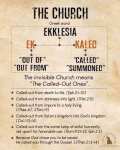







 Does the
 Then,
Then,