ISRAEL – Her Homeland

(Links are used in lieu of footnotes or references)
This is for the select who erroneously believe that Israel is an ‘occupier’ of the area now known as Israel. Here is a map that extends back to around 975 B.C., showing Israel’s historic possession of the lands known as Israel.
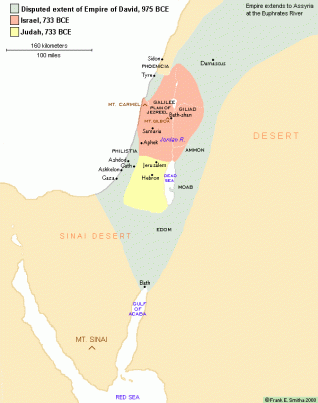
(Click this map link for a clearer view)
King David ruled the region around 1000 B.C. His son, who became King Solomon, is credited with building the first holy temple in ancient Jerusalem. In about 931 B.C., the area was divided into two kingdoms: Israel in the north and Judah in the south. (Let it be stated that Israel is not a current occupier or current inhabitant of this region).
Around 722 B.C., the Assyrians invaded and destroyed the northern kingdom of Israel. In 568 B.C., the Babylonians conquered Jerusalem and destroyed the first temple, which was replaced by a second temple in about 516 B.C.
For the next several centuries, the land of modern-day Israel was conquered and ruled by various groups, including the Persians, Greeks, Romans, Arabs, Fatimids, Seljuk Turks, Crusaders, Egyptians, Mamelukes, Islamists and others
Then, from 1517 to 1917, what is today Israel, along with much of the Middle East, was ruled by the Ottoman Empire.
But World War I dramatically altered the geopolitical landscape in the Middle East. In 1917, at the height of the war, British Foreign Secretary Arthur James Balfour submitted a letter of intent supporting the establishment of a Jewish homeland in Palestine. The British government hoped that the formal declaration—known thereafter as the Balfour Declaration—would encourage support for the Allies in World War I.
When World War I ended in 1918 with an Allied victory, the 400-year Ottoman Empire rule ended, and Great Britain took control over what became known as Palestine (modern-day Israel, Palestine and Jordan).
The Balfour Declaration and the British mandate over Palestine were approved by the League of Nations in 1922. Arabs vehemently opposed the Balfour Declaration, concerned that a Jewish homeland would mean the subjugation of Arab Palestinians.
The British controlled Palestine until Israel, in the years following the end of World War II, became an independent state in 1947.
In 1947, after more than two decades of British rule, the United Nations proposed a plan to partition Palestine into two sections: an independent Jewish state and an independent Arab state. The city of Jerusalem, which was claimed as a capital by both Jews and Palestinian Arabs, was to be an international territory with a special status.
Jewish leaders accepted the plan, but many Palestinian Arabs—some of whom had been actively fighting British and Jewish interests in the region since the 1920s—vehemently opposed it.
Arab groups argued that they represented the majority of the population in certain regions and should be granted more territory. They began to form volunteer armies throughout Palestine. (Taken from History.com)
If one chief theme in the post-1948 pattern was embattled Israel and a second the hostility of its Arab neighbors, a third was the plight of the huge number of Arab refugees. The violent birth of Israel led to a major displacement of the Arab population, who either were driven out by Zionist military forces before May 15, 1948, or by the Israeli army after that date or fled for fear of violence by these forces. Many wealthy merchants and leading urban notables from Jaffa, Tel Aviv, Haifa, and Jerusalem fled to Lebanon, Egypt, and Jordan, while the middle class tended to move to all-Arab towns such as Nablus and Nazareth. The majority of fellahin ended up in refugee camps. More than 400 Arab villages disappeared, and Arab life in the coastal cities (especially Jaffa and Haifa) virtually disintegrated. The center of Palestinian life shifted to the Arab towns of the hilly eastern portion of the region—which was immediately west of the Jordan River and came to be called the West Bank.
Like everything else in the Arab-Israeli conflict, population figures are hotly disputed. Nearly 1,400,000 Arabs lived in Palestine when the war broke out. Estimates of the number of Arabs displaced from their original homes, villages, and neighborhoods during the period from December 1947 to January 1949 range from about 520,000 to about 1,000,000; there is general consensus, however, that the actual number was more than 600,000 and likely exceeded 700,000. Some 276,000 moved to the West Bank; by 1949 more than half the prewar Arab population of Palestine lived in the West Bank (from 400,000 in 1947 to more than 700,000). Between 160,000 and 190,000 fled to the Gaza Strip. More than one-fifth of Palestinian Arabs left Palestine altogether. About 100,000 of these went to Lebanon, 100,000 to Jordan, between 75,000 and 90,000 to Syria, 7,000 to 10,000 to Egypt, and 4,000 to Iraq.
The term “Palestinian”
Henceforth, the term Palestinian will be used when referring to the Arabs of the former mandated Palestine, excluding Israel. Although the Arabs of Palestine had been creating and developing a Palestinian identity for about 200 years, the idea that Palestinians form a distinct people is relatively recent. The Arabs living in Palestine had never had a separate state. Until the establishment of Israel, the term Palestinian was used by Jews and foreigners to describe the inhabitants of Palestine and had only begun to be used by the Arabs themselves at the turn of the 20th century. With the Arab world in a period of renaissance popularizing notions of Arab unity and nationalism amid the decline of the Ottoman Empire, most saw themselves as part of the larger Arab or Muslim community. The Arabs of Palestine began widely using the term Palestinian starting in the pre-World War I period to indicate the nationalist concept of a Palestinian people. But after 1948—and even more so after 1967—for Palestinians themselves the term came to signify not only a place of origin but, more importantly, a sense of a shared past and future in the form of a Palestinian state.
In May 1948, less than a year after the Partition Plan for Palestine was introduced, Britain withdrew from Palestine and Israel declared itself an independent state, implying a willingness to implement the Partition Plan.
Almost immediately, neighboring Arab armies moved in to prevent the establishment of the Israeli state. The 1948 Arab-Israeli War that ensued involved Israel and five Arab nations—Jordan, Iraq, Syria, Egypt and Lebanon. By the war’s end in July 1949, Israel controlled more than two-thirds of the former British Mandate, while Jordan took control of the West Bank and Egypt took control of the Gaza Strip.
The 1948 conflict opened a new chapter in the struggle between Jews and Palestinian Arabs, which now became a regional contest involving nation-states and a tangle of diplomatic, political and economic interests.
The PLO Is Born
In 1964, the Palestine Liberation Organization (PLO) was formed for the purpose of establishing a Palestinian Arab state on the land previously administered under the British Mandate, and which the PLO considered to be occupied illegitimately by the State of Israel. (taken from Britannica).
Here is a current-day map of Israel:

All of this is ‘said and done’ and is recorded in history. Still, there are those who, either by the desire to mislead others or out of ignorance, choose to deny the holocaust ever happened and foolishly say that Israel is an illegitimate occupier of their own lands.
None-the-less, the recent atrocities by the Hamas terrorists which are funded and trained by Iran, are not justified by the desire of the so-called Palestinian-Arabs to establish a homeland.
Nothing can justify the evil and murderous hatred of certain Arabs and peoples, who have publicly stated their desire to destroy Israel and wipe all of her people off the face of the earth. This would be a genocide on an almost unparalleled level – exceeding the evils and horrors of the holocaust perpetrated by Hitler and his Nazis.
So, I want to conclude by saying that if you or anyone you know, and to those who would say that the recent attacks on and the slaughter of innocent Jewish men, women, children and babies by Hamas and Hezbollah and other maniacal murderers in that area are justifiable, YOU ARE EITHER TRAGICALLY MISTAKEN OR ARE FILLED WITH AN EVIL THAT MUST BE ERADICATED.
I will endeavor to make peace with all people, but for those who are filled with lies, rage and the desire to see the destruction of Israel and her people, I will avoid you. I will expose you. I will fight against you.
I pray for the peace of Israel – I stand with Israel.
Michael Young
“And I, God, will bless those who bless you Israel,
And the one who curses you, I will curse.
And in you all the families of the earth will be blessed.”
(Paraphrased from Genesis 12:3)
(Please comment if you agree. A simple “yes” will suffice.)
Discover more from Whitestone Fellowship
Subscribe to get the latest posts sent to your email.


Yes! Brother Mike.
LikeLike