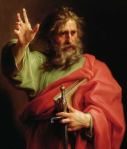
The Purpose of This Letter, The Coming Day of The Lord, A New Heaven and A New Earth
This letter serves as a summary and a recapitulation of Peter’s previously (inspired and God breathed) words of instruction and warnings. (I find myself asking what this all means to me and all other Christians alive during these times? In fact, since our responses, actions and behaviors, as Christians, should emanate from our commitment to our covenant with our Lord and from the power of the indwelling Holy Spirit, I should ask the fundamental of all questions: (1). What truly is God’s salvation of my soul? (2). Am I truly saved? (3). What do I believe is the result of this salvation, which is the most telling of all questions? (4). Do my thoughts, behaviors and actions, particularly in response to this, Peter’s epistle, show that I truly believe what he is saying? Do I believe God’s Word is for me and do my actions show it? (Please consider these questions as you finish this letter).
Purpose of This Letter
2 Peter 3:1,Beloved, this is now the second letter I am writing to you in which I am stirring up your sincere mind by way of a reminder, verse 2, to remember the words spoken beforehand by the holy prophets and the commandment of the Lord and Savior spoken by your apostles.
(Commentary Break): Peter is reaching back to the prophetic writings and warnings of the holy prophets of Israel and continuing in remembrance to what Jesus said and taught (all of which is prophetic in its nature) and which has been passed to the Apostles. Typically, only the most ardent student of the Bible and of Biblical prophecies, would be able to recall all of and to which Peter is referring. So he summarizes. (End Commentary Break).
The Coming Day of the Lord
Verse 3. Know this first-of-all, that in the last days mockers will come with their mocking, following after their own lusts, Verse 4, and saying, “Where is the promise of His coming? For ever since the fathers fell asleep, all things continue just as they were from the beginning of creation.” Verse 5. For when they maintain this, it escapes their notice that by the word of God the heavens existed long ago and the earth was formed out of water and by water, verse 6, through which the world at that time was destroyed by being flooded with water. Verse 7. But by His word the present heavens and earth are being reserved for fire, kept for the day of judgment and destruction of ungodly people.
(Commentary Break): Take careful notice that Peter says “in the last days” mockers will come with their mocking. Peter, in agreement with Jesus, and along with the Apostles Paul and John and the disciple Timothy, is warning that the Last Days – the Tribulation had already begun.
Again, please note: This was written in or around A.D. 68 and the mocking had already begun has only intensified since that time. This is just another clear sign that the “Birth Pains” of the tribulation, (see the Words of Jesus in Matthew 24:8), had already begun in or around the birth of the Christ. Peter continues speaking of the Last Days, (re-read verses 5 through 7), as Peter refers to a time “from the beginning of creation”, going through the judgment by the great deluge, the flood of Noah’s days as a harbinger of judgment and destruction at the End of Days, Bowl Judgments of the Great Tribulation, which conclude with the destruction of the heavens and the earth by a fervent heat. WE HAVE BEEN WARNED IN ADVANCE. (End Commentary Break).
Verse 8. But do not let this one fact escape your notice, beloved, that with the Lord one day is like a thousand years, and a thousand years like one day. Verse 9. The Lord is not slow about His promise, as some count slowness, but is patient toward you, not willing for any to perish, but for all to come to repentance.
(Commentary Break): “With the Lord one day is like a thousand years, and a thousand years like one day”, is a reference to Psalm 90:4, and is God’s POINT OF VIEW or FRAME OF REFERENCE and NOT a reference to the actual passage of a specific period of time. It reflects God’s divine perspective of time contrasted with a human perspective of time. God’s promises and decrees, including the return of Christ, are not delayed but are unfolding according to His perfect timing. (End Commentary Break).
A New Heaven and Earth
Verse 10. But the day of the Lord will come like a thief, in which the heavens will pass away with a roar and the elements will be destroyed with intense heat, and the earth and its works will be discovered. Verse 11. Since all these things are to be destroyed in this way, what sort of people ought you to be in holy conduct and godliness, verse 12, looking for and hastening the coming of the day of God, because of which the heavens will be destroyed by burning, and the elements will melt with intense heat! Verse 13. But according to His promise we are looking for new heavens and a new earth, in which righteousness dwells.
(Commentary Break): Jesus also says, in Matthew 24:42-44, “Therefore be on the alert, for you do not know which day your Lord is coming. But be sure of this, that if the head of the house had known at what time of the night the thief was coming, he would have been on the alert and would not have allowed his house to be broken into. For this reason you must be ready as well; for the Son of Man is coming at an hour when you do not think He will.” This is not saying Jesus is a ‘thief’ but that He will return stealthily and without warning. The great question here is what does He mean to “be on the alert” of to be ready for His return? (See Matthew 24:42-51 through Matthew 25:1-29 and the parables of the ten virgins and of the talents given to His servants.) (End Commentary Break).
Verse 14. Therefore, beloved, since you look for these things, be diligent to be found spotless and blameless by Him, at peace, verse 15, and regard the patience of our Lord as salvation; just as also our beloved brother Paul, according to the wisdom given him, wrote to you, verse 16, as also in all his letters, speaking in them of these things, in which there are some things that are hard to understand, which the untaught and unstable distort, as they do also the rest of the Scriptures, to their own destruction.
(Commentary Break): We, as His children, are to pray for and realize the fruit of the Holy Spirit of peace, love, joy, peace, patience, kindness, goodness, faithfulness, gentleness, and self-control which dwell within each of us which we must exercise. Peter also urges us to know that we are to be patient as Jesus reminds that “it is the one who endures to the end who will be saved”. Furthermore, Peter is speaking of God’s merciful patience, allowing more time for repentance and salvation. This aligns with 2 Peter 3:9, which states that God is patient, not wanting anyone to perish. The concept of divine patience is also seen in the Old Testament, such as in the story of Noah (Genesis 6-9), where God waited patiently while the ark was being built. This patience is a reflection of God’s character, as seen in Exodus 34:6, where God is described as “slow to anger.” (End Commentary Break).
Verse 17. You therefore, beloved, knowing this beforehand, be on your guard so that you are not carried away by the error of unscrupulous people and lose your own firm commitment, verse 18, but grow in the grace and knowledge of our Lord and Savior Jesus Christ. To Him be the glory, both now and to the day of eternity. Amen. (End Second Peter).
Peter finishes by once again warning against spending time around or with false teachers and unscrupulous people and the deleterious effects of being around such.
Dear friends, it would be easy to read these things and think “this is just too much for me to remember or too hard for me to do. So I will do what I can and that will have to be enough”. There is some truth to that line of reasoning, but I caution even myself to exercise all discipline and care to educate and inform myself by the full Word of God. There is no such thing as being “partially saved” or “sort of saved”. You either are or you are not. It is to your benefit to “go all in”. Be that fully devoted follower and disciple of Jesus and God will know your heart.
This book and chapter may be one of the clearest warnings about the deceits and dangers of false prophets, the potential of apostasy and its consequences and the most difficult to resolve when cast in the light of the major denominational doctrinal views. (I will comment based only on a Whole-Bible-context using a face-value-reading perspective; and I will strive to use a sound exegetical approach – as opposed to eisegesis).
Please remember, that although this was written in around A.D. 65 its extended audience is every true believer in Christ Jesus, (i.e., Christians), throughout the ages, even to this very day and until the consummation of the age. I am appealing to us all to take this seriously, especially in our day of the corruption that has infected the Church. This is personal.
The Appearance of False Prophets
2 Peter 2:1, But false prophets also appeared among the people, just as there will also be false teachers among you, who will secretly introduce destructive heresies, even denying the Master who bought them, bringing swift destruction upon themselves.
(Commentary Break): The following is lengthy, but considering the importance of Peter’s words of warning, it is necessary. Please be patient and read.
The deceitful methods used by false prophets which will come in the form of a religious (Bible) teacher, pastor, evangelist, theologian and the likes, perhaps having attended the best schools and seminaries. They skillfully reinterpret scriptures to fit their own views for their own gain. They may even “provide great signs and wonders, so as to mislead, (deceive and lure), if possible, even the elect” with destructive heresies.
(Note: The following commentary is gleaned from various sources is not mine, but I whole heartedly agree with what is presented):
Destructive heresies rarely show up today with their old historical labels—they tend to reappear in updated, more subtle forms inside churches, media ministries, and popular teaching. Here’s how many of the classic errors are showing up in modern Christianity:
1. Arianism (Denying Christ’s full deity), “Jesus is less than God” language
Modern form:
Jesus described as:
“a great teacher”,
“a created being”,
“a model of divine potential we all share”.
Seen in some fringe groups and occasionally in watered-down preaching.
Why it matters:
If Jesus is not fully God, the gospel becomes moral example, not atoning salvation.
11. Soft Apostasy. Gradual drifting, not outright denial
This is one of the most common today.
Looks like:
Deconstructing faith without reconstruction,
Quietly abandoning core doctrines,
Redefining Christianity to match culture.
A Key Pattern.
Most modern distortions fall into three categories:
1. Lowering God / Christ.
Making Jesus less divine, less authoritative.
2. Elevating Man
Making salvation about:
self-improvement,
self-expression,
self-empowerment,
3. Redefining Sin and Salvation.
Sin becomes:
weakness, not rebellion.
Salvation becomes:
fulfillment, not redemption.
A Biblical Safeguard.
The New Testament repeatedly gives a simple guardrail:
Stay anchored in apostolic teaching (Acts 2:42).
Test everything (1 Thessalonians 5:21).
Watch doctrine and life closely (1 Timothy 4:16).
Bottom Line
Modern heresies rarely sound extreme at first—they usually:
sound compassionate,
feel empowering,
seem spiritually deep.
But ultimately shift the center away from Christ and the gospel. (end internet web sources).
There is a view that “the elect” cannot be deceived, but in light of what Peter is saying, nothing according to the various denominational doctrinal views is settled on this matter. Take the inspired words of the scriptures at their face value wherever appropriately possible and beware. (End Commentary Break).
Verse 2. Many will follow their indecent behavior, and because of them the way of the truth will be maligned; verse 3, and in their greed they will exploit you with false words; their judgment from long ago is not idle, and their destruction is not asleep.
(Commentary Break): Please forgive the graphic nature of these contemporary examples of “Many will follow their indecent behavior” and “in their greed they will exploit you with false words”, but they will serve as a warning. You are not immune. Be on guard. (End Commentary Break).
Verse 4. For if God did not spare angels when they sinned, but cast them into hell and committed them to pits of darkness, held for judgment; verse 5, and did not spare the ancient world, but protected Noah, a preacher of righteousness, with seven others, when He brought a flood upon the world of the ungodly; verse 6, and if He condemned the cities of Sodom and Gomorrah to destruction by reducing them to ashes, having made them an example of what is coming for the ungodly; verse 7, and if He rescued righteous Lot, who was oppressed by the perverted conduct of unscrupulous people, verse 8, (for by what he saw and heard that righteous man, while living among them, felt his righteous soul tormented day after day by their lawless deeds), verse 9, then the Lord knows how to rescue the godly from a trial, and to keep the unrighteous under punishment for the day of judgment, verse 10, and especially those who indulge the flesh in its corrupt passion, and despise authority. Reckless, self-centered, they speak abusively of angelic majesties without trembling, verse 11, whereas angels who are greater in might and power do not bring a demeaning judgment against them before the Lord. Verse 12. But these, like unreasoning animals, born as creatures of instinct to be captured and killed, using abusive speech where they have no knowledge, will in the destruction of those creatures also be destroyed, verse 13, suffering wrong as the wages of doing wrong. They count it a pleasure to revel in the daytime. They are stains and blemishes, reveling in their deceptions as they feast with you, verse 14, having eyes full of adultery that never cease from sin, enticing unstable souls, having hearts trained in greed, accursed children; verse 15, abandoning the right way, they have gone astray, having followed the way of Balaam, the son of Beor, who loved the reward of unrighteousness; verse 16, but he received a rebuke for his own offense, for a mute donkey, speaking with a human voice, restrained the insanity of the prophet.
Verse 17. These are springs without water and mists driven by a storm, for whom the black darkness has been reserved. Verse 18. For, while speaking out arrogant words of no value they entice by fleshly desires, by indecent behavior, those who barely escape from the ones who live in error, verse 19, promising them freedom while they themselves are slaves of corruption; for by what anyone is overcome, by this he is enslaved.
(Commentary Break): Peter is referring to the time before the Great Deluge and the time of Noah to compare and contrast a time when “the LORD saw that the wickedness of mankind was great on the earth, and that every intent of the thoughts of their hearts was only evil continually” and His just punishment of their sin. This Great Flood was not only God’s Judgment but is also a harbinger of things to come.
People, throughout the ages, have been reflective of this depravity and it is no different in our day. Except that in our day there is a concurrence and a convergence of events such as the world has not seen before. (End Commentary Break).
Verse 20. For if, after they have escaped the defilements of the world by the knowledge of the Lord and Savior Jesus Christ, they are again entangled in them and are overcome, the last state has become worse for them than the first. Verse 21. For it would be better for them not to have known the way of righteousness, than having known it, to turn away from the holy commandment handed on to them.
(Commentary Break): There is a strong argument for the Calvinist reformed view of “the perseverance of the saints” (once saved always saved) but when tested the adherents fall back on the “man-made” theory that “they probably were not really saved in the first place”. But Peter is issuing a warning that, in no uncertain terms, seems to say otherwise. Romans 6:4-8 also warns, “For it is impossible, in the case of those who have once been enlightened and have tasted of the heavenly gift and have been made partakers of the Holy Spirit, and have tasted the good word of God and the powers of the age to come, and then have fallen away, to restore them again to repentance, since they again crucify to themselves the Son of God and put Him to open shame. For ground that drinks the rain which often falls on it and produces vegetation useful to those for whose sake it is also tilled, receives a blessing from God; but if it yields thorns and thistles, it is worthless and close to being cursed, and it ends up being burned.” (End Commentary Break).
Verse 22. It has happened to them according to the true proverb, “A DOG RETURNS TO ITS OWN VOMIT,” and, “A sow, after washing, returns to wallowing in the mire.”
(Commentary Break): This imagery underscores the repulsive nature of returning to sinful behaviors after having known the truth of the Gospel. The proverb serves as a warning against apostasy and the dangers of reverting to a sinful lifestyle after experiencing the cleansing power of Christ. The image of a washed sow returning to the mud further illustrates the futility of external cleansing without internal transformation. In Jewish culture, pigs were considered unclean animals, and the act of washing a pig only for it to return to the mud highlights the superficiality of outward change without genuine repentance. This reflects the broader biblical theme that true conversion involves a change of heart, not just behavior. The imagery serves as a caution against superficial faith and underscores the necessity of a deep, transformative relationship with Christ. And yes, this is very personal. (End Commentary Break). (End of 2 Peter, Chapter 2).
Peter begins this Chapter saying, “But false prophets also appeared among the people, just as there will also be false teachers among you, who will secretly introduce destructive heresies, even denying the Master who bought them” which what Jesus warned of in Matthew 24:4-5, When “He said to them, “See to it that no one misleads you. For many will come in My name, saying, ‘I am the Christ,’ and they will mislead many people.” All of this began during the time of Christ ministry on earth and has increased in its intensity and has been overlapping with other End Times prophetic warnings such as wars and rumors of war, famines, plagues (of new diseases), earthquakes, apostasy and great persecution and martyrdom of believers.
Let’s take heed, dear friends. Those days are upon on and the “fig tree” is telling us that the season of the return of Christ for His Church is near. Let’s stand fast, praying for one another and completing the tasks and commands of our Lord.
I have said in many of these Bible studies that I will use “commentary breaks” for commenting or to highlight certain principles and to make certain verses clear for context and intent. All of this is not meant to be as a deep theological study as found in many excellent bible commentaries or helps such as the Blue Letter Bible, BibleHub.com, GotQuestions.Org, Strong’s Concordance or Enduring Word, to name just a few. I will draw on these aforenamed resources for their expertise.
But my primary intention here is to focus on the values, importance and urgency of the application of these scriptures in our daily lives. Not just as a matter for show, but to engage and to release this remarkable power of the Gospel and the authorities given us by our Lord Jesus Christ into the world through our own lives and bodies. (Please know that I am aware of how this might sound to some, but to have all knowledge and wisdom that is unused and unapplied renders it as just idle information. It is as Matthew reminds us, “You are the salt of the earth, but if salt has lost its taste, how shall its saltiness be restored? It is no longer good for anything except to be thrown out and trampled under people’s feet.”
I pray that this Book of the Scriptures, when applied through your life, will accomplish the very things God intended – and nothing will ever be the same.
The Book of Second Peter, Chapter 1
Growth in Christian Virtue, Eyewitness
The Book of First Peter was instrumental in laying out the foundations of the corporate Church. The Book of Second Peter is instrumental in strengthening and preparing the individual Christian to become all that God intended for, in and through His Church.
Please, dear brothers and sisters in Christ, please do not forget that we have learned that although you and I were once not a people, but we are now a people; we are living stones being built up as a spiritual house as a holy priesthood to offer sacrifices that are acceptable to God through Jesus Christ.
You and I, we, are a chosen people, a royal priesthood, a holy nation, a people for God’s own possession, so that you may proclaim the excellencies of Him who has called you out of darkness into His marvelous light; for you once were not a people, but now you are the people of God; you had not received mercy, but now you have received mercy.
This Book is written to you, and for you. So let’s act as His Chosen, as His Royal Priesthood and offer our lives up as that good and acceptable sacrifice to God through Jesus Christ. (To God, you are somebody – you are His.)
Growth in Christian Virtue
2 Peter 1:1, Simon Peter, a bond-servant and apostle of Jesus Christ,
To those who have received a faith of the same kind as ours, by the righteousness of our God and Savior, Jesus Christ:
(Commentary Break): Peter, the impulsive, the brave, the fearful, the chosen. If you had known Peter before his transformation through Christ by way of the transforming power of the Holy Spirit you might have a hard time recognizing him now. Peter whose faith has been forged by the fires of the sufferings of Christ is relating to his brothers in the bonds of this faith. But, if all we do is learn about Peter, we have missed the main point: This is the same faith God is both offering and to which God is calling you. It is this kind of faith that will completely transform you and your life from that of a bystander into a fully devoted disciple of Christ and a fully engaged warrior of the Cross. Once the process of your transformation is begun, people may well ask of you also, “is this the same person I once knew?” This process as taught by Jesus, by which one arrives at or obtains this “faith of the same as ours” is described and taught by Jesus Himself in Matthew 5:1-14. (Please click here and read before proceeding, to The Sermon on The Mount). (End Commentary Break).
Verse 2. Grace and peace be multiplied to you in the knowledge of God and of Jesus our Lord, verse 3, for His divine power has granted to us everything pertaining to life and godliness, through the true knowledge of Him who called us by His own glory and excellence.
(Commentary Break): Please read this again: “For His divine power has granted to us…”. We are not alone; we are not helpless and we are not bystanders. We are, if we so choose, an active participant in a partnership with God, through our advocate Jesus Christ. He has empowered us to accomplish all He has decreed through the power and working of the Holy Spirit which pertains to life, godliness and the true knowledge of Him.
The true knowledge of Him is not just an acknowledgment or ‘head knowledge’ of Him, i.e. it is not just a cognitive matter. This knowledge, (epignōsis) of Him denotes an experiential, relational, and transforming knowledge. It is more than data acquisition; it embraces recognition, acknowledgment, and personal appropriation of truth revealed by God. In the New Testament it is always anchored in divine initiative and always bears moral and spiritual consequences. It is a deep penetrating knowing that originates only in the regenerate spirit of a believer, which wells up through the emotions, the will and the mind, instructing, creating, causing and enabling us by way of His own glory and excellence. This is not a metaphor nor is it a simile. It is the living outcome of the truth spoken into and through the fully devoted and engaged disciple of Christ giving us all things pertaining to life and godliness. (End Commentary Break).
Verse 4. Through these He has granted to us His precious and magnificent promises, so that by them you may become partakers of the divine nature, having escaped the corruption that is in the world on account of lust.
(Commentary Break): It is estimated, by several sources that the Bible contains somewhere between 7,000 and 8,000 promises in the Bible (depending on how promises are counted and defined) with about 5,000 attributed specifically to God. Many religious people, including Christians, will mistakenly “claim” the promises of God for themselves, as if to say they can “name it and claim it” for their own exclusive use or benefit. But claiming a promise of God really should mean that one is trusting that God is faithful to His Word; that we can pray bases on what God’s Word says; and that we can properly apply scriptures in context. It is less about what will happen and more about relying on God’s character. In this case, however, Peter is telling us that God’s magnificent promises make it possible for us to partake in His divine nature.
(Taken from GotQuestions.Org) There are several notable points in 2 Peter 1:3–4. First, God’s power has granted us the “very great promises” concerning our salvation. Second, it is through those promises that we are made “partakers of the divine nature.” Third, being partakers of the divine nature involves escaping the world’s decay and rising above sinful desires. Simply put, when we are saved, we receive a new nature, by which we do not perish with the world.
Human “nature” in the Bible is what makes us “us.” A man’s nature is the sum total of qualities that make him who he is. It is a person’s inherent character and that which constitutes his or her individuality. According to the Bible, every human being is born with Adam’s nature, which is sinful; we have a natural bent toward pleasing self (Romans 5:12; 7:14). Our natural selves cannot please God (Romans 8:8). Our sin nature keeps us from fellowship with God, keeps us in bondage to sin, and leads eventually to spiritual death (Romans 6:16, 23; 7:14; 2 Peter 2:19). We cannot free ourselves from sin because we cannot change our natures, just as a tiger cannot change its stripes.
When we believe on the Lord Jesus Christ, we are saved (Acts 16:31), and we undergo a radical spiritual transformation. This is what Peter means when he says we are made partakers of the divine nature. We are made new creations in Christ (2 Corinthians 5:17). We are born again (John 3:3). We died, and now our lives are “hidden with Christ in God” (Colossians 3:3). We are “in Christ” (Romans 8:1).
As partakers of the divine nature, believers do not have to follow the sin nature any more. At salvation, our old nature is defeated, and we receive a new, divine nature that desires the things of God (2 Corinthians 5:17). We love what He loves and hate what He hates (Galatians 5:22; 1 John 4:4).
As partakers of the divine nature, believers are no longer enslaved to the passions and sins of the flesh (Romans 6:6, 14). We have power from on high to conquer every temptation that comes against us (1 Corinthians 10:13).
As partakers of the divine nature, believers are made part of the family of God (John 1:12), and this results in a changed life. First John 3:9 says, “No one who is born of God will continue to sin, because God’s seed remains in them; they cannot go on sinning, because they have been born of God.” By giving us His nature, God makes us His sons and daughters and conforms us to the image of His Son (Romans 8:29; 2 Corinthians 6:18).
As partakers of the divine nature, believers have the Holy Spirit indwelling them. God declares that we are “more than conquerors” because of the power of the Holy Spirit within our hearts (Romans 8:37). Our Comforter/Advocate/counselor is with us wherever we go (John 14:16). We will never be forsaken (Hebrews 13:5).
God is faithful to keep His “great and precious promises,” and we praise Him for our Savior and Redeemer, Jesus Christ; for the gift of the Holy Spirit; and for the everlasting life we enjoy as partakers of His divine nature. (End excerpt).
(End Commentary Break).
Verse 5. Now for this very reason also, applying all diligence, in your faith supply moral excellence, and in your moral excellence, knowledge, verse 6, and in your knowledge, self-control, and in your self-control, perseverance, and in your perseverance, godliness, verse 7, and in your godliness, brotherly kindness, and in your brotherly kindness, love. Verse 8. For if these qualities are yours and are increasing, they do not make you useless nor unproductive in the true knowledge of our Lord Jesus Christ.
(Commentary Break): Herein lies the intersection of the human and the divine. Here is where we cease to be idle bystanders, recipients alone waiting for God to change us without our participation, and become partakers, accomplices in His transformative works. This is important for all believers to understand. God begins His transforming work within the believer – in his or her regenerated spirit. This transforming power is infused in our core being, or spirit (pneuma), and wells up and spreads first through our soul (the psyche which is our mind, will and emotions), then having influenced how we feel, and how we think and our will to act, this transformation moves to the cognitive mind and body (soma) and we live out and live in and by His divine nature. This is truly a miracle of unparalleled proportions. As it is said in 2 Corinthians 5:17, you will have been made into a new creation, “Therefore if anyone is in Christ, this person is a new creation; the old things passed away; behold, new things have come”, and again in 1 Thessalonians 5:23, “Now may the God of peace Himself sanctify you entirely; and may your spirit and soul and body be kept complete, without blame at the coming of our Lord Jesus Christ”. (End Commentary Break).
Verse 9. For the one who lacks these qualities is blind or short-sighted, having forgotten his purification from his former sins.
(Commentary Break): Spiritual nearsightedness can lead to a separation from God, making it difficult to recognize His presence and respond to His call. This condition may also result in poor judgment, self-deception, and a lack of personal growth in faith.
Spiritual nearsightedness, often referred to as spiritual blindness, can have significant negative effects on an individual’s relationship with God and their overall spiritual well-being. Below are the key consequences:
Separation from God
Difficulty Recognizing God’s Presence: Individuals may struggle to feel or see God’s influence in their lives.
Inability to Respond to God’s Call: This separation can lead to a lack of awareness of spiritual guidance and purpose.
Poor Judgment
Misleading Beliefs: Without clear spiritual vision, individuals may fall for false teachings or ideologies that seem appealing but are ultimately harmful.
Inability to Discern Truth: This can result in making unwise choices that lead to regrets.
Lack of Personal Growth
Stagnation in Faith: Spiritual blindness can prevent individuals from experiencing growth or maturity in their faith.
Missed Opportunities for Fulfillment: Without spiritual insight, individuals may miss out on the deeper blessings and wisdom that come from a relationship with God.
Self-Deception
False Sense of Security: People may believe they are on the right path spiritually, even when their actions contradict their beliefs.
Hypocrisy: This can lead to judgmental attitudes and a lack of empathy towards others.
Impact on Relationships
Strained Interpersonal Connections: Spiritual blindness can manifest as judgmental behavior or a lack of understanding, harming relationships with others.
Community Effects: The consequences of one person’s spiritual blindness can extend to families and communities, leading to broader issues.
Addressing spiritual nearsightedness is crucial for restoring clarity and connection with God, allowing for a more fulfilling spiritual life. (End Commentary Break).
Verse 10. Therefore, brothers and sisters, be all the more diligent to make certain about His calling and choice of you; for as long as you practice these things, you will never stumble;
(Commentary Break): “Be all the more diligent to make certain about His calling and choice of you”, implies active effort and diligence. The “calling” refers to God’s invitation to salvation. This reflects the biblical tension between divine sovereignty and human responsibility. The assurance of one’s calling and election is not passive but requires active participation in faith and obedience. And, “these things” refer to the qualities listed earlier in the chapter, such as faith, virtue, knowledge, self-control, perseverance, godliness, brotherly kindness, and love. Practicing these virtues is a sign of spiritual growth and maturity. The emphasis on practice suggests that faith is demonstrated through action, aligning with James 2:17, which states that “faith by itself, if it does not have works, is dead.” This concept is echoed in Philippians 2:12, where believers are urged to “work out your own salvation with fear and trembling.” (End Commentary Break).
verse 11, for in this way the entrance into the eternal kingdom of our Lord and Savior Jesus Christ will be abundantly supplied to you.
(Commentary Break): There is much that can be said about verse 11. First, the phrase, “the kingdom (of our Lord and Savior Jesus Christ): Such a succinct and simple sounding statement by Peter is in reality a profound oracle of God. It is the portal to the ‘Other Side’ – from the natural world into the realm where all things originate. It is the ‘Basileia Ouranos’, the Kingdom of Heaven.
Also see Matthew 5:1, When Jesus saw the crowds, He went up on the mountain; and after He sat down, His disciples came to Him. Verse 2. He opened His mouth and began to teach them, saying, verse 3, “Blessed are the poor in spirit, for theirs is the kingdom of heaven”.
The kingdom of heaven, from Strong’s #939, conveys the notion of a foundation of power;
1) royal power, kingship, dominion, rule
1a) not to be confused with an actual kingdom but rather the right or authority to rule over a kingdom
1b) of the royal power of Jesus as the triumphant Messiah
1c) of the royal power and dignity conferred on Christians in the Messiah’s kingdom.
(Note: This comes from a root word baino, “to walk”, AV-foot (sole of);
1) a stepping, walking
2) that with which one steps, the foot
This reminds us of the tremendous proclamation in Joshua 1:3 “Every place on which the sole of your foot treads, I have given it to you, just as I spoke to Moses.” And this is the outcome of the promise and the living reality of “His precious and magnificent promises, so that by them you may become partakers of the divine nature”.
We are becoming and, in a real sense we have already become, heirs of the Kingdom of God, the place of the foundation of all power kingship, dominion and rule, not to be confused with an actual kingdom but rather the right or authority to rule over a kingdom, God’s Kingdom. It is of the royal power of Jesus as the triumphant Messiah. It is the Place of the royal power and dignity conferred on Christians in the Messiah’s kingdom. (From Strong’s concordance, definitions and translations of the Greek and Hebrew languages) Also see Ephesians 1:4, But God, being rich in mercy, because of His great love with which He loved us, even when we were dead in our transgressions, made us alive together with Christ and raised us up with Him, and seated us with Him in the heavenly places in Christ Jesus, (End Commentary Break).
Verse 12. Therefore, I will always be ready to remind you of these things, even though you already know them and have been established in the truth which is present with you. Verse 13. I consider it right, as long as I am in this earthly dwelling, to stir you up by way of reminder, verse 14, knowing that the laying aside of my earthly dwelling is imminent, as also our Lord Jesus Christ has made clear to me. Verse 15. And I will also be diligent that at any time after my departure you will be able to call these things to mind.
Eyewitnesses
Verse 16. For we did not follow cleverly devised tales when we made known to you the power and coming of our Lord Jesus Christ, but we were eyewitnesses of His majesty.
Verse 17. For when He received honor and glory from God the Father, such a declaration as this was made to Him by the Majestic Glory: “This is My beloved Son with whom I am well pleased”— verse 18, and we ourselves heard this declaration made from heaven when we were with Him on the holy mountain.
(Commentary Break): We are not hearing a second-hand news report here, which could be subject to interpretation and error. This is Peter’s first-hand account. It is trustworthy. (End Commentary Break).
Verse 19. And so we have the prophetic word made more sure, to which you do well to pay attention as to a lamp shining in a dark place, until the day dawns and the morning star arises in your hearts. Verse 20. But know this first of all, that no prophecy of Scripture becomes a matter of someone’s own interpretation, verse 21. for no prophecy was ever made by an act of human will, but men moved by the Holy Spirit spoke from God.
(Commentary Break): The Bible, The Word of God, as testified to by the Apostle Peter is prophetic, creative, causative and instructional by its very nature and is never a matter of someone’s own interpretation which is all too often the case in these Last Days. The Word of God moved certain men by the Holy Spirit, and they spoke from God. So, if you hear someone say, in relation to events or situations, “Thus sayeth the Lord”, turn away from the and turn to the Word. The events that surround us may give us a glimpse of what has already been decreed by God, and there is not and will never be any new revelation. Beware. (see Matthew 24:4-5). (End Commentary Break).
(End of the Book of Second Peter chapter 1).
We are not to build nests or dig holes and call them the Church; we are not to ‘settle in and spend our days looking skyward, just waiting for His return, planning and enjoying our ‘christian lifestyles’. No. We are the Church – organic, militant and on the move – finishing the commission and commands of God through Christ; reclaiming His Ground and His Children from the enemy. We know that the gates of hell cannot prevail against us, (see Matthew 16:18, which means that the power of evil and death and the realm of the dead will not overcome the church of Jesus Christ. It assures us as believers that despite challenges, we will ultimately have victory over Satan, death through faith in Christ.
So we, by faith, mount the attack and hold our ground.