God’s “called out ones”, that is those people who believe in, follow and are called out of the world’s system and ways, called out from “living in darkness to living in God’s Light”, called out from impure living to holy living, called out of Satan’s kingdom into God’s Kingdom, called out from the sinfulness of humanity for honorable use by God.
Those who worship and glorify God, build up the unity of the fellowship, learn through teaching and discipleship. Those who actively evangelize and serve with compassion and proclaim the Kingdom of God, who are being transformed and sanctified by the word of God, equipping others for eternity.
Those who make disciples, glorify Christ, build up the saints of God, worship in community, serve God and represent His justice.
Then, shouldn’t (The Church), be the same as,
, The Purpose of the Church, and , The Mission of the Church?
These are the
Of The Church
So, what would you call a large group of people who are loving, and who show unselfish concern for other; people who are joyful and show an inner peace; people who are patient, and show not only the ability to wait, they wait with kindness, people who are good, faithful, and gentle, showing great self-control?
People who show a loving attitude and behavior that allows them to endure with patience and serenity; a people showing a love that is kind and thoughtful, that is not jealous or envious; a people showing a kind of love does not brag and is not proud or arrogant. People who are not rude; not self-seeking, not provoked nor are overly sensitive and not easily angered; People with a loving attitude that does not take into account a wrong endured. They do not rejoice at injustice, but rejoice with the truth when right and truth prevail.
People with a love toward others that bears all things regardless of what comes upon them, believes all things, that is looking for the best in each person, hopes all things, remaining steadfast during difficult times, and endures all things without weakening. People with a love that never fails, never fades and never ends.
Then the sum is that The Church which exists to glorify God, disciple believers, proclaim the message of salvation, demonstrate compassion, and uphold the truth of Scripture. Grounded in the consistent testimony of Scripture, the church continues to stand as a radiant beacon of faith and hope to the world, pointing all people to a loving Creator and the resurrected Redeemer.
Thus, the Church is a dynamic and ongoing endeavor, rooted in the teachings of Scripture and empowered by the Holy Spirit. It encompasses evangelism, discipleship, worship, community service, and social justice, all aimed at glorifying God and advancing His kingdom on earth. Through faithful obedience to this mission, the Church fulfills its calling as the body of Christ, bearing witness to the transformative power of the Gospel.
Now, let’s be honest and frank with ourselves: Is this what you find when you “go to church”?
Is this what you practice when you “go to church”?
If not, then something is terribly wrong with our own equation of Church, and please dear friends, you and I may just need to do or re-do the math. These A, B, Cs should equal Church.
Genesis 6:1-4, Now it came about, when mankind began to multiply on the face of the land, and daughters were born to them, that the sons of God saw that the daughters of mankind were beautiful (or good); and they took wives for themselves, whomever they chose.Then the Lord said, “My Spirit will not remain with man forever (or rule in; or strive with), because he is also flesh (or, in his going astray, he is flesh); nevertheless (or, therefore) his days shall be 120 years.” The Nephilim (or, the fallen ones) were on the earth in those days, and also afterward, when the sons of God came in to the daughters of mankind, and they bore children to them. Those were the mighty men who were of old, men of renown.
Dr. Chuck Missler discusses the Nephilim as beings linked to UFO phenomena and explores their biblical significance, suggesting they may have a disturbing agenda for Earth. He emphasizes the relevance of these topics in contemporary discussions about extraterrestrial life and biblical prophecy.
This subject has not gone away. On the contrary, much new evidence has surfaced with global implications. Chuck explores the Biblical relevance and disturbing agenda of the apparent extraterrestrial life forms that have been forcing themselves into our global consciousness, and reveals their most disturbing agenda.
“For there shall arise false Christs, and false prophets, and shall shew great signs and wonders; insomuch that, if it were possible, they shall deceive the very elect.” (Matthew 24:24)
If this is true – and more and more evidence is suggesting it is true – what happens to your view of the Bible and your view of God? (You and I really need to get ahead of this – NOW!)
(I was taking notes on this subject as a means for me to explore and understand why I and others are feeling so restless about Church. Then, I decided to turn it into an article. So, I would ask, why do you go to church? And, do you feel you are completing the Great Commission in your life and experience?).
Acts 2:42 could be considered a purpose statement for the church: “They devoted themselves to the apostles’ teaching and to the fellowship, to the breaking of bread and to prayer.” According to this verse, the purposes/activities of the church should be 1) teaching biblical doctrine, 2) providing a place of fellowship for believers, 3) observing the Lord’s supper, and 4) praying. (GotQuestions.Org). The Apostle Paul gave an excellent illustration to the believers in Corinth. The church is God’s hands, mouth, and feet in this world—the body of Christ (1 Corinthians 12:12-27). We are to be doing the things that Jesus Christ would do if He were here physically on the earth. The church is to be “Christian,” “Christ-like,” and Christ-following.
The purpose of the Church is deeply rooted in God’s plan of redemption and ongoing work in the world:
Spiritual Worship and Glorification of God. (BibleHum.com).
In sum, the church exists to glorify God, disciple believers, proclaim the message of salvation, demonstrate compassion, and uphold the truth of Scripture. Historical, archaeological, and manuscript findings reinforce that the earliest believers actively embraced these purposes, laying the foundation for the church’s ongoing mission. Grounded in the consistent testimony of Scripture, the church continues to stand as a radiant beacon of faith and hope to the world, pointing all people to a loving Creator and the resurrected Redeemer. (BibleHub.com).
The Mission of the Church
The mission of the church is to make disciples. (GotQuestions.Org).
The mission of the church is to glorify Christ. (GotQuestions.Org).
The mission of the church is to build up the saints. (GotQuestions.Org).
Conclusion: The mission of the Church is a dynamic and ongoing endeavor, rooted in the teachings of Scripture and empowered by the Holy Spirit. It encompasses evangelism, discipleship, worship, community, service, and social justice, all aimed at glorifying God and advancing His kingdom on earth. Through faithful obedience to this mission, the Church fulfills its calling as the body of Christ, bearing witness to the transformative power of the Gospel.
Interestingly enough, however, here are the top 10 reasons on “Why I Attend Church”, given by Americans who attend religious services at least once a month, according to a Pew Research survey. Respondents were allowed to give more than one reason. The percentage refers to people who said this was a “very important” reason for their decision:
To become closer to God. (81%)
So their children will have a moral foundation. (69%)
To become a better person. (68%)
For comfort in times of trouble or sorrow. (66%)
They find the sermons valuable. (59%)
To be part of a faith community. (57%)
To continue their family’s religious traditions. (37%)
They feel a necessary obligation to go. (31%)
To meet new people or socialize. (19%)
Because the pastor knows my name. (added by author.)
Is the Church in a conundrum here? Are people going to church for the ‘Right Reasons’? (And, just as interesting, people stop going to church if they do not get what is on the list of 10 reasons they came to church in the first place – or because the music is too loud or too contemporary; the sermons are too long, the seats are uncomfortable, etc.)
And conversely, are churches following the Biblical model and mandate of the Mission and Purpose of the Church?
No matter the source you turn to for the answer, Pew Research, Barna Research, The Heritage Foundation, Gallup, etcetera, the answer is the same. The Church is adrift from God’s Biblically stated Mission and Purpose, pandering to the wishes and wants of the spiritually hungry in order to draw a crowd (for the cash?).
2 Timothy 4:3-4 warned this day was coming, “For the time will come when they will not tolerate sound doctrine; but wanting to have their ears tickled, they will accumulate for themselves teachers in accordance with their own desires, and they will turn their ears away from the truth and will turn aside to myths”.
How can we, or should we, get back to the basics? If so, we should start from ‘the ground up’. How did it all get started?
It could be said that the forerunner of the Christian church was the Tabernacle also known as the Tent of the Congregation or the Tent of the Meeting. It was the portable earthly dwelling of God used by the Israelites from the Exodus until the conquest of Canaan. Moses was instructed at Mount Sinai to construct and transport the tabernacle with the Israelites on their journey through the wilderness and their subsequent conquest of the Promised Land. After 440 years, Solomon’s Temple in Jerusalem superseded it as the dwelling-place of God (also see The Tabernacle, Learn Religions).
The Tabernacle was an outward expression of an inward confession and conviction. The Lord spoke to Moses and to Aaron after the Israelite fled captivity in Egypt, and gave them explicit instructions on setting up their wilderness camp. Numbers 2 consists entirely of God giving commandments as to how the Israelite camp should be arranged. From the NASB:
On the east, toward the sunrise, the divisions of the camp of Judah are to encamp under their standard. The tribe of Issachar will camp next to them. The tribe of Zebulun will be next. All the men assigned to the camp of Judah, according to their divisions, number 186,400. They will set out first. (The rest of the tribes are described).
So the Israelites did everything the Lord commanded Moses; that is the way they encamped under their standards, and that is the way they set out, each of them with their clan and family.
If you want to read more about the significance and the symbolism of the Tabernacle and the of Holies, click here: The Tabernacle, or here, Explore the Tabernacle.
Why does the Bible record all the things that happened during those 40 years? The Scripture tells us it was for an example, a foreshadowing. These things happened to them for our admonition. Paul makes a point in 1 Corinthians 10:11 that everything written then is for our application now. Every one of the events in Numbers has a lesson for us. And that’s why it is so important to study this book in detail.
The word ”example” in Greek is ‘tupos’, which is ”a figure, an image, a pattern, a pre-figuring.” That’s where we get the term ”type,” or model. Engineers speak of a prototype, which is from the same root. Types are common in the Bible, where some event, some object, or some situation is a lesson, in advance, of what’s coming. Once again, the Tabernacle and the wilderness camp was an outward expression of an inward conviction and confession.
The center of the Tabernacle was the Holy of Holies, the Holy Place, the outer chamber, which was surrounded first by priests of the tribe of Levi, then by the clan or tribes of Israel, the warriors and their families. It is easy to imagine the layers of protection provided from the outer to the innermost, the Holy of Holies. Possibly a pattern for the Christian’s human psyche and even the intent for the Christian church. But with the coming of Christ, the outermost is the Church Body or the Body of Christ. The courtyard resembles the priestly duties of spiritual gifts at work of each and every Christian. The Holy are of the Tabernacle is accessible by those who are fully dedicated in prayer and service to God through Christ Jesus and the Holy of Holies is the presence of God within each believer.
Should we, today, model and build our church buildings in such a fashion? Probably not. Jesus removed the barriers and indwells the believer. We are now One with Him.
However, it is worthy to note that the early church met in homes as reflected in Acts 2:37-42, 46-47, “Brothers, what are we to do?”Peter said to them, “Repent, and each of you be baptized in the name of Jesus Christ for the forgiveness of your sins; and you will receive the gift of the Holy Spirit. For the promise is for you and your children and for all who are far away, as many as the Lord our God will call to Himself.” And with many other words he solemnly testified and kept on urging them, saying, “Be saved from this perverse generation!” So then, those who had received his word were baptized; and that day and that day there were added about three thousand souls.
They were continually devoting themselves to the apostles’ teaching and to fellowship, to the breaking of bread and to prayer.
Verse 46. Day by day continuing with one mind in the temple, and breaking bread from house to house, they were taking their [ax]meals together with gladness and sincerity of heart, praising God and having favor with all the people. And the Lord was adding to their number day by day those who were being saved.
Then, shortly after the establishment of the Christian Church things began to change. Partly due to convenience and partly due to influences outside the church. Sacred Christian architecture in the West, in particular Western Europe, was being influenced by a variety of architectural styles that initially derived from Roman pagan designs to new forms that attempted to break away from Roman influences. Christian church architecture indicates the cultural influences on Christianity but also reflected men’s spiritual ideas dominant in the period churches were built.
After 313 AD, as Christianity became accepted by the Roman government under Constantine, early churches were beginning to be established in Western Europe and the Roman Empire. By this point, churches had already existed throughout the Sassanian Empire and Armenia, but had yet to be established, at least formally, in the Roman Empire. Initially, late Roman Empire churches often utilized converted pagan temples, as these were readily available structures that could accommodate many people. It was also convenient to use existing worship areas for the masses that had converted – this too, was and is an outward expression of an inward belief and conviction and confession. The drift to apostasy had begun!
There are many today that will say that the style, appearance or type of building is irrelevant. A building is just a “tool for ministry”. And, I might agree. But I am not referring to architecture. I am referring to intent and priorities. Is it our intention to follow the teachings and of Jesus and the Bible and to pay close attention to the significance of the meanings contained in the symbolism of the Tabernacle and of the Temple, or are we willing to go our own way in order to draw a crowd? Well, it isn’t working for the ‘mainline’ protestant churches in the twenty-first century, and this drift did not begin in the twenty-first century. It began shortly after the establishment of the early Church. Today we see the fruit of our arrogance.
Let me begin by saying that I know very few will have read this. I also know that I have little to no influence on the church or on those who lead and formulate policy for the church. So, why bother? Am I just ranting? Perhaps. But like the man who would stroll the beach after the tides would recede, picking up starfish, one at a time, tossing them back into the water. When asked why he would bother since thousands and thousands are stranded, dying on the beach, he picked up one more and said, it means something to this one. So it is with me.
We need to let our faith in Christ, and our understanding and belief in The Word, be expressed – pressed out – our expression, conviction and confession.
The Holy of Holies in the Tabernacle, should be expressed by how we speak, how we deport ourselves, how we live and how we treat others. It is Christ in us, our hope of glory, on display.
The outer courts and where we invite and receive those who are drawn to Christ, where we proclaim the Gospel message and make disciples. This work takes place both outside and inside the Temple.
Although the architecture of modern-day church buildings may differ from the Tabernacle and the Temple, and the spiritual significance and symbolisms have been fulfilled with the coming of the Christ Jesus. It remains true that our beliefs and faith are expressed within the Church – be it a building, a program or a person. All of these things should not conform to the world, but must be transformed by the renewing of our minds so the we may prove what is the will of God, that which is good, acceptable and perfect! Or do you not know that your body is a templeoftheHolySpirit within you?
In conclusion, we should allow the Holy of Holies to influence, guide, direct and establish our ways. It should be ‘from the inside to the outside’. Every act and service of our worship is a result of our focus on the Holy of Holies, from the Holy places, to our priesthood as believers, to our encampment around our Tabernacles, through our inner courts, outer courts and into this world. Anything and everything else, is just a sideshow.
Your Brother and Friend,
Mike Young
PS:Examples of sideshows: Easter bunnies and egg hunts at church. Halloween at church disguised as Fall festivals – they are a copy of paganism and witchcraft. Christmas parties at church focused on materialism. There are times allotted for these things in the world, but not in the sanctuary, not in the Church. Remember, the Church is an Expression of what you and I really and truly believe, and the world is watching and all-to-often, scoffing and mocking.
(“Does this mean I can learn to be an advanced Christian disciple and disciple-maker?”)
Jesus and the Pre-Church Age
Jesus. Yes, just Jesus. (See Matthew 4:13-17). Then He called men and made them His disciples, (see Matthew 4:18-23), who were men who learned from Him – through His teaching and by His example. These disciples were considered as “uneducated and untrained men – they were amazing, were recognized as having been with Jesus.” (see Acts 4:13).
Jesus took His disciples from person to person, town to town, city to city demonstrating and “teaching in their synagogues and proclaiming the Gospel of the Kingdom, and healing every disease and every sickness among the people.” (see Matthew 4:23-24).
Then Jesus sent these men out own their own to do the work He had assigned them – and gave them authority over unclean spirits, to cast them out, and to heal every disease and every sickness. He told them, “as you go, preach, saying, ‘The kingdom of heaven has come near.’ Heal the sick, raise the dead, cleanse those with leprosy, cast out demons.” (See Matthew 10).
Unlike the Pharisees and the Sanhedrin, there were no schools of Rabbinic Judaism. There were no universities, no formal education except for what they had learned about the Torah from their father, by reading, listening and through example. And unlike today, where formal education in doctrine, dogma, form and fashion of a Christian Religion is taught in colleges, universities and seminaries.
And they righted the world by turning it upside-down in the name of Jesus. (see Acts 17:6).
The Early Church
The first use of the word “Church” is found in Matthew 16:18, when Jesus says, “And I also say to you that you are Peter, and upon this rock I will build My church; and the gates of Hades will not overpower it.” This word then appears 75 more times in the New Testament (KJV). It is derived from the Greek word “ekklesia,” meaning an assembly or congregation of called-out ones.
When they had entered the city, that is Peter, John, James, and Andrew, Philip and Thomas, Bartholomew and Matthew, James the son of Alphaeus, Simon the Zealot, and Judas theson of James, they went up to the upstairs room where they were staying. All these were continually devoting themselves with one mind to prayer, along with the women, and Mary the mother of Jesus, and with His brothers. (see Acts 1:12-14).
At this time Peter stood up among the brothers and sisters (a group of about 120 people was there together and said, “Brothers, the Scripture had to be fulfilled, which the Holy Spirit foretold. (see Act 2:42).
The Church is Born
And with many other words Peter solemnly testified and kept on urging them, saying, “Be saved from this perverse generation!” So then, those who had received his word were baptized; and that day there were added about three thousand souls.
They were continually devoting themselves to the apostles’ teaching and to fellowship, to the breaking of bread and to prayer. (see Act 2:40-42).
Then Came Denominationalism
The first Christian church is generally considered to be the Church of Jerusalem, founded around 33 A.D following the Ascension of Christ. This early church was composed of Jesus’ disciples and was recognized as the mother of all Christian communities.
The first Christian church was established in Jerusalem around 33 AD, shortly after the Ascension of Jesus Christ. This church is often referred to as the “Mother of all Churches.” It was founded by Jesus’ disciples, who were primarily Jewish, and it served as the initial community for early Christians.
As Christianity spread beyond Jerusalem, it began to diversify. The early followers initially identified as Jews and practiced their faith within the context of Second Temple Judaism. Over time, as the message of Christianity reached Gentiles, the church evolved, leading to various interpretations and practices.
By the end of the first century, Christianity had spread to various regions, including Rome, Greece, and North Africa. This expansion led to the formation of different communities, each with unique beliefs and practices. The term “Christian” was first used in Antioch, where followers of Jesus were distinguished from other Jewish sects.
The Catholic Church claims to be the original Christian church, tracing its leadership back to the apostles, particularly Peter, who is considered the first pope. The term “Catholic” was first used by Ignatius of Antioch in the early 2nd century, indicating a universal church that included all believers.
Century
Events and Developments
1st Century
The birth of Christianity with the ministry, crucifixion, and resurrection of Jesus Christ. Formation of the earliest Christian communities in Jerusalem, Antioch, and other locations.
2nd Century
Emergence of various theological schools and interpretations of Christian doctrine, including Gnostic sects and early Christian apologists. Development of the office of bishop in some Christian communities.
3rd Century
Persecutions of Christians under Roman emperors. Development of the Nicene Creed in response to theological controversies, defining key Christian beliefs.
4th Century
313 AD: Emperor Constantine’s Edict of Milan legalizes Christianity in the Roman Empire.
325 AD: The First Council of Nicaea is convened to address theological disputes and establish the Nicene Creed.
381 AD: The First Council of Constantinople reaffirms and amends the Nicene Creed. The emergence of Eastern Orthodox Christianity and Western (Roman) Christianity.
5th Century
431 AD: The Council of Ephesus deals with Christological controversies, contributing to the schism between Eastern and Western Christianity.
451 AD: The Council of Chalcedon addresses further Christological issues, deepening the divide between the Eastern Orthodox and the Oriental Orthodox churches.
11th Century
1054 AD: The Great Schism occurs, leading to the formal split between the Eastern Orthodox Church and the Roman Catholic Church.
16th Century
1517 AD: Martin Luther’s Ninety-Five Theses mark the beginning of the Protestant Reformation.
1520s-1530s: Emergence of various Protestant denominations, including Lutheranism, Calvinism, and Anabaptism.
1534 AD: Henry VIII of England establishes the Church of England (Anglicanism) after his break with the Roman Catholic Church.
17th Century
1600s: The Baptist tradition emerges, with various Baptist denominations forming in England and North America.
18th Century
1700s: The Methodist movement begins as a reform movement within Anglicanism, eventually leading to the formation of the Methodist Church.
19th Century
1800s: The Restoration Movement in the United States gives rise to the Churches of Christ, Disciples of Christ, and other Restorationist groups.
1830: The Church of Jesus Christ of Latter-day Saints (Mormonism) is founded by Joseph Smith.
20th Century
Various Pentecostal and Charismatic movements gain prominence within Protestantism. Ecumenical efforts lead to increased dialogue and cooperation between some Christian denominations.
21st Century (up to 2021)
see below
Continued growth of non-denominational and independent churches. Ongoing dialogue and attempts at ecumenism among various Christian groups. Various theological and social issues continue to shape the landscape of Christian denominations.
Today, it is reported that there are over 2,000 Christian denominations in America alone (including those claiming to be non-denominational and some considered as cults). Worldwide there are estimated to be over 30,000 varying denominations claiming the name of Jesus in one fashion or another.
Then Came the Religious Training – Colleges and Seminaries – And we got really “smart” at religion.
The first Christian seminaries were established during the Counter-Reformation, particularly after the Council of Trent in the 16th century, which called for the creation of seminaries to train clergy. Along with the spread of denominationalism came the spread of religious training. Initially churches were the training ground for pastors and preachers. Then various denominations established formal institutions for educating student and future pastors in their particular brand of Christianity. And with time, this training became intensely formal and academic, offering levels of degrees, mimicking secular universities undergraduate bachelor’s degrees, master’s level of degrees and doctorates in multiples of disciplines. Each denomination with their own twist. A far cry from Jesus and his band of twelve uneducated and untrained men who turned the world upside down.
Then Came the Apostasy
As the training and teaching expanded so did the innovation and opinion-based influences creep into the church.
For further examples, scores of protestant denominations and hundreds of thousands of churches, over time, have abandoned the clear mandates, doctrines and teachings of the Bible.
AD 1 The Church of Jesus Christ, The Body of Christ, had no buildings, little money and no wealth. The Church was a Movement.
Jesus said to make disciples; collect no money except to make your journey.
The penalty for becoming a Christian was often death.
The Church grew exponentially.
AD 49 The Church expanded into Greece. The Church became a philosophy to many. The Church grew and size and influence.
AD 313 The Church expanded into Rome and it gained recognition. It grew in power and popularity. It obtained wealth, buildings, property and influence. It became an institution.
AD 380 The Church expanded into Europe. It was becoming a worldwide phenomenon. It grew in wealth, stature, power and influence. It had become a culture.
AD 1607 The Church reaches America.
AD 1681 The Church became corporate. It had become a business and incorporated. It became regulated by the government.
The Corporate Church grew. It needed money to support growth and expansion, which meant the Corporate Church needed more people.
AD 1777 The state of Virginia granted tax exemption to houses of worship.
AD 1894 The corporate church was granted tax exemptions by the Federal Government.
AD 1954 The Federal Government regulated what a church could and could not say in order to retain tax-exempt status.
The church continued to grow, and in order to attract more people the Corporate Church lowered its membership and doctrinal standards. More people became ‘members’ and gave more money to support more growth.
The Church corporation is complete with leaders, boards and membership and a business model.
Local churches compete against one another for members (customers). The church is selling itself in “three line slogans”.
The Church members now have choices and have become religious consumers. Church people can shop around for the religious brand and standards that best suits them. (2 Timothy 3)
The Leadership (pastors and preachers) have become CEOs, disciples have become church leaders, growing their 501(c)(3) business models.
Record numbers of pastors quitting because of stress, burnout or are being fired by their congregations (some stats say 1500 – 1700 leave “the ministry” each month).
Church debt in America soars; church foreclosures soar.
AD 1968 The church ordains homosexuals as clergy.
AD 1972 The United church of Christ ordains homosexual clergy
AD 2010 The Lutheran church ordains homosexual clergy
AD 2024 The church is losing and has lost influence. The church in 2020 is losing members.
AD 2025 Much of the church is teaching and living a different Gospel than that of the Apostles.
SO, WHAT TO DO?
Let me begin by saying that I know very few will have read this. I also know that I have little to no influence on the church or on those who lead and formulate policy for the church. So, why bother? Am I just ranting? Perhaps. But like the man who would stroll the beach after the tides would recede, picking up starfish, one at a time, tossing them back into the water. When asked why he would bother since thousands and thousands are stranded, dying on the beach, he picked up one more and said, it means something to this one. So it is with me.
We need to let our faith in Christ, and our understanding and belief in The Word, be expressed – pressed out – our expression, conviction and confession.
Put in the simplest and perhaps the most mundane of terms, ask yourselves, WWJD, (What would Jesus do?) And in order to find your answer, read the New Testament Gospel Books (and I suggest using the New American Standard Version of the Bible). Then do exactly as He taught and demonstrated. Period.
Or, if you want a more detailed and slightly more complicated answer:
The Holy of Holies in the Tabernacle, should be expressed by how we speak, how we deport ourselves, how we live and how we treat others. It is Christ in us, our hope of glory, on display.\
The outer courts and where we invite and receive those who are drawn to Christ, where we proclaim the Gospel message and make disciples. This work takes place both outside and inside the Temple.
Although the architecture of modern-day church buildings may differ from the Tabernacle and the Temple, and the spiritual significance and symbolisms have been fulfilled with the coming of the Christ Jesus. It remains true that our beliefs and faith are expressed within the Church – be it a building, a program or a person. All of these things should not conform to the world, but must be transformed by the renewing of our minds so the we may prove what is the will of God, that which is good, acceptable and perfect! Or do you not know that your body is a templeoftheHolySpirit within you?
In conclusion, we should allow the Holy of Holies to influence, guide, direct and establish our ways. It should be ‘from the inside to the outside’. Every act and service of our worship is a result of our focus on the Holy of Holies, from the Holy places, to our priesthood as believers, to our encampment around our Tabernacles, through our inner courts, outer courts and into this world. Anything and everything else, is just a sideshow.
Your Brother and Friend,
Mike Young
PS:Examples of sideshows: Easter bunnies and egg hunts at church. Halloween at church disguised as Fall festivals. Christmas parties at church focused on materialism. There are times for these things, but not in the sanctuary, remembering, the Church is an Expression of what you really and truly believe. Just don’t do them and do not teach them to your children.
THE LEAVEN of SIN and EVIL, or THE LEAVEN OF HEAVEN?
The Bible mentions leaven, or yeast, in several contexts. In some contexts, the reference to leaven is obviously literal; in other contexts, leaven takes on symbolic connotations.
I. In the Mosaic Law, leaven represents sin or corruption
II. Jesus, in the New Testament, compared the false teaching of the Pharisees and Sadducees and Herodians to leaven. The Pharisees had come to Jesus to test Him (verse 1), but Jesus perceived their true intent and the state of their hearts. He later warned His disciples against being taken in by their teachings (verse 12), which He compared to leaven. A small portion of the “leaven” of falsehood can permeate a person’s heart and mind. In Luke 12:1 Jesus specifies that the leaven of the Pharisees is “hypocrisy.” Having a show of piety, without true holiness, is like leaven in that it gradually increases and spreads corruption, puffing up a person with vanity. Lies and hypocrisy can poison one’s whole character.
In one of Jesus’ parables of the kingdom of heaven, He uses leaven in a different sense: “The kingdom of heaven is like yeast that a woman took and mixed into about sixty pounds of flour until it worked all through the dough” (Matthew 13:33). In this case, leaven is not used as a symbol of evil; rather, leaven is a symbol of the kingdom, which will gradually and secretly permeate society. Just as a woman uses the smallest bit of leaven in the dough, so the gospel starts with small beginnings. Just as the leaven quietly works its way through the whole batch, the gospel will have a profound impact on all sectors of society.
III. So, the bottom line is that yeast or leaven in the Bible, can be literal yeast for making bread or other edible products, or it can be symbolic of an idea, an ideology or a teaching that rises up from small beginnings and spread, affecting or infecting everything near it, whether for good or for evil.
The metaphor of yeast can also be seen as representative of the intentions of churches, church leaders, pastors, preachers, Bible teachers and theologians. Some infer, imply or teach that since we live in the ‘here-and-now’ that our focus should be, primarily, on the here-and-now. We should be the ‘best version of who we can be, now’ as they see it in scriptures. Not a bad idea, but that’s just half the ‘story’.
Others emphasize continuing the work of Jesus, spreading His teaching, modeling His behavior during our short time on earth, but emphasize the future, an eternity with God in heaven.
Then there are those who emphasize and promote a social gospel or an egocentric view of the Bible. They usually believe and teach that religion and most of the Bible is allegorical. It represents truth as seen through the eyes and mind of religious humanists or religious secularists. They postulate that good and evil, right and wrong, are inventions of the imagination of people and is based on their situation at the time. They do not see the Bible as literal nor do they consider it without error; they see truth as it is measured by conditional or situational ethics. So, truth or error is ever-changing and shifting with time. And, they see the Bible containing truth as they define it, but archaic and in need of modernization. Therefore, they consider it their responsibility to correct perceived errors in the Bible and go about correcting them and clarifying them and teaching them. These people may or may not believe in a literal God, in heaven, nor in an afterlife. They live for the moment – some adhere to some kind of religious system, some may be religious pagans, most can be hedonistic. (The Bible often calls these people as false teachers, false prophets, and wolves among the flock, and says to avoid them).
So, where is the truth and the balance? Well, the Bible says very clearly that the Truth is a person and His Name is Jesus. And balance? If you know Jesus, you know that you only find balance in its extreme form. It is Jesus, or nothing. That is His definition of balance.
Everything God has created, He created in a perfect balance. It is humankind’s rebellion toward God that has thrown his world out of balance. This could be why the disciples of Jesus were said to have turned the world upside down – they righted it. Only to have to it leavened by the evil one and thrown it out of balance, at least for now.
The Bible says that the kingdom of heaven is like yeast. And speaking of the kingdom of heaven, it is the rule of an eternal, sovereign God over all the universe. Jesus says, “the kingdom of heaven has come near” announcing His arrival on earth. And furthermore, it is only the “poor in spirit” and only those who do the will of The Father can inherit or enter this kingdom. And finally, the Message of the Gospel, the Good News of Jesus Christ is the entryway, for He says, “I am the door; if anyone enters through Me, he will be saved, and will go in and out and find pasture.”
Therefore, when we, as Christians, mix this yeast of the Gospel Message, through how we live and by our testimonies, into ‘the flour’ or the ingredients of this world’ it will work all through ‘the dough” (of this world) and will gradually and secretly permeate society. Just as a woman uses the smallest bit of leaven in the dough, so the gospel starts with small beginnings. Just as the leaven quietly works its way through the whole batch, the gospel will have a profound impact on all sectors of society.
And, it is not enough to just mix yeast of the kingdom of heaven into our world. We must first ingest and digest this yeast, this Message of the Gospel. It is then that we are transformed into the likeness and image of Christ, which will affect lasting change. It is then that we are considered able to effectively mix this yeast of the kingdom into the flour.
IV. Now finally, and please consider this carefully: Yes, we must live in-the-moment, in the here-and-now, but with your eyes heavenward, and by girding up the loins of your mind, being sober, and hoping to the end for the grace that is to be brought unto you at the revelation of Jesus Christ; preparing for a future with the Lord.
And yes, we must be ‘our best selves now’, but only if that self is dead, and we have been made alive in Christ. By this, people won’t see that old cadaver of self, but Christ Who dwells in us! We are made new in Him. Knowing that those of us who are being sanctified have been made perfect by that One Sacrifice! (Hebrews 10:14).
So, if you are a welder, work to be the BEST of all the welders. Not in just fitting joints, but in all things. If you are an accountant, work to be the BEST of all accountants. A homemaker, a salesperson, a teacher, a nurse, a doctor, a truck driver, a cook, an athlete or whatever you do. Work to be the best at who you are and at whatever you do as for the Lord and not for people, knowing that it is from the Lord that you will receive the reward of the inheritance. It is the Lord Christ whom you serve.
So, in this is perfect balance. To whom God would make known what is the riches of the glory of this mystery among the Gentiles; which is Christ in you, the hope of glory: Whom we preach, warning every man, and teaching every man in all wisdom; that we may present every man perfect in Christ Jesus: Colossians1:28-29.
Many if not most pastors and churches have decided, whether deliberately or ignorantly, to make themselves and the ‘church experience’ more relatable for the potential ‘seeker’ or casual church attender.
They say they try to look like and be more like the general public because coming to church can be an intimidating experience. You come into a place where you don’t know anyone, people behave differently and the service can be a little confusing.
Oh yeah? Well, these same people go to ball games where they don’t know anyone, people behave wildly different and getting into the stadium and finding your assigned seating can be a little confusing too. But they still go – by the thousands.
These same people go to movies, theaters, museums, restaurants, amusement parks, lectures, political gatherings, comedy clubs, and the likes, most of which can be an intimidating experience at first because you come into a place where they don’t know anyone, people behave differently and it can be a little confusing. But they still go – by the millions.
But, according to Jesus and according to the Bible, the primary aim of going to church should not be about being entertained or having ones’ adrenalin or dopamine flow increased.
According to GotQuestions.Org, coming to church is God’s will for believers. Hebrews 10:25 says we should “not be giving up meeting together, as some are in the habit of doing, but encouraging one another—and all the more as you see the Day approaching.” Even in the early church, some were falling into the bad habit of not meeting with other believers. The author of Hebrews says that’s not the way to go. We need the encouragement that church attendance affords. And the approach of the end times should prompt us to be even more devoted to going to church.
When a person trusts Jesus Christ for salvation, he or she is made a member of the body of Christ (1 Corinthians 12:27). For a church body to function properly, all of its “body parts” need to be present and working (1 Corinthians 12:14–20). We are not to attend church as if we are mere spectators. We are actually part of our church. Not only does our church help equip us for ministry, it is a place where we serve, using the spiritual gifts God has given us (Ephesians 4:11-13) A believer will never reach full spiritual maturity without having that outlet for his gifts, and we all need the assistance and encouragement of other believers (1 Corinthians 12:21–26). As we serve, worship, and live in community together, the body of Christ reflects who God is. Together, we are the light of the world (Matthew 5:14–16).
For these reasons and more, church attendance, participation, and fellowship should be regular aspects of a believer’s life. Weekly church attendance is in no sense “required” for believers, but someone who belongs to Christ should have a desire to worship God, receive His Word, and fellowship with other believers.
Jesus is the Cornerstone of the Church (1 Peter 2:6), and we are “like living stones . . . being built into a spiritual house to be a holy priesthood, offering spiritual sacrifices acceptable to God through Jesus Christ” (1 Peter 2:5). As the building materials of God’s “spiritual house,” we naturally have a connection with one another, and that connection is evident every time the Church “goes to church.”
And therein lies the problem. When the church organization becomes more like a 501-c-3 legal entity, and begins to adopt worldly attributes and begins to function as a corporate entity, many of God’s intentions and design for the church are either marginalized, obscured or relegated to the dustbin.
So, you enter many churches and you will be greeted by a coffee bar, prepared greeters and people milling around, chatting and ignoring all but their own little clutch. Almost like the lobby in a theatre. Relatable?
Then you enter an auditorium complete with padded seating, an elevated stage, stage lights, audio-visual effects. This used to be called the ‘sanctuary’, a place to reflect on God before the sermon. Now you read about upcoming events on a large screen while you uncomfortably avoid eye contact with others.
Then the show begins. A quality production and a mix of gospel music, religious rock-style music, accompanied by guitars, pianos, drummer’s rhythmic beats, and a ‘worship team’ of well-trained singer-actors.
I am not criticizing. I am critiquing. The fact is that all of this can be very entertaining and can get you in the mood. It elevates your mood and can put you on an emotional high, readying you for the final two acts – the offering (somebody has to pay for all this) and the sermon.
Now the unfortunate rub. One of the most frequent complaints you might hear from church seekers, visitors or casual attenders is that “it’s always about money”. (Jesus even dealt with this when When Jesus went into the temple of God and drove out all those who bought and sold in the temple, and overturned the tables of the money changers and the seats of those who sold doves. And He said to them, “It is written, ‘My house shall be called a house of prayer,’ but you have made it a ‘den of thieves.’ ” (see Matthew 21:12-13 and Mark 11:15-18)).
Perhaps all this is necessary in order to draw a crowd so they can hear the Gospel Message. Perhaps. But even that is dependent on two contributing factors. #1, will they hear a Gospel Truth? And, #2, if you build it, will they come?
A recent report from veteran researcher George Barna and the Cultural Research Center at Arizona Christian University showed that just 37% of Christian pastors have a biblical worldview, with the predominant worldview among pastors (62%) being syncretism, a hybrid mixture of disparate worldview elements blended into a customized philosophy of life. According to this latest report, the widespread absence of biblical worldview among American pastors is resulting in eroding beliefs in areas as basic as salvation through Jesus Christ, the nature of God, the sinful condition of human beings, and the existence of objective truth.
It can be a challenge to attract first time visitors to your church.
A study and survey by Pew research shows that people come to church for these top 9 reasons, or at least by those who attend religious services at least once a month. (For your information, respondents were allowed to give more than one reason.) The percentage refers to people who said this was a “very important” reason for their decision:
To become closer to God. (81%)
So their children will have a moral foundation. (69%)
To become a better person. (68%)
For comfort in times of trouble or sorrow. (66%)
They find the sermons valuable. (59%)
To be part of a faith community. (57%)
To continue their family’s religious traditions. (37%)
They feel a necessary obligation to go. (31%)
To meet new people or socialize. (19%)
They will also leave a church if these expectations are not met.
Counter Cultural?
I will offer a meek (and probably a weak) contrast and rebuttal to all these statistical analyses, as this comes from my personal experience as a church deacon, Sunday School teacher, guest speaker, itinerant preacher, evangelist and pastor. (In order to shorten an already too lengthy article, I will cite just a few examples).
EXAMPLE #1.
As a relatively new Christian, I was asked to start a young adults Sunday school class. After about six months of effort, we had just three attendees. Me, my wife and one other. Visitors would come and leave. As failure hung over my efforts and weighed on my mind, I decided that I had nothing to lose, so rather than offering the typical Sunday school lesson from a Baptist quarterly, I would take a risk. I would use the Bible to relate to our daily lives. We would study a book of the Bible and search for practical and spiritual guidance. (I had very little-to-no idea of how to teach the Bible). But we began, and after about six months we had over 100 people coming to this class.
We had some gifted Bible teachers in the class now, so I recruited them to co-teach and rotated the responsibility. This group grew to around 200 people, and from this group we established six home based bible based social ‘small groups’. (This was before the ‘small group’ concept was popular so the senior pastor panicked a little at first, wondering how such a thing could happened. Was it a revolt? A takeover? Not likely considering it was being led by an inexperienced and lowly ‘layman’.) None-the-less, he politely and lovingly suggested it be restructured and a ‘more experienced’ bible teacher was assigned to the class. The small groups were disbanded. The class shrunk down to about 25 people. Everyone else found a different bible study group or stopped coming to Sunday School. Many simply left the church in search of what they had experienced.
My point? People do come to church and Sunday school for these 8 reasons, and I would like to add one more observable reason:
To become closer to God. (81%)
So their children will have a moral foundation. (69%)
To become a better person. (68%)
For comfort in times of trouble or sorrow. (66%)
They find the Bible lesson valuable. (59%)
To be part of a faith community. (57%)
To meet new people or socialize. (19%)
To feel included, loved, cared for and useful (100%).
EXAMPLE #2.
I was a deacon in a medium sized Baptist church, but concerned that the Sunday School program was not well attended nor was it growing. So I asked the senior pastor if I could start a class. He said there was no class room space available. So, I asked if I could use the sanctuary space if we ended our class time early enough that we would not interrupt the main service. He told me to give it a try.
I began by calling everyone who had once attended or was on the membership role, but had stopped coming to church. I explained that we were going to try a new approach, reciting what I had discovered during my time at our previous church. Many of those I called came. The group had immediate growth. We had people from our ‘church leadership teams’ sneak in to see what we were doing to cause this growth and excitement, and there was concern. We were not using the Baptist quarterly and we were laughing and making too much noise.
The pastor came to me with the concerns of ‘those people’. He said they had emptied a storage room for us to use. The room was more like a closet – windowless and small. They had succeeded in keeping the status quo. The class disbanded.
What can we gather from that? I think you know. But as a P.S., we started a small group with many of these folks at our home on Friday evenings. Covered dish dinners, bible studies, games and the entire family was invited. We grew to over 50 coming until our home could not hold any more. So, we divided into other homes. We discovered that people love to come together in order….
To become closer to God. (81%)
So their children will have a moral foundation. (69%)
To become a better person. (68%)
For comfort in times of trouble or sorrow. (66%)
They find the Bible lesson valuable. (59%)
To be part of a faith community. (57%)
To meet new people or socialize. (19%)
To feel included, loved, cared for and useful (100%).
EXAMPLE #3.
We moved to another church and after some time had passed I was asked to be a Sunday School teacher. Several in the class agreed to have some ‘at home socials’. After a few social events which included meals, testimonies, singing, games and prayer, it was my wife and my turn to host. It would be on a Memorial Day weekend. I reasoned that most people would be away. So, reasoning that we should invite more than we could expect to come, I recruited a friend to help and we invited around 85 people to a cookout at our house. The response was immediate. We had 85 respond in the affirmative, but wanted to bring other family members or friends. We made the adjustment, added another grill for cooking and, wow, what a crowd. We sang together, laughed, played games, told testimonies and prayed together, late into the evening.
Soon afterwards, the executive pastor called me and asked how we had accomplished what we had done, and would we show him how to do it? I said yes, and we planned another get-together. He sat and listened to the invitation process. He attended the gathering. Again we had around 80 people show up. Same process, same results. Everyone wanted to know when we would meet again! (All these folks attended this church, but had been avoiding Sunday school).
The executive pastor asked if we would head up a ‘small groups ministry’. I explained this was not a project, it was friends making friends and ‘loving the stuffings out of it’ and out of one another. But, yes, I would do it. He then said, ‘let’s keep the groups to around 12 people per group’. I explained that friends do not like to be segregated. They do that on their own. So, no, I would not be able to continue with that limitation. So, he relented and watched as the ‘main group’ eventually led to smaller groups at others’ homes. And just as it should be, the effect flowed over to greater attendance in the church building and in Sunday School class attendance.
You know, it seems that the vast majority of our seminary trained church leaders, pastors, and teachers know so much ABOUT church, that they have neglected to actually get to know the Church – which is THE PEOPLE OF GOD – The Ekklesia!
Similarly Jesus once said something like, “You’re hopeless, you religion scholars and Pharisees! Frauds! You keep meticulous account books, tithing on every nickel and dime you get, but on the meat of God’s Law, things like fairness and compassion and commitment—the absolute basics!—you carelessly take it or leave it. Careful bookkeeping is commendable, but the basics are required. Do you have any idea how silly you look, writing a life story that’s wrong from start to finish, nitpicking over commas and semicolons?” (Too harsh a comparison?)
I could go on, but you get it, right? People, and especially Christians are not cattle to be herded. They are God’s people and they need to be heard. And here is what they are saying:
I want to get closer to God.
I want my children to have a moral foundation through my church and through bible study.
I want to become a better person, a better Christian.
I want comfort from my Christian friends and my church in times of trouble or sorrow.
I want to find valuable Bible Lessons to live by.
I want to be part of a loving, interactive Christian faith community.
I want to meet other Christians to socialize with.
I want to feel included, loved, cared for and useful.
I am fortunate enough to be part of a faith community that provides these things which helps me to achieve and to have these things. I wish that for you. I pray for that for you.
But I have this to say to the church as a 501-c-3 business organization. I know it’s a tough business. And therein lies the problem. IT IS NOT A BUSINESS and there should be no such overriding priority such as ‘the business of church’. It killed Jesus for One Reason, and it will kill you for a thousand other reasons!
The Church is the Body of Christ. Hear that again, and this time listen: The Church is the BODY OF CHRIST. All the Williams, Marys, Timothys, Susans, Howards, Cathys, Sarahs, Billys and millions of others. They, all of them, are the BODY OF JESUS.
You say you ‘know Jesus’ but you admit that you don’t know each and every person who is part of Jesus’ Church? Naw. You don’t KNOW ALL OF JESUS if that is the case. You only know about Him. (Too harsh a comparison?)
If this angers some of you who read this, guess why? Guess why you are angry? So were the Pharisees, the scribes and the Sadducees angered. And, why were they angry? (You know why, don’t you.)
Oh, and by the way. Jesus and His Church is counter-cultural.
A noun
A culture, with values or lifestyles in opposition to those of the established culture.
Any culture whose values and lifestyles are opposed to those of the establishedmainstream culture, especially to western
A culture with lifestyles and values opposed to those of the established culture.
So, what is the answer? Pray and read your Bible, Pray and understand what you read in the Bible. Pray and spend time with Jesus and His Body!
Now, let’s go and BE THE CHURCH and leave the ‘organizing’ to God’s people.
(Reaching the Lost and Making Disciples for Jesus)
Family, Individual and Youth Discipleship and Development
Objectives: Reach the lost and gather the straying sheep, build up the Body of Christ, His Church.
We are to be built up into the priesthood of believers, commissioned and sent as missionaries and ambassadors of Christ, to
(# 1), the lost, and,
(# 2), the straying sheep of God, and
(# 3), for the building up of the Body of Christ.
(In other words, we need to tell and show the lost and remind the straying sheep of God, the Gospel message in word, by our behavior and deed. Then, to make disciples, teaching and training them to also become missionaries (disciple-makers) for Christ. By this we establish the Church (Ekklesia, the called out ones) within our Church Body.
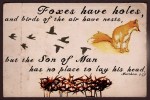
Jesus taught that “Foxes have holes and Birds of the Air have nests”. He is saying that we are to go out and make disciples. We are not to retreat to the comfort and safety of our ‘fox dens’ or our ‘feathered nests’. He never advocated a stationary and static church, i.e., a “legacy type of church”.
Everything we do should point to making individuals, families (fathers, mothers and children) integral participants in Jesus’ Mission, in our local Body.
We must change what ‘coming to church’ or ‘attend church’ means. We come to Church in order to GO OUT from the Church to reach our community and world, and that is how we are to GROW!
To accomplish this, we probably need to consider reviewing or changing our attitude and paradigm of “coming to church”.
First of all, research shows that people come to church for specific reasons. And becoming an audience or an adherent is not on the list. But, they will leave if thier initial expectations are not met.
Here are the top 10 reasons given by Americans who attend religious services at least once a month, according to Pew. Survey. (For you information, respondents were allowed to give more than one reason.) The percentage refers to people who said this was a “very important” reason for their decision:
To become closer to God. (81%)
So their children will have a moral foundation. (69%)
To become a better person. (68%)
For comfort in times of trouble or sorrow. (66%)
They find the sermons valuable. (59%)
To be part of a faith community. (57%)
To continue their family’s religious traditions. (37%)
They feel a necessary obligation to go. (31%)
To meet new people or socialize. (19%)
Because the pastor knows my name. (added by author.)
People need to come to church to meet Jesus; to learn about Him, to come to know Him personally and intimately by the Word of God, and by our living example; they need to learn how to follow Him – which is both taught and caught, and learn to become fully devoted followers of Jesus. Then, they and we, together, GO and live out our relationship with Him let that be our witness! Go and order to Grow!
We need to understand the demographics and discover ways to become more visible and find UNIQUE ways to serve the community – and that boils down to being like Jesus and doing what He did and taught.
GO OUT with activities: Churches tend to hold ‘events’ in order to attract people to Church. So, we invite people to Chruch on a holiday or a speical occasion, maybe once very few months, hoping we will attract some to come back. But unless there is something to keep them coming back, (about 25% will come back a second time if everything goes just right), it’s a one-and-done matter.
It is God who draws people and saves them. We are simply His Hands, Feet and Voice. We go in His Name. But,
#1. We need “Meet them where they live”. We take the Church to them. It can no longer be “Come Grow With Us”. It has to be “Let’s GO and Grow in Christ Together”. Find ways to keep them coming back, every week.
Many church growth programs actually pander to the community, so they attract those ‘already saved’ who are shopping churches. That is, I believe, why baptisms are so low. We aren’t reaching a lost world, we are reaching a saved and straying world!
We can continue to do what is working. PLUS here are some EXAMPLES of IDEAS to go OUT and build:
(1). Build a youth soccer program – A uniquely Christian approach – teach and coach joy, to be peacemakers, kind, good, patient, gentle, self-controlled, yet, proficient, competitive, hardworking, reaching for excellence. Imagine the (Concealed Name) Baptist Church Family Youth Soccer Program!
(Just FYI, I have had experience and qualifications as national youth license, 15 + years experience.
Area Demographics known. Here is an examples of another church doing these very things: Shepherds.Org.
(1.a). Pickleball is one of the fastest growing sports in America! Kids love it, Dads and Moms love it and if you try it, you will love it too! It is a perfect FAMILY activity! Build a uniquely Christian approach to this sport and influence our area for Christ!
This is a kid and family magnet. Imagine, the (Concealed Name) Baptist Church Family Pickleball Club!!
(And by the way, I have been a pickleball club director and I am currently rated as an advanced player and coach)
(1b.) Bible Quzzing is another exciting and fun ways to get our kids and teens into memorizing the Bible. This is an exciting activity with a purpose! would be greatly surprized how fun this is and how much the kids love it!
Imagine the (Concealed Name) Baptist Church Quiz Team!! (And by the way, my wife has been a Quizzing coach and organizer when our kids were adolecents and teens).
(1c). Offering public neighborhood and citywide conferences on subjects such as
“Is The End Of The World A Possibiliy?” (Eschatology – End Times),
“Is Peace Possible in this crazy world – And How About Me and My Family?”,
“How Can I Kknow That God Really Exists – And How Does That Change Things for Me?”
Future planning: There is a plethora of other means and a multitude of ideas, but the main thing is that we build continuity into our Family, Teen and Children’s ministry. Something parents and kids will come back for, week after week, and not just a seasonal or occasional ‘one-and-done’ activity which repeats quarterly or annually.
ALL OF THESE THINGS, AND MORE, TO INFLUENCE AND REACH YOUR HOME AREA AND BEYOND FOR CHRIST!
(2) We must intentionally ADOPT our visitors and new members as “being part of our family”, from day ONE.
(a). Greeting our visitors and getting to know our new members in ways that make them feel at home, can be intimidating for our MEMBERS. So, perhaps we should hold classes and teach, help and train our MEMBERS the “HOW TO techniques and methods” on greeting, creating conversations and making our visitors feel at home and part of our Church Family. (Improve our ‘meet and greet the people around you’ only to go back to ‘sitting in our own little groups, staring forward and listening to the sermon after our greetings.)
(3). Coming to church AS A VISITOR can be uncomfortable, and even intimidating for most people. We must remember that our visitors are just that: visiting us. And we only get ONE CHANCE at making a FIRST IMPRESSION, and that it is a 25-70 deal at best. So, we must turn that around and make it about them. We need to let them know how important they are to us and to Jesus. We need to make them feel as if they are at home, and it is as if we are the visitors in their house! We have to change the paradigm.
(4). Perhaps we could form Parent-children mentoring (discipleship) sessions early in the visitation process or “new member’s class” process. For example: we begin meeting in special orientation sessions as a way to help them integrate.
(4a). Design short discussion games with parents and kids.
(4b). Separate into parent groups and youth groups. Teach from selected scriptures. Then, discuss achievements and needed improvement in behaviors, activities, family environments, etc., in light of selected scriptures.
Form and Technique: What is meant is that we must build the next generation by TRULY making disciples. I.e., “we must decrease in our influence so Jesus can increase through us and the others among us”. It means that we must teach, train, encourage and send; THEN we must begin to replace ourselves with THE NEXT GENERATION – on purpose!
We will be building a Family Ministry to young families and youth as part of the main Body here at (Concealed Name) Baptist Church, yet separate from the routine – think of it as a Missionary Church Plant WITHIN OUR OWN BODY!
Our focus must be on Jesus’ mission, calling, plan, methods and ways. We should minimize our own creativity. We must constantly be on mission, teaching, instructing, training and inspiring fathers, mothers and children to become mature as living examples, teaching, and training in righteousness, so that they, as servants of God are thoroughly equipped for every good work through the Spiritual Gifts God has granted each one for the building up of the Body: (also see Pastor Vern Collins, UMC Boone).
Lead them to Christ; disciple them in His Name, His calling, His mission, His purpose and His ways;
Lead them to become fully involved, inspired, excited, devoted followers of Jesus, and
Teach them to become disciple makers,
Executing Jesus’ mission, His plan, using His method for His purpose.
Then, send them. They, then, ARE the Church. “It is no longer ‘we four, and no more’”.
Encourage and assist them in building His Church (not ‘our church’), and sending His church out (not ‘our church’). WE MUST DECREASE SO HE, JESUS, CAN INCREASE.
We begin with those in our Church whom God has gifted to be disciple-makers. God has alredy Gifted and Equipped them. These will become our Church Planters (Family and Youth Ministry planters) within our Church. This will be and EXTENSION of our Body, new and separate, but fitted together with the Body.
God will provide the gifts and talents necessary, not only for our Church Planters but also for these new believers to – FROM DAY ONE – to become capable of leading the way forward!
God will provide the gifts and talents necessary, not only for our Church Planters but also for these new believers to – FROM DAY ONE – to become capable of leading the way forward! Please take a look at this list of Spiritual Gifts and the linked test below this list.
I am providing an example here, of how new believers become “fitted together with the Body” when establishing a Young Families and Youth Ministry by Planting a church within a Church. (see Boone UMC – Vern Collins link below). My son and his family were living in Boone, NC. Their pastor was a man named Vern Collins. I met him at my son and daughter-in-law’s house during a soccer related cookout. (My son and family were moving). Instead of leaving after the cookout, Vern stayed and helped them pack their moving van. Vern lives with and in Jesus’ Church body. They are his extended family. I visited their church after they moved and got to know Vern Collins just a little better. The Boone United Methodist church needed to attract and establish (grow) a youth group.
They started by building a group within the Church and ended up planting a new church INSIDE the existing Church and eventually they GREW TOGETHER and ‘co-mingled’. They are still doing that to this day! (Please view the LINK at the bottom of this page).:
We say that we are ambassadors for Christ which is just another way to say that we are missionaries for Christ. We are on mission, planting churches – first within our own Church Body, then OUTSIDE our walls in the future!
We say we are missionaries and ambassadors for Christ. So, let’s be that!
(And as an addition to my resume and experience: I have had decades experience working with youth, both in the church and outside the church).
Your Brother and Friend,
Mike Young (Pastor/Teacher/Evangelist/Church Planter).
Statistics show that we, the Church, are losing attendance, losing members, losing credibility, and we are losing the next generation to the world’s ways and beliefs. Some are dropping out from boredom, some from disappointment, others dont’ see the relevance. They are being influenced and trained by liberal and pagan social media outlets.
We have to engage them in Biblically sound and exciting ways. It has to be exciting, relevant, active, life challenging and life changing. It has to be the Gosple as Jesus taught it. People, families and kids want to be involved and not just an idle audience.
God is calling, and if we are willing, this is going to happen. We will be that “light of the world, a city set on a hill that cannot be hidden”.
Your pastor, brother and friend,
Mike Young
PS:
I would not be coming here to perpetuate a Legacy Church. I am called to do the will of God by following Jesus
By proclaiming and teaching His Message, His Methods and His Ways;
To execute His Plan by adopting and following his Purpose, Using His Methods.
I have no doubt in my mind that God is calling me, has commissioned and sent me to bring His Good News to the humble and afflicted;
That He has is sending me to bind up the wounds of the brokenhearted, and to release the mental, emotional, physical and spiritual captive from their confinement, condemnation and bondage and to set those prisoners free by the will and power of the Gospel of Jesus.
I am here to proclaim the favor of the LORD is to come upon this Church.
I am here to comfort all who mourn, to give them a new hope instead of living in the ashes of the past; I am bringing oil of gladness instead of mourning, and a cloak of praise instead of a disheartened spirit.
You would become known as oaks of righteousness, a planting of the LORD, that He may be glorified.
We will rebuild the ruins of the postmodern Church, and we will raise up and restore the former ways of Christ Jesus.
We will renew the ruined sanctuary of God, and the memory of the glories our God to this generation and this in this day.
Henceforth, people you haven’t known up until now, will come and will give to you freely, and they will become your laborers in God’s Work here.
You shall be called the priests of the LORD in this place; people will speak of you as the ministers of God.
You will enjoy a new health and new wealth.
Instead of our former embarrassments or shame we will share in a double portion of God’s Spiritual Blessings; And instead of past humiliation we will shout for joy over this new portion from God.
Everlasting joy will be ours – for those who will trust and follow God in all of His plans, purposes, methods and way.
WHAT ARE YOU TO BELIEVE – WHAT ARE YOU TO DO – WHAT ARE YOU TO BE ?
I submit that there are at least four basic elements of a Christian church, and not necessarily in this order: (1). Community, (2). The well-being of and the ministering to the Christians in the church, (3). Training and teaching the Church (those within the church) the mindset, attitudes, methods and ways of Jesus, and, (4). Sending Christian disciples into the world to make disciples, teaching them to observe all that He has taught us. (This may be the order initially necessary to get everyone settled in, oriented to the mission, and then sent out on mission.
But in order of mission priority, it more likely would be, (first). Training and teaching the Church (those within the church) the mindset, attitudes, methods and ways of Jesus, and, (second). Sending Christian disciples into the world to make disciples, teaching them to observe all that He has taught us. (third). The well-being of and the ministering to the Christians in the church, (fourth). Community.
Of course, each element is important, in and of itself, and are probably interchangeable depending on the stage of the Church Body growth and maturity. (I also believe that far too much emphasis is placed on church numerical growth and too little emphasis is placed on fulfilling the Great Commission.)
But this matter is not as ‘cut and dried’ as it sounds. Jesus spoke these words, “For God so loves the world, that He gave His only Son, that whoever believes in Him should not perish but have eternal life.” Because He loves us, He is providing us with promises of our redemption from the curse of sin and death and our safekeeping both now and eternally with Him in heaven. This is the Good News.
This is not a labor of ‘blood, sweat and tears’, it is a labor of love. And, until the disciple fixes this in their mind and attitude, very little will get done in the Name of Jesus.
I would ask, what are we, as churches claiming the Name of Jesus, actually teaching and encouraging Christians to do? What are your church sermons, Sunday school classes, discipleship classes and revival meetings encouraging? Is the central and primary message the love of God through Jesus for our world? Does your church sermons and teachings inspire you to tell of His great love for them, and to warn them of the coming judgement? Are they teaching, encouraging and inspiring you to do what Jesus commanded and taught, or are we just teaching about the Bible and about Jesus?
Let’s take a brief look at WHAT Jesus thought, taught and WHAT Jesus demonstrated and told His followers, His disciples to do, and compare it to what you are doing in your local church Body. Then, perhaps, we would make some much-needed adjustments and return to the teachings of Jesus, and really live.
(I will garner this information directly from the Words of Jesus found in the New Testament of the Bible).
MATTHEW 4
This is the second recorded time in the New Testament that Jesus spoke:
Matthew 4:4, “But he answered, “It is written, ’Man shall not live by bread alone, but by every word that comes from the mouth of God’.
First, the word “live” here is the Greek verb, zaó, which primarily means “to live” or “to be alive.” It is used in the New Testament to describe physical life, spiritual life, and eternal life. The term encompasses both the biological aspect of living and the qualitative aspect of life that is found in a relationship with God through Jesus Christ. It is often used to contrast life with death, both physically and spiritually.
In the Greco-Roman world, life was often understood in terms of physical existence and vitality. However, in the Jewish and early Christian context, life had a deeper, spiritual dimension. The concept of life was closely tied to one’s relationship with God, obedience to His commandments, and the hope of resurrection. The New Testament writers, particularly the Apostle John, emphasize the abundant and eternal life that Jesus offers to believers, which transcends mere physical existence.
The word, “word” in this verse is the Greek word, ‘stoma’, meaning “the mouth, speech, eloquence in speech, the point of a sword”. This is the breath or the breathed Word of God.
Jesus is saying that life is more than what we eat or drink. In fact, life is meaningless, left wanting and impotent without the Breath of God, the Breathed Word of God which gave us life and continues to give us life!
These marching orders for the Church are like the Word found in Joshua 1:1-19 and of Deuteronomy 6:1-11, which have been fulfilled or completed by the advent of Jesus the Messiah.
Joshua 1:1-9,After the death of Moses the servant of the Lord, the Lord said to Joshua the son of Nun, Moses’ assistant, “Moses my servant is dead.Now therefore arise, go over this Jordan, you and all this people, into the land that I am giving to them, to the people of Israel. Every place that the sole of your foot will tread upon I have given to you, just as I promised to Moses. From the wilderness and this Lebanon as far as the great river, the river Euphrates, all the land of the Hittites to the Great Sea toward the going down of the sun shall be your territory. No man shall be able to stand before you all the days of your life. Just as I was with Moses, so I will be with you. I will not leave you or forsake you. Be strong and courageous, for you shall cause this people to inherit the land that I swore to their fathers to give them. Only be strong and very courageous, being careful to do according to all the law that Moses my servant commanded you. Do not turn from it to the right hand or to the left, that you may have good success wherever you go. This Book of the Law shall not depart from your mouth, but you shall meditate on it day and night, so that you may be careful to do according to all that is written in it.
For then, you will make your way prosperous, and then you will have good success. Have I not commanded you? Be strong and courageous. Do not be frightened, and do not be dismayed, for the Lord your God is with you wherever you go.”
The book of Joshua is told and re-told as a narrative about the continuing the story of the Israelites after the exodus from Egypt. It is presented as chronicles of the approximately 20 years of Joshua’s leadership of the people after Moses anointed him at the end of Deuteronomy. The twenty-four chapter divisions of the Book of Joshua are summarized as follows:
Chapters 1 through 12: Entering and conquering the Promised Land.
Chapters 13 through 22: Instructions for distributing the portions of the Promised Land.
Chapters 23 and 24: Joshua’s farewell address.
Joshua is presented as a prime example of the benefits of a worthy mentor. For years, he remained close to Moses. He watched Moses as he followed God in an almost flawless manner. He learned to pray in a personal way from Moses. Furthermore, he learned how to obey through the example of Moses. Joshua apparently also learned from the negative example that cost Moses the joy of actually entering the Promised Land.
But more than this, these words were written to you and for you. They are, by their nature, prophetic and therefor are instructional, creative and causative. They speak the truth to you and when you set your mind on them by meditating on them and make them your own in order to do them, they will tell the truth to you and through you! And no man will be able to stand before you to obstruct your path, all the days of your life!
Deuteronomy 6:1-11,“Now this is the commandment, the statutes and the rules, that the Lord your God commanded me to teach you, that you may do them in the land to which you are going over, to possess it, that you may fear the Lord your God, you and your son and your son’s son, by keeping all his statutes and his commandments, which I command you,all the days of your life, and that your days may be long.
Hear therefore, O Israel,and be careful to do them, that it may go well with you,and that you may multiply greatly, as the Lord, the God of your fathers, has promised you, in a land flowing with milk and honey.
“Hear, O Israel: The Lord our God, the Lord, is one. You shall love the Lord your God with all your heart and with all your soul and with all your might. And these words that I command you today shall be on your heart. You shall teach them diligently to your children, and shall talk of them when you sit in your house, and when you walk by the way, and when you lie down, and when you rise. You shall bind them as a sign on your hand, and they shall be as frontlets between your eyes. You shall write them on the doorposts of your house and on your gates.
“And when the Lord your God brings you into the land that he swore to your fathers, to Abraham, to Isaac, and to Jacob, to give you—with great and good cities that you did not build, and houses full of all good things that you did not fill, and cisterns that you did not dig, and vineyards and olive trees that you did not plant, and when you eat and are full, then take care lest you forget the Lord, who brought you out of the land of Egypt, out of the house of slavery.
What are we, therefore, TO BELIEVE, TO DO and TO BE?
These are the Words of God. Some call them the promises of God, and that they are. But they are more. They are creative, causative and prophetic.
Please, dear brothers and sisters in Christ. These are the Words, teachings and commands of Jesus. We are His Body. Let’s BE the Church and do His works! He has given these things to the ones who believes.
The mind set on these things of the Spirit of God bring life and peace.
Your Brother and Friend,
Mike Young.
NEXT: (coming soon). TO THE CHURCH – Matthew 4:7, Jesus said to him, “Again it is written, ‘You shall not put the Lord your God to the test.’”
(Please bookmark this page or subscribe for future episodes).
Typically, in our church buildings and organizations today, we are being taught or “fed” an entertainment based gospel intermixed with just enough religion and “Bible idealism” to make us think that is the Gospel of Jesus Christ. I am not saying the information presented in the sermons you may hear is incorrect. I am saying that it is just that – It is information. Most of these sermons are recitals, stories and narratives of what is written in the Bible. It is left to you to decide what to do with that information, how to apply or use that information in your daily life and why applying what you have heard is important.
Compounding the problem of making these decisions, as I see it, is the fact that methods used by churches to communicate this Bible recitals, stories and narratives is by way of,
Religious Lectures
Religious Addresses
Religious Discourses
Gospel Preaching
Bible Sermons
Religious Teaching
Christian Discipleship training
Studies show that most people don’t remember sermons, lectures, addresses or speeches. They don’t even remember paragraphs. What people remember are simple statements, slogans, and phrases. I don’t remember any speech John F. Kennedy gave, but most of us of a certain age remember his statements,
“Ask not what your country can do for you, ask what you can do for your country” and, “I am a Berliner!”
I don’t remember any sermon preached by Dr. Martin Luther King Jr., but I do remember his famous phrase,
“I have a dream!”
People tend to remember:
10% of what they read.
20% of what they only hear.
30% of what they only see.
50% of what they see and hear.
70% of what they say and write down.
90% of what they DO
People will more frequently remember simple repeated statements, slogans, and phrases.
This is the difference between having the truthful statement and knowing the truth.
But most churches are giving sermons that are little more than narratives about the Bible. That is not to say, they are informative and educational, and some are even inspirational – at times. Sometimes these narratives even conclude with a moral motto or an exercise on ethics. Other times the hearer is left to make their own conclusions.
But this is like an alphabet soup. All the letters are in there, but they are all mixed up – just floating around in a broth, so you can nibble on the ones you find to your liking.
Conversely, God has a Message, and His Message gives us His Purpose, His Plan and His Methods and directions for life. It is for us and all of His creation. You can live but you cannot live successfully without it.
One man simply puts it this way:
“Listen. Do you hear God calling you? If you can hear Him, you should listen. And He can change your life in amazing and radical ways, if you really do wish to change. If you wish to become a different person altogether in the sight of God and man; if you really do want health and peace of mind, and spiritual growth that leads to maturity, then Jesus, clearly shows you how it is to be done. The task is not an easy one, but we know that it can be accomplished, because there are those who have done it, but there is a price which must be paid; and the price is the actual carrying out of these principles in every corner of your heart, mind, soul, life, and in every daily transaction, whether you feel like it or not, whether you want to or not, and more particularly where you would much rather not.
If you are prepared to pay that price in order to really and truly break with the ‘old man or woman’, and to allow God to start the creation of the new one, then the true Gospel of Jesus Christ and following Him will indeed be your Sermon on the Mount of Redemption, Salvation, and Liberation.”
Jesus’ Gospel Message and plan shows that there is a purpose to His creation. It shows that there was and is a beginning that had and still has a purpose. His Message and Plan has an end with a purpose, and He has prepared an eternity with a purpose, waiting for those who respond. And whether you believe it or not, does not change one iota of His Message, His Purpose, His Plan and His Method. But whether you believe it or not, does make all the difference for you.
Here is a brief outline of His Message, His Purpose, His Plan and His Methods, for you, from its beginning to the end:
Humankind was created with a flaw; a sin nature. (Genesis 2:17).
Humankind sinned and thereby failed, and condemned themselves to toil in the soil by the sweat of our brow, and ultimately to eternal destruction. (Genesis 3:19).
The great global deluge, also known has Noah’s flood, was a harbinger of things to come and an example of God’s judgements. He says there is a judgement coming, however, such as the world has never seen and will never see again.
God provided a remedy for our sin-flaw and for our ultimate destruction; a Savior to redeem us and to save us from our sin, failure and destruction. (John 3:16).
There are those who say they don’t believe this and that they don’t need to be saved. Their ultimate end is set. They will live and they will die and that is the end. And they are right, for themselves, if they believe that. They will indeed perish.
God, through the sacrifice of His Son, Jesus, our redeemer and Savior, made a way for us to live now and eternally with Him. He gives us an internal roadmap for life and for our eternity. And, by this one offering, this sacrifice, God is bringing us into the sinless perfection that is required to be in His presence. And by this one sacrifice, He is perfecting all those who are being sanctified – that is being made right and holy with Him. (Hebrews 10:14).
He is coming, at the sounding of the trumpet, on the clouds where every eye will see Him, and He will gather His elect from the four winds, from one end of the sky to the other, and we will be with Him forever. (Matthew 24:29-31).
He will gather His armies and defeat His enemies and cast them into the lake of fire. (Revelation 19:11-29).
In the End, He will have created a new heaven and a new earth. Perfect in every respect. We will live with Him, in His perfect presence, and with one another (those who have been called and chosen), in the new Jerusalem, our perfect home in heaven, forever. (Revelation 21, 22).
Everything that occurs in everyone’s lifetime is part of this process. Some will respond and begin this process of being made into His perfect image.
However, be aware that much of what happens in your lifetime will be nothing more than a distraction, and unless you keep your mind focused on Christ and His Calling, His Message, His Purpose, His Plan and His Methods, you can be distracted and in danger of straying.
Let me break it down this way:
THIS IS IMPORTANT BECAUSE JESUS SAYS
Romans 6:23, “For the wages of sin is death, but the free gift of God is eternal life in Christ Jesus our Lord.”
But the Good News is,
John 3:16, “For God so loved the world, that he gave his only Son, that whoever believes Him should not perish but have eternal life.
And Jesus instructs us in,
John 14:6, “Jesus said to him, “I am the way, and the truth, and the life. No one comes to the Father except through me.”
Romans 10:9, “Because, (it is only) if you confess with your mouth that Jesus is Lord and believe in your heart that God raised him from the dead, you will be saved.”
Ephesians 2:8-9, “For by grace you have been saved through faith. And this is not your own doing; it is the gift of God, not a result of works, so that no one may boast.”
John 3:3, “Jesus answered him, “Truly, truly, I say to you, unless one is born again he cannot see the kingdom of God.”
Matthew 7:21-27, “Not everyone who says to me, ‘Lord, Lord,’ will enter the kingdom of heaven, but the one who does the will of my Father who is in heaven. On that day many will say to me, ‘Lord, Lord, did we not prophesy in your name, and cast out demons in your name, and do many mighty works in your name?’ And then will I declare to them, ‘I never knew you; depart from me, you workers of lawlessness.’ “Everyone then who hears these words of mine and does them will be like a wise man who built his house on the rock. And the rain fell, and the floods came, and the winds blew and beat on that house, but it did not fall, because it had been founded on the rock.”
WHAT DOES JESUS SAY WE ARE TO DO?
1 Peter 2:21, “For to this you have been called, because Christ also suffered for you, leaving you an example, so that you might follow in his steps.”
Matthew 16:24, “Then Jesus told his disciples, “If anyone would come after me, let him deny himself and take up his cross and follow me.”
John 8:12, “Again Jesus spoke to them, saying, “I am the light of the world. Whoever follows me will not walk in darkness, but will have the light of life.”
1 Corinthians 11:1-2,“Be imitators of me, as I am of Christ. Now I commend you because you remember me in everything and maintain the traditions even as I delivered them to you.”
Luke 9:23, “And he said to all, “If anyone would come after me, let him deny himself and take up his cross daily and follow me.”
3. WHAT WILL HAPPEN WITH ME AND TO ME?
Matthew 10:22,“And you will be hated by all for my name’s sake. But the one who endures to the end will be saved.”
John 12:26,“If anyone serves me, he must follow me; and where I am, there will my servant be also.If anyone serves me, the Father will honor him.”
Matthew 4:19, “And he said to them, “Follow me, and I will make you fishers of men.”
1 Peter 1:14-16, “As obedient children,do not be conformed to the passions of your former ignorance, but as he who called you is holy, you also be holy in all your conduct, since it is written, “You shall be holy, for I am holy.”
John 15:16-17, “You did not choose me, but I chose you and appointed you that you should go and bear fruit and that your fruit should abide, so that whatever you ask the Father in my name, he may give it to you. These things I command you, so that you will love one another.”
Matthew 4:19-25, “And he said to them, “Follow me, and I will make you fishers of men.” Immediately they left their nets and followed him. And going on from there he saw two other brothers, James the son of Zebedee and John his brother, in the boat with Zebedee their father, mending their nets, and he called them. Immediately they left the boat and their father and followed him. And he went throughout all Galilee, teaching in their synagogues and proclaiming the gospel of the kingdom and healing every disease and every affliction among the people.”
4. WHAT DOES THIS MEAN TO ME?
John 15:14,“You are my friends if you do what I command you.”
Matthew 10:38, “And whoever does not take his cross and follow me is not worthy of me.”
James 2:20-24,“Do you want to be shown, you foolish person, that faith apart from works is useless? Was not Abraham our father justified by works when he offered up his son Isaac on the altar? You see that faith was active along with his works, and faith was completed by his works; and the Scripture was fulfilled that says, “Abraham believed God, and it was counted to him as righteousness”, and he was called a friend of God. You see that a person is justified by works and not by faith alone. “
John 15:5-8,“I am the vine; you are the branches. Whoever abides in me and I in him, he it is that bears much fruit, for apart from me you can do nothing.If anyone does not abide in me he is thrown away like a branch and withers; and the branches are gathered, thrown into the fire, and burned. If you abide in me, and my words abide in you, ask whatever you wish, and it will be done for you. By this my Father is glorified, that you bear much fruit and so prove to be my disciples.”
Matthew 11:28-30, “Come to me, all who labor and are heavy laden, andI will give you rest.Take my yoke upon you, and learn from me, for I am gentle and lowly in heart, and you will find rest for your souls. For my yoke is easy, and my burden is light.”
Romans 8:16-17,“The Spirit Himself bears witness with our spirit that we are children of God, and if children, then heirs—heirs of God and joint heirs with Christ, if indeed we suffer with Him, that we may also be glorified together.”
John 14:2-3, “In My Father’s house are many rooms; if that were not so, I would have told you, because I am going there to prepare a place for you. And if I go and prepare a place for you, I am coming again and will take you to Myself,so that where I am, there you also will be.
Revelation 22:12-14,“And behold, I am coming quickly, and My reward is with Me, to give to every one according to his work. I am the Alpha and the Omega, the Beginning and the End, the First and the Last. Blessed are those who do His commandments, that they may have the right to the tree of life, and may enter through the gates into the city.”
WHAT ARE THE ODDS?
You know, it’s odd that people say they believe this or that they believe that, but have no substantial basis for what they believe. It just sounds good to them. One saying goes, “it is your own truth”. Okay. But that is truly a fools-folly.
Finally, please, reason with me.
If you were a gambling man or woman, and you were given the odds of 1 to 100, 000, 000, 000, 000, 000, 000, 000, 000, 000, 000, 000, 000, 000, 000, 000, 000, 000, 000, 000, 000, 000, 000, 000, 000, 000, 000, 000, 000, 000, 000, 000, 000, 000, 000, 000, 000, 000, 000, 000, 000, 000, 000, 000, 000, 000, 000, 000, 000, 000, 000, 000, 000, (or 1 to 10 to the 157th power), in favor of something coming to pass, would you bet against it?
These are the odds against – yes, AGAINST – Jesus Christ having fulfilled just 48 of the over 450 prophecies written about Him. But, facts show that
In order to give you some perspective, electrons are very small objects. They’re smaller than atoms. It would take 2.5 TIMES 10 to the 15th power of them, laid side by side, to make one inch. Even if we counted 250 of these electrons each minute, and counted day and night, it would still take 19 million years just to count a line of electrons one-inch long. 19 MILLION YEARS!
Read that again, please. Why is that significant?
It is significant because it gives us evidence that the Bible is true and correct when it says that Christ Jesus came to earth and is the Savior of the world.
It gives YOU evidence, if you choose to pay attention, that your life can be eternal with the only LIFE source which gives eternal Peace, Safety, Security, Joy and fulfillment the universe has ever known or ever will know.
Just think about it: It is a scientific and a mathematical impossibility that HAS COME TO PASS! No odds can defy the REALITY of Jesus Christ.
5. FROM THE ALPHA TO THE OMEGA
So, that is the alpha to the omega. From the beginning to the end. Now, it is up to you. I would urge you to use the one gift God has graciously given to each of His created – the power of choice. A free will. You only get this one chance at life. Make your choices wisely.
Is there such a thing as a perfect Church? Some will say there is no such thing as a perfect Church because a church is made up of people, and there are no perfect people – or so they say!
There are so many examples of where men and women, striving to be Christians, have misunderstood or reinterpreted the Words of Jesus and the Words of the Bible to fit their own understanding and for their own purposes. and it is pervasive. And the matter of “Biblical Perfection” is one of those times. How would things be different if we, Christians, interpreted the Word of God according to how God says and sees things? Allow me to explain and illustrate.
FIRST, THE MATTER OF
Please allow me to start with an encounter I had recently, at church, on the matter of “perfection”:
I was walking into our church building and as I passed one of our pastors, I greeted him and he asked in return, “how are you doing?”. I replied, “perfect”, to which he did an about face, stopped and looked directly at me, frowned and said, “Not hardly. Not in this life”. He said, “we are not perfect and we should not say that. We will not be perfected until we are in heaven”, as if what I said annoyed him. Now, the fact is that I did not say that I am perfect. I responded to the question, “how are things”.
I decided to explain, so I smiled and said, “Well, my past is forgiven. I am living safe in the presence of God today, and my future is secured by His grace and mercy. So, I say, “that is about as perfect as it gets. And besides, I did not say that I am perfect. I answered your question, “how are things”. But while we are on the matter, God does say that you and I are to be perfect – that words translates as becoming “mature in Him”. And, although it may not look that way to you, that’s what is going on inside of me, God willing. And, how are you, today?” To which, he forced a weak smile and went on his way. Maybe he’s just having a bad day? Hmmmmm. But it happens.
We did not have time to get into a theological discussion on “practical and positional sanctification” or that God only sees us through the redeeming and cleansing blood of Christ, etc. But who cares what you think you know, if no one knows whether you care about them? I was just trying to give a positive-minded greeting.
Wow. Welcome to church!
But back to the matter of “perfection”. God, through His Word, commands, (yes, commands), that we, as Christians shall be perfect even as He is perfect. This is both a practical command and a prophetic utterance. See these examples from Scriptures:
Matthew 5:43-48, “You have heard that it was said, ‘YOU SHALL LOVE YOUR NEIGHBOR and hate your enemy.’ But I say to you, love your enemies and pray for those who persecute you, so that you may prove yourselves to be sons of your Father who is in heaven; for He causes His sun to rise on the evil and the good, and sends rain on the righteous and the unrighteous. For if you love those who love you, what reward do you have? Even the tax collectors, do they not do the same? And if you greet only your brothers and sisters, what more are you doing than others? Even the Gentiles, do they not do the same? Therefore you shall be perfect, as your heavenly Father is perfect.(from the Greek word, ‘teleios’, having reached its end, complete, perfect, full grown, of full age, specially of the completeness of Christian character). (ESV).
James 1:2-4,Consider it all joy, my brothers and sisters, when you encounter various trials, knowing that the testing of your faith produces endurance. And let endurance have its perfect result, so that you may be perfect, and complete, lacking in nothing. (from the Greek word, ‘teleios’, having reached its end, complete, perfect, full grown, of full age, specially of the completeness of Christian character). (NASB)
Matthew 19:21, Jesus said to him, “If you want to be perfect, go and sell your possessions and give to the poor, and you will have treasure in heaven; and come, follow Me.” (from the Greek word, ‘teleios’, having reached its end, complete, perfect, full grown, of full age, specially of the completeness of Christian character). (ESV).
2 Timothy 3:16, All scripture is given by inspiration of God, and is profitable for doctrine, for reproof, for correction, for instruction in righteousness: That the man (or woman) of God may be perfect, (from the Greek word, ‘ar’-tee-os’: perfect, complete, fitted, ready. Thoroughly furnished unto all good works). (KJV).
Hebrews 10:14, For by one offeringHe HAS PEFECTEDfor all time those who are sanctified. And the Holy Spirit also testifies to us; for after saying, “THIS IS THE COVENANT WHICH I WILL MAKE WITH THEM AFTER THOSE DAYS, DECLARES THE LORD: I WILL PUT MY LAWS UPON THEIR HEARTS, AND WRITE THEM ON THEIR MIND,” He then says,
“AND THEIR SINS AND THEIR LAWLESS DEEDS I WILL NO LONGER REMEMBER.” Now where there is forgiveness of these things, an offering for sin is no longer required. (From the Greek word, ‘tel-i-o’-o’, meaning to bring to an end, to complete, perfect, as a course, a race, or the like: I complete, finish, as of time or prediction: I accomplish, (c) I make perfect; pass: I am perfected – PAST TENSE). (ESV).
So, yes, you and I,
Shall be perfect, as our heavenly Father is perfect.
Encounter various trials, knowing that the testing of our faith produces endurance. And let endurance have its perfect result, so that you may be perfect, and complete, lacking in nothing.
Go and sell our possessions and give to the poor, and you will have treasure in heaven; and come, follow Jesus If you want to be perfect.
The man (or woman) of God may be perfect, (This is not optional, by the way.)
NOW, ON THE MATTER OF…
“CHURCH” or “church”,
depending on how you see it.
Jesus and the Apostles through the Bible, define and describe what the Church is and is to be. Beginning with Saint Augustine, the Catholics and now the rest of us in this postmodern world, have done an excellent job of redefining the word and meaning of Church, the mission of the church and the methods of the church, to the point that there is little left that is recognizable.
In the New Testament, the Apostle Paul referred to the church as the body of Christ. Please think about that: The Church as the BODY of Christ. He used this metaphor to relay significant truths about the church and to help believers better understand the value of diversity within the church.
Paul wrote this to the church of Corinth: “Just as a body, though one, has many parts, but all its many parts form one body, so it is with Christ. For we were all baptized by one Spirit so as to form one body—whether Jews or Gentiles, slave or free—and we were all given the one Spirit to drink. Even so the body is not made up of one part but of many” (1 Corinthians 12:12-14).
The church is called the body of Christ because Christ is the head of the church and we are called to do the work of Christ, each like members of a body. We have different skills, purposes, and spiritual gifts, yet every believer is equally important to the full functioning, mission, and efficacy of the church.
Church: ekklesia (from Strong’s concordance #1537, ek, “out from and to” and #2564/kaléō, “to call”) – people called out from the world and to God, the outcome being the Church, the mystical body of Christ – i.e. the universal (total) body of believers whom God calls out from the world and into His eternal kingdom.
Next, Jesus described the mission and the method of the Church, first to His disciples, Matthew 10:7, As you GO, preach, saying, ‘The kingdom of heaven has come near.’ Heal the sick, raise the dead, cleanse those with leprosy, cast out demons. Freely you received, freely give. Do not acquire gold, or silver, or copper for your money belts, or a bag for your journey, or even two tunics, or sandals, or a staff; for the worker is deserving of his support. And whatever city or village you enter, inquire who is worthy in it, and stay at his house until you leave that city. As you enter the house, give it your greeting. If the house is worthy, see that your blessing of peace comes upon it. But if it is not worthy, take back your blessing of peace. And whoever does not receive you nor listen to your words, as you leave that house or city, shake the dust off your feet. Truly I say to you, it will be more tolerable for the land of Sodom and Gomorrah on the day of judgment, than for that city. This is the way that Jesus taught and modeled!
Matthew 28:18-19, Then Jesus said to His eleven Apostles and to the Church, “All authority in heaven and on earth has been given to Me. GO, therefore, and make disciples of all the nations, baptizing them in the name of the Father and the Son and the Holy Spirit, teaching them to follow all that I commanded you; and behold, I am with you always, to the end of the age.” This is the way that Jesus taught and modeled!
Now in the 21st century we, the church, no longer GO. We invite. We invite ‘them’ to come. We say, “Come to church”, and the marquis say, “Come Join Us”, “Come Grow With Us”. But Jesus said, “GO and make disciples”.
Why have we modified and reversed Jesus’ teachings and ways? Was for our convenience?
And, when and where did we get off track? I’ll tell you when and where. The problem began almost as soon as the Church started and was accelerated by the Roman Emperor, Constantine the First, in A.D. 327, when he legitimized and synchronized Christianity into the existing culture. He gained fame and recognition from the developing Catholic church and the march toward apostasy had begun.
But, let’s go back to the beginning, to Jesus’ resurrection. Christ became a “life-giving spirit” (1 Corinthians 15:45). Therefore, He could take up residence in the believers, thus making them His Temple, His house. Ever since Christ had risen, we Christians became the temple of God. And, It is for this reason that the New Testament always reserves the word church (i.e., ‘ekklesia’), for the people of God. It never uses this word to refer to a building of any sort.” (Excerpts in blue lettering are from Frank Viola & George Barna’s book, “Pagan Christianity”, Tyndale Publishing, 2002, 2008)
When Christianity was born, it was the only religion on the planet that had no sacred objects, no sacred persons, and no sacred spaces.
Although surrounded by Jewish synagogues and pagan temples, the early Christians were the only religious people on earth who did not erect sacred buildings for their worship. The Christian faith was born in homes, out in courtyards, and along roadsides. For the first three centuries, the Christians did not have any special buildings!
As one scholar put it, “The Christianity that conquered the Roman Empire was essentially a home-centered movement.”
Meeting in homes was a conscious choice of the early Christians. It was a coming together in a more intimate setting, a ones’ home. Very little could be hidden in such an environment.
THE DRIFT BEGINS – 391 A.D.
The Church was barely out of its infancy when the religious spirit of innovation appeared, in the late second and third centuries, and a shift occurred.
Christians not only adopted sacred spaces; they also had created sacred objects. (They would soon develop a sacred priesthood.) It might seem they had forgotten Moses and the golden calf.
In all of this, the second and third century Christians began to assimilate the magical mind-set that characterized existent pagan thinking.
These factors made the Christian terrain ready for the man who would be responsible for creating church buildings.
In AD 327,Constantinebegan erecting the first church buildings throughout the Roman Empire, some at public expense.’ In so doing, he followed the path of the pagans in constructing temples to honor God.Augustine of Hippo, a theologian and a philosopher, (later, sainted by the Catholic church), began his work of making the Christian Movement ‘legitimate’ by government and Catholic standards.
Interestingly, he named his church buildings after saints — just as the pagans named their temples after gods. Constantine built his first church buildings upon the cemeteries where the Christians held meals for the dead saints.
(I ask, WHAT WOULD YOU CALL AN ACT LIKE THAT?)
Constantine brought peace for all Christians.'” Under his reign, the Christian faith had become legitimate. In fact, it had risen to a status greater than Judaism and paganism.
For these reasons, the Christians saw Constantine’s rise to emperor as an act of God. Here was God’s instrument who had come to their rescue.
Christianity and Roman culture were now melded together.”
(Again I ask, WHAT WOULD YOU CALL THAT?)
The Christian building demonstrates that the church, whether she wanted it or not, had entered into a close alliance with pagan culture.’ As Will Durant, author of The Story of Civilization (a sweeping, eleven-volume work on world history that earned him a Pulitzer Prize), put it, “Pagan isles remained in the spreading Christian sea.”
As one historian put it, “Church buildings took the place of temples; church endowments replaced temple lands and funds.”
Under Constantine, tax-exempt status was granted for all church property.
Consequently, the story of the church building is the sad saga of Christianity borrowing from heathen culture and radically transforming the face of our faith.
To put it bluntly, the church buildings of the Constantinian and post-Constantinian era essentially became holy shrines. The Christians embraced the concept of the physical temple. They imbibed the pagan idea that there exists a special place where God dwells in a special way. And that place is made “with hands.”‘
(Once again, I ask, WHAT WOULD YOU CALL AN ACT LIKE THAT?)
“As with other pagan customs that were absorbed into the Christian faith (such as the liturgy, the sermon, clerical vestments, and hierarchical leadership structure), third- and fourth-century Christians incorrectly attributed the origin of the church building to the Old Testament. But this was misguided thinking.”
“Most Americans are struggling to clarify their identity. They tend to see themselves as unique individuals, Americans, members of their family, occupational professionals, consumers, and then as followers of Christ — in that order of priority.
“In the minds and hearts of most Americans — even those whose beliefs classify them as “born-again Christians”— their identity as a follower of Christ pales in importance in comparison to the other roles they embrace.
(WHAT WOULD YOU CALL THAT MINDSET?)
Oddly, most of the born again Christians consider themselves to be servants of God and to have been transformed by their faith in Christ.
Clearly, however, there are some missing connections in this self-evaluation. Perhaps the confusion is due to the enormous number of inter-actions and responsibilities that people take on each day.
Maybe it has to do with the disjointed, topical teaching that most of us receive from our churches. It may even be attributable to the lure of competing perspectives and images bombarding us from the ever-present media.
THE DRIFT
AD 1 The Church of Jesus Christ, The Body of Christ, had no buildings, little money and no wealth. The Church was a Movement.
Jesus said to make disciples; collect no money except to make your journey.
The penalty for becoming a Christian was often death.
The Church grew exponentially.
AD 49 The Church expanded into Greece. The Church became a philosophy to many. The Church grew and size and influence.
AD 313 The Church expanded into Rome and it gained recognition. It grew in power and popularity. It obtained wealth, buildings, property and influence. It became an institution.
AD 380 The Church expanded into Europe. It was becoming a worldwide phenomenon. It grew in wealth, stature, power and influence. It had become a culture.
AD 1607 The Church reaches America.
AD 1681 The Church became corporate. It had become a business and incorporated. It became regulated by the government.
The Corporate Church grew. It needed money to support growth and expansion, which meant the Corporate Church needed more people.
AD 1777 The state of Virginia granted tax exemption to houses of worship.
AD 1894 The corporate church was granted tax exemptions by the Federal Government.
AD 1954 The Federal Government regulated what a church could and could not say in order to retain tax-exempt status.
The church continued to grow, and in order to attract more people the Corporate Church lowered its membership and doctrinal standards. More people became ‘members’ and gave more money to support more growth.
The Church corporation is complete with leaders, boards and membership and a business model.
Local churches compete against one another for members (customers). The church is selling itself in “three line slogans”.
The Church members now have choices and have become religious consumers. Church people can shop around for the religious brand and standards that best suits them. (2 Timothy 3)
The Leadership (pastors and preachers) have become CEOs, disciples have become church leaders, growing their 501(c)(3) business models.
Record numbers of pastors quitting because of stress, burnout or are being fired by their congregations (some stats say 1500 – 1700 leave “the ministry” each month).
Church debt in America soars; church foreclosures soar.
AD 1968 The church ordains homosexuals as clergy.
AD 1972 The United church of Christ ordains homosexual clergy
AD 2010 The Lutheran church ordains homosexual clergy
The Episcopal Church in the United States and the Christian Church (Disciples of Christ) have also allowed ordination of openly gay and lesbian candidates for ministry for some years.
AD 2024 The church is losing and has lost influence. The church in 2020 is losing members.
AD 2024 Much of the church is teaching and living a different Gospel than that of the Apostles.
There is a misguided belief that if you can just ‘lure’ people into church, they can hear the Gospel Message and some will get saved. What has happened, instead, is that the remain pagan in their core beliefs, adopt the name of Jesus for convenience, take over as leaders within the church, and the church becomes apostate! You can see this pattern repeating itself in hundreds and thousands of churches, worldwide.
Now, many, if not most churches, practice a brand of church as a formality, but in reality, they simply tickle the ears of the adherents, while draining their resources. Then they travel around to make one convert, and when someone becomes one, they make them twice as much a son or daughter of hell as themselves! (see Matthew 23:15).
So, you may ask, what’s the big deal? In order to answer that, we must first look at how has this drift has affected societies and governments and how is it being reflected in our government and society:
(#1). There is an increase in hostilities between nations. A war is being waged and is raging, with Marxist and Socialist forces, aligned against democracies in particular, those which have been and are influenced by Judeo-Christian principles. Therefore, there are increasing numbers of wars and rumors of wars between these.
(#2). Nations are realigning and are rising against nations.
(#3.) There is an increasing rejection of traditional Christianity, in society, by the government and in our churches.
(#3.a). Simultaneously, there is an increase in paganistic beliefs and practices in society, in governments and in our churches.
(#4). Around the world, there is a rising persecution and murder of Christians.
(#5). There is a global Christian apostasy taking place; a falling away from the faith.
(#6). There is an exponential increase in lawlessness and anarchy. Societies are fracturing. There is a loss of trust. People’s regard for one another has grown cold.
(#7). There is an increase in the numbers of false Christian teachers and false Gospels, using Jesus’ name, being taught.
How are we to respond in the face of an aggressive and spreading evil?
FIRST, let’s circle back around ‘to the beginning’. For those who have surrendered their life to God, by His grace and through faith in Christ, it is important to remember that, just like in the beginning with Jesus, our struggle is not against flesh and blood. This can be a very difficult thing to do, since our adversaries are clothed as people. But, as Christians, our struggle and our war is against the rulers, against the powers, against the world forces of this darkness, against the spiritual forces of wickedness in the heavenly places which inhabit and are influencing people.
Make no mistake, our adversaries are evil people, but, Matthew 5:39, says, “But I say to you, do not show opposition against an evil person; but whoever slaps you on your right cheek, turn the other toward him also.”
Our struggle is against the schemes of the Devil, and James 4:7 says, we are to instead, to submit ourselves to God, and resist the devil, and he will flee from us.”
Our struggle is a different war and a different warfare than the one we see. Our war is for the lives and souls of people and for the Kingdom of God.
We, as Christian disciples of Jesus, are to (#1), GO and makes disciples, (#2), baptizing them in the name of the Father, and the Son and the Holy Spirit, (#3), teaching them to follow all that He has commanded us!
This is our mission until the day comes, when He will appear in the heavens, and every eye will see Him, and He will gather us, His elect, you and me, from the four corners of the earth, and take us to our eternal destination (see Matthew 24:29-31). Then, He will pour out His judgment and wrath. (see Revelation 8).
Then, He will reappear on a white horse with the armies of heaven to defeat His and our enemies. (see Revelation 19:11-16).
SECONDLY, just like with the establishment of the early Church, day by day, we are to continue with one mind within the Church, and breaking bread from house to house, taking our meals together with gladness and sincerity of heart, praising God and having favor with all the people. And the Lord will add to our number day by day, that is those who are to be saved.
Then, on one particular day and hour, which no one knows, not even the angels of heaven, nor the Son, but the Father alone,the Son of Man will come. It will be just like the days of Noah.For as in those days before the flood they were eating and drinking, marrying and giving in marriage, until the day that Noah entered the ark,and they did not understand until the flood came and took them all away; so will the coming of the Son of Man be.
At that time there will be two men in the field; one will be taken and one will be left. Two women will be grinding at the mill; one will be taken and one will be left.
Therefore, we are to be on the alert. We are to be faithful to be doing the things He has told us to do and to be. Those who are not faithful and diligent will find themselves in great distress, for when that time comes, some who thought they would be invited to go with Him, will also be left behind.
Please, dear friends, don’t buy into the simple salvation and cheap grace message. The litmus test is that you are ready and found to be doing the bidding of our Master and Lord, either if and when you should die before His coming and if you are alive at His coming. (see Matthew 24:42 – Matthew 25:29).
It is both as simple as that and difficult as that.
Let’s not be the church just as a noun. A noun is just a description of a person, a place or a thing.
Let’s be the Church of the verb; the part of speech that expresses action! The Church alive, organic, on the move, reaching and reaching out.
A large group of people – who are loving and who show unselfish concern for other; people who are joyful and show an inner peace; people who are patient, and show not only the ability to wait, they wait with kindness, people who are good, faithful, and gentle, showing great self-control. AND, WHAT WOULD YOU CALL THAT? THAT IS THE CHURCH! THIS DESCRIBES WHAT YOU AND I MUST BE.
People who profess faith in Jesus show a loving attitude and behavior that allows them to endure with patience and serenity; a people showing a love that is kind and thoughtful, that is not jealous or envious; a people showing a kind of love does not brag and is not proud or arrogant. People who are not rude; not self-seeking, not provoked nor are overly sensitive and not easily angered; People with a loving attitude that does not take into account a wrong endured. They do not rejoice at injustice, but rejoice with the truth when right and truth prevail. AND WHAT WOULD YOU CALL THAT? THAT IS THE CHURCH! THIS DESCRIBES WHAT YOU AND I MUST BE.
People who profess faith in Jesus with a love toward others that bears all things regardless of what comes upon them, believes all things, that is looking for the best in each person, hopes all things, remaining steadfast during difficult times, and endures all things without weakening. People with a love never fails, never fades and never ends. What would you think? What would you do? AND, YES, WHAT WOULD YOU CALL THAT? THAT IS THE CHURCH! THIS DESCRIBES WHAT YOU AND I MUST BE.
I am willing. Are you willing? Let’s do this together, One Body, One Mind, Unified in Christ Jesus.
What does ‘going to church’ and what is ‘assembling yourselves together’ really mean?
Please watch this video “The Restless Church Introduction” and comment. What do you think?
What if I told you that YOU are the Church, and everything that Jesus tells us about following Him and being His Body is really describing His Church – The Church?
What if I told you that ‘going to church’ is never required by anyone in the Bible?
And, what if I told you that assembling yourselves together as Christians, does not necessarily mean going to a building to listen to a few songs, saying a few prayers, hearing a sermon or a religious lecture that only gives talking points but rarely moves people to act as Jesus commanded and taught?
What if I told you there is a difference between what church has been redefined as and what the Bible says Church is all about?
There is a vast difference. It is the difference between really living and just existing.
It is the difference between living with purpose and just living.
It is the difference between life and death.
What if I told you there is such a Church that will make a difference in your life? A Church that is a model of what Jesus intended and what the Bible describes. A place where you can really begin to live, with purpose and on purpose! A place that will lead to life!
And what if I told you that you can BE that church, and
You will get closer to God.
You will get your children a moral foundation.
You will become a better person.
You will find comfort in times of trouble or sorrow.
You will find ‘sermons’ valuable, useful and appliable. .
You will be an important part of a faith community.
You will find your necessary obligation to be the Church.
You will meet new people on the same journey.
You will come to a place where the pastor and others will know your name!
It would seem that many churches and pastors are in a dilemma. People (and pastors) are leaving the traditional church in droves. It’s not like it used to be. Church, for many people, in a sense, became their extended families. But it’s rarely, if ever, like that anymore. Church, in many instances, has become a production. It has become a consumer’s matter of choice.
Some are leaving church because they are curious about other churches. Some are leaving church because they have been either hurt, disappointed, disillusioned, or they are just bored. It can be complicated.
Some people are just looking for another church that better suits their view of Christianity.
Some people are leaving in search of another church that better suits their wants.
Some people are leaving in search of another church that better suits their needs.
Some people are just dropping out of church, but not dropping out of religion.
Some people are just dropping out of church, but not dropping out of Christianity.
Do any of these reasons resonate with you?
I would think that we should, and I think I would want to look back at why I started going to church in the first place. Something attracted me and drew me to church. What was ‘that thing’, and what has happened in the meantime?
Let me get this out front: It doesn’t matter WHY you started going to church or who invited you to church, God is the One Who drew you to church. It is always the work of the Holy Spirit. What you do with what you encountered is what matters, and it is why you are where you are at this moment.
A Pew Research Center study offers something different: a survey of 4,729 Americans telling us precisely why they do (or don’t) attend religious services.
The survey complicates other stereotypes about Americans who rarely, if ever, attend religious services. As it turns out, they’re all not atheists, or even members of the “spiritual but not religious” crowd. Many say religion is important in their lives, and lean conservative, politically.
“The people who attend religious services less often are not a monolithic group,” said Becka Alper, a research associate at Pew..”
Here are the top 10 reasons given by Americans who attend religious services at least once a month, according to Pew. Survey respondents were allowed to give more than one reason. The percentage refers to people who said this was a “very important” reason for their decision:
To become closer to God. (81%)
So their children will have a moral foundation. (69%)
To become a better person. (68%)
For comfort in times of trouble or sorrow. (66%)
They find the sermons valuable. (59%)
To be part of a faith community. (57%)
To continue their family’s religious traditions. (37%)
They feel a necessary obligation to go. (31%)
To meet new people or socialize. (19%)
Because the pastor knows my name. (added by author.)
And, most people are smart enough to know that this is not just ‘caught’, assuming that if they are around like-minded people, searching for the same or similar things, it will rub off on them, although that has some truth to it. They come to be ‘taught’. Taught from the Bible. Taught from the Living Word of God, about HOW TO
To become closer to God.
To get their children a moral foundation.
To become a better person.
Find comfort in times of trouble or sorrow.
Find the sermons valuable.
To be part of a faith community.
To continue their family’s religious traditions.
Feel a necessary obligation to go to church.
To meet new people or socialize.
Because the pastor knows my name. (added by author).
Are any of these reasons YOUR reason(s)?
So, HEY PREACHER. Stop begging. Stop guessing, and stop being so creative in your own ways, and listen and look. People are not coming to hear you or to see your ideas – as well-intentioned as they may be. People are BEING DRAWN BY GOD TO HIS CHURCH SO THEY CAN
Get closer to HIM.
Give their children a moral foundation.
Become a better person.
Find comfort in times of trouble or sorrow.
Find sermons valuable.
Be a part of a faith community.
Continue their family’s religious traditions.
Find a necessary obligation to go to church.
Meet new people or socialize.
Because the pastor knows my name. (added by author).
Henry Blackaby, in his book and study, Experiencing God, wisely calls the “Seven Realities” as
(1). God is always at work around you. (So, join Him in what He is already doing).
(2). God pursues a continuing love relationship with you that is real and personal. (Surrender to Him. Engage Him).
(3). God invites YOU to become involved with Him in HIS work.
(4). God speaks by the Holy Spirit through the Bible, prayer, circumstances and the church to reveal Himself, His purposes and His ways. (Listen and follow Him).
(5). God’s invitation for you to work with Him always leads you to a crisis of belief that requires faith and action. (Just do it).
(6). You must make major adjustments in your life to join God in what He is doing.
(7). You come to know God by experience as you obey Him, and He accomplishes His work through you.
Finally, The Bible.
Simply, honestly, humbly, teach what Jesus teaches and do it His Way: Speak The Words, Show the Wonders, Send the Workers. Don’t deviate. Don’t create. Just do and be like Jesus. Lead others by His Example. Don’t be a C.E.O., don’t be a visionary, don’t direct others, YOU DO IT, and they will follow you IF you are following Jesus.
Your Brother and Friend,
Mike Young
PS: And, pastors, you will manage if you stop always trying to over-manage others. They are also called to the ministry, as believers. Teach, model, make disciples, send them. And if you want to be effective and if you want to see Kingdom Results, you go first. And, while you are at it, pastors, please stop bossing and PLEASE stop begging.
(Please note that I use page links in lieu of footnotes, citations and references, You can pause the audio to follow a page link. These links are important for a complete understanding and for gaining details on references).
IS CHURCH IS A NOUN when it should be A VERB?!
Church: ekklesia (from Strong’s concordance #1537, ek, “out from and to” and #2564/kaléō, “to call”) – people called out from the world and to God, the outcome being the Church, the mystical body of Christ – i.e. the universal (total) body of believers whom God calls out from the world and into His eternal kingdom.
The English word “church” comes from the Greek word kyriakos, “belonging to the Lord” (kyrios). Strong’s concordance #1577, ekklēsía (“church”) is the root of the term “ecclesiology” and “ecclesiastical.”
Jesus said, first to His disciples, Matthew 10:7, As you GO, preach, saying, ‘The kingdom of heaven has come near.’ Heal the sick, raise the dead, cleanse those with leprosy, cast out demons. Freely you received, freely give. Do not acquire gold, or silver, or copper for your money belts, or a bag for your journey, or even two tunics, or sandals, or a staff; for the worker is deserving of his support. And whatever city or village you enter, inquire who is worthy in it, and stay at his house until you leave that city. As you enter the house, give it your greeting. If the house is worthy, see that your blessing of peace comes upon it. But if it is not worthy, take back your blessing of peace. And whoever does not receive you nor listen to your words, as you leave that house or city, shake the dust off your feet. Truly I say to you, it will be more tolerable for the land of Sodom and Gomorrah on the day of judgment, than for that city.”
Matthew 28:18-19, Then Jesus said to His eleven Apostles and to the Church, “All authority in heaven and on earth has been given to Me. GO, therefore, and make disciples of all the nations, baptizing them in the name of the Father and the Son and the Holy Spirit, teaching them to follow all that I commanded you; and behold, I am with you always, to the end of the age.”
Now in the 21st century we, the church, no longer GO. We invite. We invite ‘them’ to come. We say, “Come to church”, and the marquis say, “Come Join Us”, “Come Grow With Us”. But Jesus said, “GO and make disciples”.
When and where did we get off track? I’ll tell you when and where. The problem began almost as soon as the Church started. The Roman Emperor, Constantine the First, in A.D. 327, legitimized Christianity.
But, let’s go back to the beginning, (Excerpts in blue lettering are from Frank Viola & George Barna’s book, “Pagan Christianity”, Tyndale Publishing, 2002, 2008)
When Christianity was born, it was the only religion on the planet that had no sacred objects, no sacred persons, and no sacred spaces.
Although surrounded by Jewish synagogues and pagan temples, the early Christians were the only religious people on earth who did not erect sacred buildings for their worship. The Christian faith was born in homes, out in courtyards, and along roadsides. For the first three centuries, the Christians did not have any special buildings!
As one scholar put it, “The Christianity that conquered the Roman Empire was essentially a home-centered movement.”
Meeting in homes was a conscious choice of the early Christians. It was a coming together in a more intimate setting, a ones’ home. Very little could be hidden in such an environment.
THE DRIFT BEGINS – 391 A.D.
The Church was barely out of its infancy when the religious spirit of innovation appeared, in the late second and third centuries, and a shift occurred.
Christians not only adopted sacred spaces; they also had created sacred objects. (They would soon develop a sacred priesthood.) It might seem they had forgotten Moses and the golden calf.
In all of this, the second and third century Christians began to assimilate the magical mind-set that characterized existent pagan thinking.
These factors made the Christian terrain ready for the man who would be responsible for creating church buildings.
In AD 327, Constantinebegan erecting the first church buildings throughout the Roman Empire, some at public expense.’ In so doing, he followed the path of the pagans in constructing temples to honor God. Augustine of Hippo, a theologian and a philosopher, (later, sainted by the Catholic church), began his work of making the Christian Movement ‘legitimate’ by government and Catholic standards.
Interestingly, he named his church buildings after saints — just as the pagans named their temples after gods. Constantine built his first church buildings upon the cemeteries where the Christians held meals for the dead saints.
(I ask, WHAT WOULD YOU CALL AN ACT LIKE THAT?)
Constantine brought peace for all Christians.'” Under his reign, the Christian faith had become legitimate. In fact, it had risen to a status greater than Judaism and paganism.
For these reasons, the Christians saw Constantine’s rise to emperor as an act of God. Here was God’s instrument who had come to their rescue.
Christianity and Roman culture were now melded together.”
(Again I ask, WHAT WOULD YOU CALL THAT?)
The Christian building demonstrates that the church, whether she wanted it or not, had entered into a close alliance with pagan culture.’ As Will Durant, author of The Story of Civilization (a sweeping, eleven-volume work on world history that earned him a Pulitzer Prize), put it, “Pagan isles remained in the spreading Christian sea.”
As one historian put it, “Church buildings took the place of temples; church endowments replaced temple lands and funds.”
Under Constantine, tax-exempt status was granted for all church property.
Consequently, the story of the church building is the sad saga of Christianity borrowing from heathen culture and radically transforming the face of our faith.
To put it bluntly, the church buildings of the Constantinian and post-Constantinian era essentially became holy shrines. The Christians embraced the concept of the physical temple. They imbibed the pagan idea that there exists a special place where God dwells in a special way. And that place is made “with hands.”‘
(Once again, I ask, WHAT WOULD YOU CALL AN ACT LIKE THAT?)
“As with other pagan customs that were absorbed into the Christian faith (such as the liturgy, the sermon, clerical vestments, and hierarchical leadership structure), third- and fourth-century Christians incorrectly attributed the origin of the church building to the Old Testament. But this was misguided thinking.”
“Most Americans are struggling to clarify their identity. They tend to see themselves as unique individuals, Americans, members of their family, occupational professionals, consumers, and then as followers of Christ — in that order of priority.
“In the minds and hearts of most Americans — even those whose beliefs classify them as “born-again Christians”— their identity as a follower of Christ pales in importance in comparison to the other roles they embrace.
(WHAT WOULD YOU CALL THAT MINDSET?)
Oddly, most of the born again Christians consider themselves to be servants of God and to have been transformed by their faith in Christ.
Clearly, however, there are some missing connections in this self-evaluation. Perhaps the confusion is due to the enormous number of inter-actions and responsibilities that people take on each day.
Maybe it has to do with the disjointed, topical teaching that most of us receive from our churches. It may even be attributable to the lure of competing perspectives and images bombarding us from the ever-present media.
THE DRIFT
AD 1 The Church of Jesus Christ, The Body of Christ, had no buildings, little money and no wealth. The Church was a Movement.
Jesus said to make disciples; collect no money except to make your journey.
The penalty for becoming a Christian was often death.
The Church grew exponentially.
AD 49 The Church expanded into Greece. The Church became a philosophy to many. The Church grew and size and influence.
AD 313 The Church expanded into Rome and it gained recognition. It grew in power and popularity. It obtained wealth, buildings, property and influence. It became an institution.
AD 380 The Church expanded into Europe. It was becoming a worldwide phenomenon. It grew in wealth, stature, power and influence. It had become a culture.
AD 1607 The Church reaches America.
AD 1681 The Church became corporate. It had become a business and incorporated. It became regulated by the government.
The Corporate Church grew. It needed money to support growth and expansion, which meant the Corporate Church needed more people.
AD 1777 The state of Virginia granted tax exemption to houses of worship.
AD 1894 The corporate church was granted tax exemptions by the Federal Government.
AD 1954 The Federal Government regulated what a church could and could not say in order to retain tax-exempt status.
The church continued to grow, and in order to attract more people the Corporate Church lowered its membership and doctrinal standards. More people became ‘members’ and gave more money to support more growth.
The Church corporation is complete with leaders, boards and membership and a business model.
Local churches compete against one another for members (customers). The church is selling itself in “three line slogans”.
The Church members now have choices and have become religious consumers. Church people can shop around for the religious brand and standards that best suits them. (2 Timothy 3)
The Leadership (pastors and preachers) have become CEOs, disciples have become church leaders, growing their 501(c)(3) business models.
Record numbers of pastors quitting because of stress, burnout or are being fired by their congregations (some stats say 1500 – 1700 leave “the ministry” each month).
Church debt in America soars; church foreclosures soar.
AD 1968 The church ordains homosexuals as clergy.
AD 1972 The United church of Christ ordains homosexual clergy
AD 2010 The Lutheran church ordains homosexual clergy
AD 2024 The church is losing and has lost influence. The church in 2020 is losing members.
AD 2024 Much of the church is teaching and living a different Gospel than that of the Apostles.
There is a misguided belief that if you can just ‘lure’ people into church, they can hear the Gospel Message and some will get saved. What has happened, instead, is that the remain pagan in their core beliefs, adopt the name of Jesus for convenience, take over as leaders within the church, and the church becomes apostate! You can see this pattern repeating itself in hundreds and thousands of churches, worldwide.
Now, many, if not most churches, practice a brand of church as a formality, but in reality, they simply tickle the ears of the adherents, while draining their resources. Then they travel around to make one convert, and when someone becomes one, they make them twice as much a son or daughter of hell as themselves! (see Matthew 23:15).
So, you may ask, what’s the big deal? In order to answer that, we must first look at how has this drift has affected societies and governments and how is it being reflected in our government and society:
(#1). There is an increase in hostilities between nations. A war is being waged and is raging, between Marxist and Socialist forces, and democracies, in particular, those which have been and are influenced by Judeo-Christian principles. Therefore, there are increasing numbers of wars and rumors of wars between these.
(#2). Nations are realigning and are rising against nations.
(#3.) There is an increasing rejection of traditional Christianity, in society, by the government and in our churches.
(#3.a). Simultaneously, there is an increase in paganistic beliefs and practices in society, in governments and in our churches.
(#4). Around the world, there is a rising persecution and murder of Christians.
(#5). There is a global Christian apostasy taking place; a falling away from the faith.
(#6). There is an exponential increase in lawlessness and anarchy. Societies are fracturing. There is a loss of trust. People’s regard for one another has grown cold.
(#7). There is an increase in the numbers of false Christian teachers and false Gospels, using Jesus’ name, being taught.
How are we to respond in the face of an aggressive and spreading evil?
FIRST, and this is for those who have surrendered their life to God, by His grace and through faith in Christ, only. It is important to remember that our struggle is not against flesh and blood. This can be a very difficult thing to do, since our adversaries are clothed as people. But, as Christians, our struggle and our war is against the rulers, against the powers, against the world forces of this darkness, against the spiritual forces of wickedness in the heavenly places.
Make no mistake, our adversaries are evil people, but, Matthew 5:39, says, “But I say to you, do not show opposition against an evil person; but whoever slaps you on your right cheek, turn the other toward him also.”
Our struggle is against the schemes of the Devil, and James 4:7 says, we are to instead, to submit ourselves to God, and resist the devil, and he will flee from us.”
Our struggle is a different war and a different warfare than the one we see. Our war is for the lives and souls of people and for Kingdom of God.
We, as Christian disciples of Jesus, are to (#1), GO and makes disciples, (#2), baptizing them in the name of the Father, and the Son and the Holy Spirit, (#3), teaching them to follow all that He has commanded us!
This is our mission until the day comes, when He will appear in the heavens, and every eye will see Him, and He will gather us, His elect, you and me, from the four corners of the earth, and take us to our eternal destination (see Matthew 24:29-31). Then, He will pour out His judgment and wrath. (see Revelation 8).
Then, He will reappear on a white horse with the armies of heaven to defeat His and our enemies. (see Revelation 19:11-16).
SECOND, day by day, we are to continue with one mind within the Church, and breaking bread from house to house, taking our meals together with gladness and sincerity of heart, praising God and having favor with all the people. And the Lord will add to our number day by day, that is those who are to be saved.
Then, on one particular day and hour, which no one knows, not even the angels of heaven, nor the Son, but the Father alone,the Son of Man will come. It will be just like the days of Noah.For as in those days before the flood they were eating and drinking, marrying and giving in marriage, until the day that Noah entered the ark,and they did not understand until the flood came and took them all away; so will the coming of the Son of Man be.
At that time there will be two men in the field; one will be taken and one will be left.
Two women will be grinding at the mill; one will be taken and one will be left.
Therefore, we are to be on the alert. We are to be faithful to be doing the things He has told us do and to be. Those who are not faithful and diligent will find themselves in great distress, for when that time comes, some who thought they would be invited to go with Him, will also be left behind.
Please, dear friends, don’t buy into the simple salvation and cheap grace message. The litmus test is that you are ready and found to be doing the bidding of our Master and Lord, either if and when you should die before His coming and if you alive at His coming. (see Matthew 24:42 – Matthew 25:29).
It is both as simple as that and difficult as that.
Let’s not be the Church just as a noun. A noun is just a description of a person, a place or a thing, a quality or an action that can function as the subject of object of a verb.
Let’s be the Church as a verb; the part of speech that expresses action! The Church alive, organic, on the move, reaching and reaching out.
It could be said that the forerunner of the Christian church was the Tabernacle also known as the Tent of the Congregation or the Tent of the Meeting. It was the portable earthly dwelling of God used by the Israelites from the Exodus until the conquest of Canaan. Moses was instructed at Mount Sinai to construct and transport the tabernacle with the Israelites on their journey through the wilderness and their subsequent conquest of the Promised Land. After 440 years, Solomon’s Temple in Jerusalem superseded it as the dwelling-place of God (also see The Tabernacle, Learn Religions).
The Tabernacle was an outward expression of an inward confession and conviction. The Lord spoke to Moses and to Aaron after the Israelite fled captivity in Egypt, and gave them explicit instructions on setting up their wilderness camp. Numbers 2 consists entirely of God giving commandments as to how the Israelite camp should be arranged. From the NASB:
On the east, toward the sunrise, the divisions of the camp of Judah are to encamp under their standard. The tribe of Issachar will camp next to them. The tribe of Zebulun will be next. All the men assigned to the camp of Judah, according to their divisions, number 186,400. They will set out first. (The rest of the tribes are described).
So the Israelites did everything the Lord commanded Moses; that is the way they encamped under their standards, and that is the way they set out, each of them with their clan and family.
If you want to read more about the significance and the symbolism of the Tabernacle and the of Holies, click here: The Tabernacle, or here, Explore the Tabernacle.
Why does the Bible record all the things that happened during those 40 years? The Scripture tells us it was for an example, a foreshadowing. These things happened to them for our admonition. Paul makes a point in 1 Corinthians 10:11 that everything written then is for our application now. Every one of the events in Numbers has a lesson for us. And that’s why it is so important to study this book in detail.
The word ”example” in Greek is ‘tupos’, which is ”a figure, an image, a pattern, a pre-figuring.” That’s where we get the term ”type,” or model. Engineers speak of a prototype, which is from the same root. Types are common in the Bible, where some event, some object, or some situation is a lesson, in advance, of what’s coming. Once again, the Tabernacle and the wilderness camp was an outward expression of an inward conviction and confession.
The center of the Tabernacle was the Holy of Holies, the Holy Place, the outer chamber, which was surrounded first by priests of the tribe of Levi, then by the clan or tribes of Israel, the warriors and their families. It is easy to imagine the layers of protection provided from the outer to the innermost, the Holy of Holies. Possibly a pattern for the Christian’s human psyche and even the intent for the Christian church. But with the coming of Christ, the outermost is the Church Body or the Body of Christ. The courtyard resembles the priestly duties of spiritual gifts at work of each and every Christian. The Holy are of the Tabernacle is accessible by those who are fully dedicated in prayer and service to God through Christ Jesus and the Holy of Holies is the presence of God within each believer.
Should we, today, model our churches in such a fashion? Probably not. Jesus removed the barriers and indwells the believer. We are one with Him.
However, it is worthy to note that shortly after the establishment of the Christian Church, Sacred Christian architecture in the West, in particular Western Europe, has been influenced by a variety of architectural styles that initially derived from Roman pagan designs to new forms that attempted to break away from Roman influences. Christian church architecture indicates the cultural influences on Christianity but also reflected the spiritual ideas dominant in the period churches were built.
After 313 AD, as Christianity became accepted by the Roman government under Constantine the Great, early churches were beginning to be established in Western Europe and the Roman Empire. By this point, churches had already existed throughout the Sassanian Empire and Armenia, but had yet to be established, at least formally, in the Roman Empire. Initially, late Roman Empire churches often utilized converted pagan temples, as these were readily available structures that could accommodate many people. It was also convenient to use existing worship areas for the masses that had converted – this too, was and is an outward expression of an inward belief and conviction and confession. The drift to apostasy had begun!
There are many today that will say that the style, appearance or type of building is irrelevant. A building is just a tool for ministry. And, I agree. I am not referring to architecture. I am referring to intent. Is it our intention to follow the teachings and of Jesus and the Bible and to pay close attention to the significance of the meanings contained in the symbolism of the Tabernacle and of the Temple, or are we willing to go our own way in order to draw a crowd? Well, it isn’t working for the ‘mainline’ protestant churches. For examples: (click images for links to webpages).
The mainline tradition’s share of the Protestant population has declined along with its share of the overall population. Today, 32% of Protestants identify with denominations in the mainline tradition, down from 35% in 2007. Evangelicals now constitute a clear majority of all Protestants in the U.S., with their share of the Protestant population having risen from 51% in 2007 to 55% in 2014.
“So what?” you might ask? Is the departure from the Tabernacle-to-Christ-to-Postmodernism-evolution related to the statistics of church attendance decline and to the emergent apostasy?
For further examples, scores of protestant denominations and hundreds of thousands of churches, over time, have abandoned the clear mandates, doctrines and teachings of the Bible.
AD 1 The Church of Jesus Christ, The Body of Christ, had no buildings, little money and no wealth. The Church was a Movement.
Jesus said to make disciples; collect no money except to make your journey.
The penalty for becoming a Christian was often death.
The Church grew exponentially.
AD 49 The Church expanded into Greece. The Church became a philosophy to many. The Church grew and size and influence.
AD 313 The Church expanded into Rome and it gained recognition. It grew in power and popularity. It obtained wealth, buildings, property and influence. It became an institution.
AD 380 The Church expanded into Europe. It was becoming a worldwide phenomenon. It grew in wealth, stature, power and influence. It had become a culture.
AD 1607 The Church reaches America.
AD 1681 The Church became corporate. It had become a business and incorporated. It became regulated by the government.
The Corporate Church grew. It needed money to support growth and expansion, which meant the Corporate Church needed more people.
AD 1777 The state of Virginia granted tax exemption to houses of worship.
AD 1894 The corporate church was granted tax exemptions by the Federal Government.
AD 1954 The Federal Government regulated what a church could and could not say in order to retain tax-exempt status.
The church continued to grow, and in order to attract more people the Corporate Church lowered its membership and doctrinal standards. More people became ‘members’ and gave more money to support more growth.
The Church corporation is complete with leaders, boards and membership and a business model.
Local churches compete against one another for members (customers). The church is selling itself in “three line slogans”.
The Church members now have choices and have become religious consumers. Church people can shop around for the religious brand and standards that best suits them. (2 Timothy 3)
The Leadership (pastors and preachers) have become CEOs, disciples have become church leaders, growing their 501(c)(3) business models.
Record numbers of pastors quitting because of stress, burnout or are being fired by their congregations (some stats say 1500 – 1700 leave “the ministry” each month).
Church debt in America soars; church foreclosures soar.
AD 1968 The church ordains homosexuals as clergy.
AD 1972 The United church of Christ ordains homosexual clergy
AD 2010 The Lutheran church ordains homosexual clergy
Let me begin by saying that I know very few will have read this. I also know that I have little to no influence on the church or on those who lead and formulate policy for the church. So, why bother? Am I just ranting? Perhaps. But like the man who would stroll the beach after the tides would recede, picking up starfish, one at a time, tossing them back into the water. When asked why he would bother since thousands and thousands are stranded, dying on the beach, he picked up one more and said, it means something to this one. So it is with me.
We need to let our faith in Christ, and our understanding and belief in The Word, be expressed – pressed out – our expression, conviction and confession.
The Holy of Holies in the Tabernacle, should be expressed by how we speak, how we deport ourselves, how we live and how we treat others. It is Christ in us, our hope of glory, on display.
The outer courts and where we invite and receive those who are drawn to Christ, where we proclaim the Gospel message and make disciples. This work takes place both outside and inside the Temple.
Although the architecture of modern-day church buildings may differ from the Tabernacle and the Temple, and the spiritual significance and symbolisms have been fulfilled with the coming of the Christ Jesus. It remains true that our beliefs and faith are expressed within the Church – be it a building, a program or a person. All of these things should not conform to the world, but must be transformed by the renewing of our minds so the we may prove what is the will of God, that which is good, acceptable and perfect! Or do you not know that your body is a templeoftheHolySpirit within you?
In conclusion, we should allow the Holy of Holies to influence, guide, direct and establish our ways. It should be ‘from the inside to the outside’. Every act and service of our worship is a result of our focus on the Holy of Holies, from the Holy places, to our priesthood as believers, to our encampment around our Tabernacles, through our inner courts, outer courts and into this world. Anything and everything else, is just a sideshow.
Your Brother and Friend,
Mike Young
PS:Examples of sideshows: Easter bunnies and egg hunts at church. Halloween at church disguised as Fall festivals. Christmas parties at church focused on materialism. There are times for these things, but not in the sanctuary, remembering, the Church is an Expression of what you really and truly believe.
Then a scribe came and said to Him, “Teacher, I will follow You wherever You go.” Jesus said to him, “The foxes have holes and the birds of the air have nests, but the Son of Man has nowhere to lay His head.” Another of the disciples said to Him, “Lord, permit me first to go and bury my father.” But Jesus said to him, “Follow Me, and allow the dead to bury their own dead.”
That is an odd thing to say to someone who wants to follow you, isn’t it? What does Jesus mean?
A scribe in the Bible, was a man learned in the Mosaic law and in the sacred writings, an interpreter, teacher. Scribes examined the more difficult and subtle questions of the law; added to the Mosaic law decisions of various kinds thought to elucidate its meaning and scope, and did this to the detriment of religion.
Scribes were trained and enrolled in the Sanhedrin political and judicial council headed by the high priest (in his role as civil ruler); in the Talmud it is described as primarily a religious legislative body headed by sages, though with certain political and judicial functions. (notes from the Online Bible edition)
So, Jesus tells this Scribe, this judge and sage, “The foxes have holes and the birds of the air have nests, but the Son of Man has nowhere to lay His head.”
Foxes retreat to the safety of their lair. They live and remain in their holes, venturing out only to gather food and water, then they scurry back to the safety of the hole. Their focus is on their safety and their hole in the ground.
Same for the birds. They have the nest they build to lay eggs and raise their young. A safe place. They, too, venture out for food, but their focus is on the safety of a nest.
BUILDING HIS CHURCH
Jesus, however, is on mission. He knows that He is the permanent sacrifice for the reconciliation of all people to God. He is doing the work of His Father. Time is short.
He is telling this scribe and His disciples that He has neither the time nor the intention of settling into a “hole in the ground” or building “a nest” into which they can settle down and feel safe.
He has no time for building programs, no time for social programs, no time for endless debate over the ‘cummin and dill’ of the Torah or the endless list of man’s constructs designed to explain and contain the Holy Scriptures. No time for holes in the ground or nests.
Jesus is saying that He is the foundation of His Church, and He is on the move, building His Church. He is the foundation for Temple of the Holy Spirit in the hearts, minds and souls of people.
His Church is Spiritually alive, organic and naturally fluid and on the move; It cannot be contained by a program or an institution. It is powerful, transformative, life changing, world altering and cannot be taught in a school on religion.
If you come to know Jesus, you will know His Church, and it is not to be found in a building, a hole in the ground or a nest.
THE CHURCH WAS A MOVEMENT
In AD 1 The Church of Jesus Christ, The Body of Christ, had no buildings, little money and no wealth. The Church was a Movement.
Jesus said to make disciples; collect no money except to make your journey.
However, the penalty for becoming a Christian was often death.
Still, the Church grew exponentially.
THE CHURCH BECAME A PHILOSOPHY
A.D. 49 – The Church expanded into Greece. The Church became a philosophy to many. The Church grew and size and influence.
THE CHURCH BECAME AN INSTITUTION
A.D. 313 – The Church expanded into Rome and it gained recognition. It grew in power and popularity. It obtained wealth, buildings, property and influence. It became an institution.
THE CHURCH BECAME A CULTURE
A.D. 380 – The Church expanded into Europe. It was becoming a worldwide phenomenon. It grew in wealth, stature, power and influence. It had become a culture.
THE CHURCH BECAME A BUSINESS
A.D. 1607 – The Church reaches America.
A.D. 1681 – The Church became corporate. It had became a business and incorporated. It became regulated by the government.
The Corporate Church grew. It needed money to support growth and expansion, which meant the Corporate Church needed more people.
A.D. – 1777 The state of Virginia granted tax exemption to houses of worship.
A.D. – 1894 The corporate church was granted tax exemptions by the Federal Government.
A.D. 1954 . The Federal Government regulated what a church could and could not say in order to retain tax-exempt status.
The church continued to grow, and in order to attract more people the Corporate Church lowered its membership and doctrinal standards. More people became ‘members’ and gave more money to support more growth.
The Church corporation is complete with leaders, boards and membership and a business model.
Local churches compete against one another for members (customers). The church is selling itself in “three line slogans”.
The Church members now have choices and have become religious consumers. Church people can shop around for the religious brand and standards that best suits them. (2 Timothy 3)
The Leadership (pastors and preachers) have become CEOs, disciples have become church leaders, growing their 501(c)(3) business models.
Record numbers of pastors quitting because of stress, burnout or are being fired by their congregations (some stats say 1500 – 1700 leave “the ministry” each month).
Church debt in America soars; church foreclosures soar.
A.D. 1968 – The church ordains homosexuals as clergy.
A.D. 1972 -The United church of Christ ordains homosexual clergy
A.D. 2010 – The Lutheran church ordains homosexual clergy
A.D. 2012 – The Presbyterian church USA, ordains homosexual clergy
We, The Church, The Body of Christ, You and I, must return to Jesus’ Way. We must be doing those Works that Jesus does and the way He does them.
Jesus faced the same circumstances during His earthly ministry. But He and His disciples stood out from the crowd. They were counter-cultural. They were reviled, mocked, spit upon, and persecuted. And they changed the world and glorified God!
The postmodern church’s way of inventing new ways of ‘doing church’ in order to connect to the culture is failure! We are not of this world – stop acting like it. Act like Jesus.
 equals
  and
and
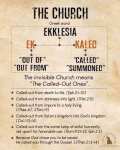



 Does the



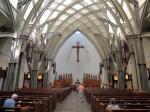






 They say they try to look like and be more like the general public because coming to church can be an intimidating experience. You come into a place where you don’t know anyone, people behave differently and the service can be a little confusing.
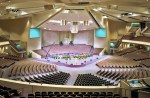




 (1). Build a youth soccer program – A uniquely Christian approach – teach and coach joy, to be peacemakers, kind, good, patient, gentle, self-controlled, yet, proficient, competitive, hardworking, reaching for excellence. Imagine the (Concealed Name) Baptist Church Family Youth Soccer Program!
 NOW THE BOMBSHELL. Plant a Church within our Church,